This article was translated from Japanese using AI. Read the Japanese original
Across the Black Forest in south-western Germany, different towns developed small workshops that shared in making wooden clocks, factories that assembled alarm clocks in large numbers, component suppliers and vocational schools. Schramberg, in the central Black Forest, shows how the factory system developed. The growth of Junghans and neighbouring businesses changed the products, the valley’s landscape, the power supply and the lives of the people who worked there. 1 2
Craft specialisation and factory mass production had different ways of organising work but drew on overlapping networks of component makers, sellers and skilled workers. Clockmaking has lost its former dominance in Schramberg. Precision machinery and industrial component firms now underpin the local economy. 1
A valley town among the Black Forest’s clockmaking centres#
Schramberg lies in the central Black Forest in Baden-Württemberg. The municipality extends from Talstadt on the valley floor to upland districts such as Sulgen and Waldmössingen. Schramberg occupies only part of the wider mountain region known as the Black Forest. Much of the town’s industry has moved from the valley floor to the upland districts. 1
Clockmaking had different centres too. Schramberg was home to Junghans, while Schwenningen was known for Bürk, Mauthe and Kienzle. Furtwangen provided training and fostered the industry around a clockmaking school founded in 1850. 2 3
Schramberg’s earlier history involved territorial government and borders. The Peace of Pressburg at the end of 1805 assigned it to Württemberg, which took control in January 1806. The boundary with neighbouring Baden continued to affect economic activity after the border changed in 1810. Industrialisation preceded clockmaking and dates back to a pottery factory founded in 1820. The growth of industry and the population led to Schramberg’s elevation to town status on 7 September 1867. 4 5
How workshops made affordable wooden clocks#
Division of work among home workshops#
In the eighteenth and nineteenth centuries, small workshops set up in people’s homes made Black Forest clocks. Clockmakers bought such items as movement frames, chains, bells, stock for wheels, dials and dial painting from specialists. They developed tools to speed individual tasks. 6
Simpler designs brought prices down too. One example described by the German Clock Museum is the anchor formed from bent sheet steel. Part of the escapement, it releases the wheel a little at a time as the pendulum swings. Sheet stock saved the work of machining a solid block of steel. Some designs combined a movement frame with the dial and small side doors, dispensing with a separate large case. 6
This division of labour predated factory production with standardised, interchangeable parts. Workshops made different patterns, and even visibly similar clocks could require individual fitting when a part was replaced. Workshops could produce affordable clocks in quantity before factories developed. Keeping accuracy and quality uniform remained a separate challenge. 6
Education and the turn to factories#
Baden’s industrial policy promoted specialist education in Furtwangen. A clockmaking school founded in 1850 and a carving school founded in 1877 supported manufacture and design. From the mid-nineteenth century, new factories emerged as entrepreneurs with commercial experience responded to a crisis in established forms of production. The state’s educational materials emphasise their role along with the growth of earlier workshops. 2 3
Home-based work continued as factories expanded. Some small businesses supplied components independently, and women supplemented household incomes through piecework at home. A 2026 article from the German Clock Museum notes how poorly this work has been documented. 7
How Junghans changed manufacture and sales#
From making parts to making clocks#
Erhard Junghans and his brother-in-law Jakob Zeller founded Zeller & Junghans on 14 April 1861 at the site of a former oil mill in the Lauterbach valley. The company’s official history says it first produced wooden cases, metal parts around dials, hands, small doors and pendulum discs. It began making complete clocks of its own in 1866. 8
Brothers Erhard and Arthur, who succeeded their father, helped the company and town grow. American-style machine production was important to that expansion. Clock designs changed to use less material, let dedicated machines make components and speed assembly. Alarm clocks and clocks for kitchens or living rooms were among the Black Forest factories’ main products for everyday use. 3 10 19
International sales in the 1903 catalogue#
The title page of the 1903 catalogue no. 107 identifies the united clock factories of the Junghans brothers and Thomas Haller in German and French. It gives Schramberg and Schwenningen as the main locations and lists offices in places including Paris, Vienna and Venice. The primary source shows the business network the company presented to buyers. 11
Pages 20–21 show the floral-cased “Blumen-Baby”, the “Concours” in an embossed brass case and the “Reform” repeat alarm. Customers could choose from case materials, plating and dials. The “Neu Radau” and “Neu Furor” could carry a print or motto at the top, exchangeable for something such as a photograph. The spread shows both mass production of movements and a variety of materials, decorations and product names to appeal to different buyers. It gives no prices or sales figures. 12
On the same pages, the illustrations and descriptions for “Marine-Uhren” show clocks with bells and alarm functions. 12
Junghans’s official history calls it the world’s largest clock factory in 1903. That claim captures the scale of factory production centred on the town. 8
Town infrastructure and component suppliers#
Schramberg had other large clock companies. The town describes the Hamburg-Amerikanische Uhrenfabrik (H.A.U.), founded and run by Paul Landenberger, as its second-largest industrial concern. Clocks bearing the crossed-arrows trademark are reminders of this other manufacturer. 10
The expansion of clock production created demand for nearby spring makers. At the Terrassenbau Museum, equipment from the local company Pfaff & Schlauder shows how springs were made. Component work developed around the clock manufacturers and spread to other uses, a regional development that the product history of a single factory can only partly show. 9
Transport and power mattered as well. The railway reached Schramberg in 1892. The municipal utility’s history records that Junghans opened a hydroelectric power station in 1894 and that Junghans and the count’s water-powered installation supplied electricity when streetlights were electrified in 1901. H.A.U. opened the Berneck power station in 1904, followed in 1911 by a large diesel engine to drive its generator. Clock companies both consumed electricity and helped supply the town. 10 13
Workshops stacked on a hillside#
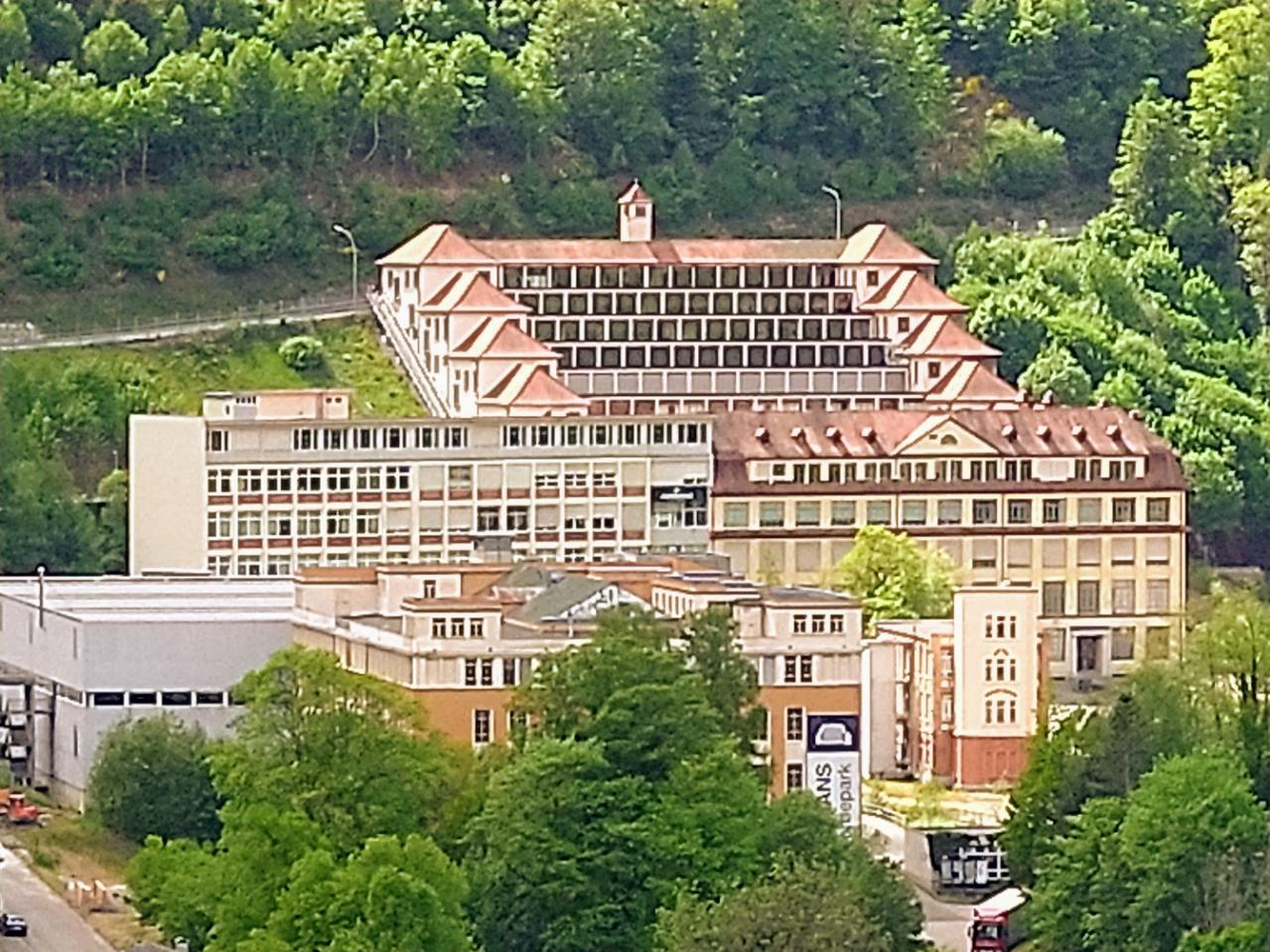
Figure 1. The Junghans Terrassenbau, with workshops and rows of windows following the slope. Photograph by Martin Hahn. Source Wikimedia Commons file record, originally Landauf, LandApp entry 216871. CC0 1.0 Universal. Unmodified.

The Junghans Terrassenbau, or terraced factory, was built from 1916 to 1918 to a design by Philipp Jakob Manz. Its nine workshop levels climb the steep hillside, where there was little flat ground. Most workstations in the long, narrow rooms were next to windows and could make use of daylight. The building’s shape reflects both the fine work of assembling clocks and the limited site. 9 14
The state history museum holds a glass-plate photograph of the factory taken in May 1930. Historical photographs, building surveys and restoration records add to what can be seen on site and show the factory’s place in the townscape. Restored from 2016 to 2018, the terraced building opened as a clock museum in 2018. 14 15
Workers and the memory of war#
Schramberg’s history also belongs to its workers. The town gained a workers’ association in 1888, a free trade union in 1894 and Catholic and Protestant organisations for workers, including women. Different political and religious organisations supported working life and workers’ rights in the industrial town. 4
During the Second World War, Junghans shifted much of its work to military production, principally fuzes. The local historian Carsten Kohlmann compared architectural records with testimony and found that shelters dug into the hillside at the factories were also used for production. By the end of 1944, machines occupied some tunnels and ventilation remained a problem. Many residents took shelter there when French troops entered the town on 20 April 1945. 16
The LEO-BW local history also records extensive use of foreign and forced labour in the town’s industries. That history is part of the story of the clock factories. The surviving industrial structures hold evidence of architecture and technology as well as memories of war and labour. 4 16
Industrial restructuring and the skills that survived#
After the war Junghans broadened its range from mechanical wristwatches to designs by Max Bill, quartz watches and radio-controlled timepieces. Its history records an initial pre-production series of quartz wristwatches presented in 1970, mass production in 1972 and the Mega 1 radio-controlled wristwatch in 1990. The move from mechanical to electronic timekeeping affected the finished products and changed the parts and processes they required. 8
Kohlmann describes substantial job losses in the early 1980s, the 1984 separation of clockmaking and fuze operations into different companies and the redevelopment of the H.A.U. factory site for business use. Clockmaking, military precision engineering and the use of the former factory site followed different paths. 16
The town’s account consulted in October 2026 identifies precision machinery and advanced industrial component suppliers as pillars of the local economy. Many are based in the upland districts. Clockmaking and its suppliers helped develop electrical engineering, equipment and machinery manufacture in the Black Forest. Some clockmakers closed or changed their lines of business. 1 2 3
Places that preserve the history#
The Schramberg Town Museum was founded in 1979 to connect technological and social history. Corporate clock collecting began earlier. In 1898 Junghans opened a museum for historical timekeepers. It hosted clockmakers who were customers and displayed historic pieces rather than what the factory was mass-producing at the time. The present town museum and the early corporate collection served different purposes. 17
The Terrassenbau Museum covers manufacturing in the building and examines Black Forest clocks and component production. The town archives preserve Junghans records, photographs, maps and personal papers. Products, factories and local records together show the different kinds of work and everyday life behind Black Forest clocks. 9 18
Timeline#
| Date | Local and clockmaking history |
|---|---|
| From the mid-eighteenth century | Division of labour and simple machinery and tools develop for wooden clockmaking in the Black Forest. 3 6 |
| Late 1805 to January 1806 | Schramberg is assigned and then transferred to Württemberg. 4 |
| 1820 | A pottery factory opens and industrialisation begins in Schramberg. 5 |
| 1850 | A clockmaking school opens in Furtwangen. 3 |
| 14 April 1861 | Zeller & Junghans is founded and initially makes components. 8 |
| 1866 | Junghans makes complete clocks of its own. 8 |
| 7 September 1867 | Schramberg gains town status. 4 |
| 1877 | Furtwangen gains a carving school. 3 |
| 1892 | The railway reaches Schramberg. 10 |
| 1894 | Junghans opens a hydroelectric power station. 13 |
| 1898 | Junghans opens a museum of historical timekeepers. 17 |
| 1903 | Catalogue no. 107 appears in German and French. Junghans’s company history identifies it as the world’s largest clock factory at this point. 8 11 |
| 1916–1918 | The Terrassenbau is built. 14 15 |
| 1941–1945 | Factory air-raid shelters are built and used in production. French troops enter Schramberg on 20 April 1945. 16 |
| 1970–1972 | Junghans presents a pre-production series of quartz wristwatches and later begins mass production. 8 |
| 1979 | The town museum is founded. 17 |
| 1984 | Junghans clockmaking and fuze operations become separate companies. 16 |
| 1990 | Junghans introduces its Mega 1 radio-controlled wristwatch. 8 |
| 2016–2018 | The Terrassenbau is restored and opens as a clock museum in 2018. 9 14 |
| Verified in October 2026 | Clockmaking continues alongside a wider industrial base including precision machinery and industrial components. 1 8 |
References#
The following web sources were accessed on 23 October 2026. Company and museum descriptions, local historical studies and period catalogues are read in light of their different purposes.
Stadt Schramberg, “Stadtportrait”. Geography and present-day industry. Its statistics are omitted from this article.
Landesbildungsserver Baden-Württemberg, “Das Uhrenindustriemuseum Villingen-Schwenningen — Bedeutung”. Factory development and regional industrial organisation.
Deutsches Uhrenmuseum Furtwangen, “Themen im Museum”, sections “Holzuhrmacherei”, “Gewerbeförderung” and “Uhrenindustrie”. On the access date, the permanent exhibition was listed as closed for renovation.
Landesarchiv Baden-Württemberg / LEO-BW, “Schramberg — Geschichte (ab 1806)”. Borders, urban growth, workers’ organisations and the war.
Stadt Schiltach, “Carsten Kohlmann: Geschichte der Großen Kreisstadt Schramberg”, 2024. Description of a lecture by a local historian and the beginnings of industrialisation in 1820.
Deutsches Uhrenmuseum, “Wie die Schwarzwälder Holzuhren bauten”, 14 June 2018. Division of labour, sheet-steel anchors and interchangeability.
Deutsches Uhrenmuseum, “Objekt des Monats: Heimarbeit von Frauen. Weit mehr als ‚Kinder, Küche, Kirche‘”, 1 May 2026. Factory production and home-based work.
Uhrenfabrik Junghans, “Uhrenfabrik / Unsere Geschichte”. Company account of its foundation and product history.
Junghans Terrassenbau Museum, official account of the building, spring manufacture and town history.
Stadt Schramberg, “Ehrenbürger”, entries on Landenberger, Arthur and Erhard Junghans and Karl von Leibbrand. The page honours individuals.
Vereinigte Uhrenfabriken von Gebrüder Junghans und Thomas Haller A.G., Katalog 1903, no. 107, title page (printed p. 1). Official digital archive copy in German and French.
Same catalogue, printed pp. 20–21. Blumen-Baby, Concours, Reform, Neu Radau and Neu Furor.
Stadtwerke Schramberg, “Die Entwicklung der Stadtwerke Schramberg”, 17 December 2005. Entries for 1892–1911.
Datenbank Bauforschung/Restaurierung, “Ehem. Junghans Uhrenfabrik, sog. Terrassenbau, heute Uhrenmuseum”, ID 198258300210, 3 July 2018. Building and restoration phases.
Haus der Geschichte Baden-Württemberg, “Schramberg — Junghans Fabrik”, inv. 1991/0140/097754. Gebrüder Metz photograph from May 1930 and collection description.
Carsten Kohlmann, “Vom Lost Place zum Gedenkort — die Luftschutzbunker aus dem Zweiten Weltkrieg bei Junghans und H.A.U. in Schramberg”, in Friedemann Kawohl (ed.), Erinnern und Vergessen: Geschichten von Gedenkorten in der Region Schwarzwald-Baar-Heuberg, 2015, pp. 167–186, especially 167–176 and 178–182.
Stadtmuseum Schramberg, “Stadtmuseum”. Entries for 1898 and 1979.
Stadt Schramberg, “Stadtarchiv”. Company records, photographs, personal papers and other holdings.
Deutsche Uhrenstraße, Geschichte · History · Histoire, 2019 edition, “Uhren am laufenden Band” (printed p. 71). American-style mass production, specialised machinery, material economies and assembly. PDF on the municipal website.