This article was translated from Japanese using AI. Read the Japanese original
Preventing an incorrect strike after incomplete operation#
A repeater sounds the time indicated by a watch when activated. A minute repeater generally strikes the hours, the quarter hours and the remaining minutes in that order. Moving the slide winds the striking spring, and stepped cams known as snails are read to determine how many times to strike. If a partial operation produced an incomplete series of strikes, the listener would take it for the wrong time. 1 2
“All-or-nothing” is the name of a safety mechanism that holds back the strike until the prescribed operation is complete. A full operation releases the strike, while a partial one leaves the watch silent. It serves a different purpose from volume control or permanent muting of the strike. It depends on correct assembly and adjustment. 1 2
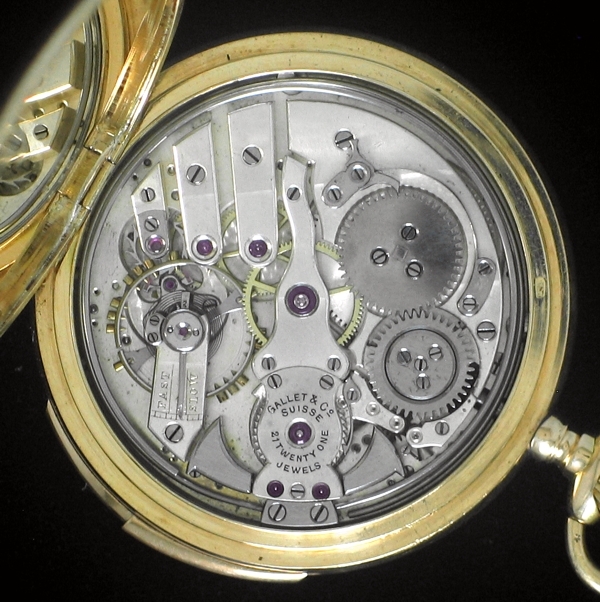
Figure. A Gallet minute repeater dated to 1905. The gongs and hammers are visible, but the image does not identify the all-or-nothing component. Creator: Time Maven. Source: Wikimedia Commons. Public domain, released by the creator. Unmodified.

How it works, with an example#
Movement of the control winds the striking spring and is also involved in reading the time. The position of the rack as it meets a step of the snail determines the number of strikes, and the wound spring drives the striking train. The blocking piece of the all-or-nothing mechanism keeps the strike from starting before the time has been read and the spring sufficiently wound. The actual linkages and release conditions vary from one design to another. 1 2
In the late-nineteenth-century E. Mathey Tissot pocket watch described by William P. Balistreri, a long blocking piece along the edge of the movement holds the quarter rack’s hook. The hook also holds the hour-striking pallet clear, so the hours do not sound even if the hour rack turns when the slide is moved partway. When the beak of the hour rack reaches the hour snail, a switch moves the blocking piece sideways and releases the quarter and minute racks and the hour-striking pallet. 2
The same repair report found that the quarter rack had been meshed incorrectly with the driving pinion, hindering its travel and release. Reassembling the parts with the correct engagement improved operation. The example shows that an all-or-nothing mechanism depends on assembly and adjustment of the surrounding parts. Avoid operating the mechanism repeatedly or adjusting parts without a specialist inspection. 2
How it differs from other safeguards#
A surprise piece helps the mechanism read the snails correctly around time transitions. The all-or-nothing piece serves the separate purpose of preventing a strike after partial operation. A lock that prevents the control from being actuated again during striking has another purpose. In a complicated watch, several safeguards work together, so the name of any one component gives only a partial picture of the protection. 2 3
Historical examples and modern designs#
A study of early minute-striking watches identifies an all-or-nothing part in a watch by Fürstenfelder and describes a different watch, by Marqüch, that lacks the part. The author argues that a similar component is depicted in Antoine Thiout’s 1741 treatise on horology. Some surviving watches are incomplete, so this comparison alone cannot identify the inventor or the first instance of use. 4
A separate modern design appears in US application US20190196409A1, published in 2019. It describes a chain linking parts of the striking mechanism. If the push-button travels its full stroke regardless of the time, slack can develop once the reading position is reached early. The application proposes a spring-loaded pulley to maintain tension. The applicant describes a reduction in fatigue. The patent publication alone establishes neither use in a production watch nor measured durability. 5
Chronology#
| Date | Documented events |
|---|---|
| 1741 | A later study identifies an all-or-nothing component in an illustration in Thiout’s treatise on horology. 4 |
| Late nineteenth century | The E. Mathey Tissot watch discussed in the repair report is made. 2 |
| 2010 | A study of early minute-striking watches compares the mechanisms of Fürstenfelder and Marqüch. 4 |
| 2012 | Balistreri describes the blocking and release functions and the repair of the watch. 2 |
| 2019 | A US application for a repeater mechanism that maintains chain tension is published. 5 |
References#
[1] Horopedia, “Minute repeater”, technical explanation (accessed 6 November 2026).
[2] William P. Balistreri, “19th Century E. Mathey Tissot Minute Repeater Pocket Watch”, Horological Times, April 2012, pp. 30–32. Article, PDF (accessed 6 November 2026).
[3] Montres Breguet SA, “Safety mechanism protecting against inadvertent actuations of the minute repeater”, US8588035B2, 2013. Patent (accessed 6 November 2026).
[4] Sebastian Whitestone, “Minute Repeating in Tompion’s Lifetime”, Antiquarian Horology, December 2010, pp. 525–531. Article, PDF (accessed 6 November 2026).
[5] Christophe Bifrare and Daniel Matteazzi, “Repeater mechanism with tensioned chain”, US20190196409A1, published 27 June 2019. Patent publication (accessed 6 November 2026).