This article was translated from Japanese using AI. Read the Japanese original
To track the air temperature every hour overnight, an observer would normally have to read a thermometer each time and write down the time and reading. The hourly temperature recorder (thermométrographe horaire in French) that Louis-Clément Breguet presented to the French Academy of Sciences in 1840 delegated that work to a clock. The pointer on a metallic thermometer moved with the air temperature, and a clock mechanism transferred its position to paper every hour. A series of dated sheets preserved the temperatures at the same location in chronological order over several days. 1 2 3
Pointer angle indicates temperature and paper position indicates time#
Using the deformation of metals directly#
The sensor was based on the trimetallic thermometer developed by Louis-Clément’s grandfather Abraham-Louis. A thin strip of bonded silver, gold and platinum was wound into a helix. Differences in thermal expansion made it wind more tightly or more loosely, turning a pointer attached to its free end. The sensor described in Nicolas Boquillon’s exhibition report was likewise a metal helix around a vertical axis. Matching the angle of the pointer to a temperature scale made the reading mechanically accessible. 2 4
The clock set the recording interval and advanced the platform carrying the paper. The clock determined the interval between marks as the temperature varied. Even when the temperature held steady, the recorder marked a different arc each hour. The observer read the time from the arc and the temperature from the graduation where the mark fell along it. 1 2
Pressing and releasing the pointer each hour#
According to the proceedings of 6 July 1840, the clock actuated a lever every hour, pressing the pointer tip against the graduated surface to make a mark. Once released, the pointer was free to follow the temperature until the next reading. The platform carrying the paper moved horizontally, bringing a different graduated arc beneath the pointer tip for the next hour. Over 24 hours, the recorder made one mark on each of 24 arcs. Replacing and dating the paper each day made it possible to track the air temperature in hourly order. 1
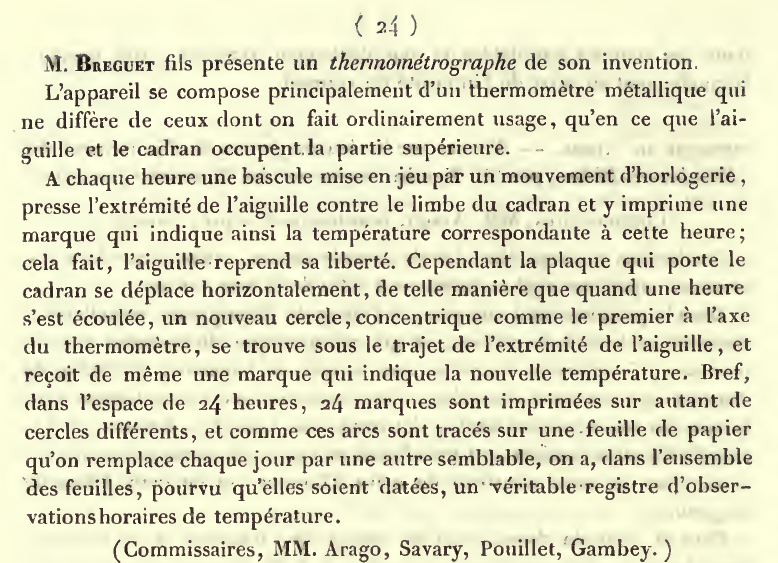
Figure 1. Proceedings of the French Academy of Sciences, 6 July 1840. The account describes the pressing and release of the pointer tip, the horizontal motion of the platform, the 24 marks and the daily replacement of the paper. Author: French Academy of Sciences. Original supplied by the Natural History Museum Library, London, and digitised by the Internet Archive. Source: Wikimedia Commons file page. Rights: Public Domain Mark 1.0. The relevant passage was cropped and converted to PNG.
The 1840 proceedings place the pointer and graduated surface at the top of the instrument. In Boquillon’s report on the 1844 French Industrial Exhibition, the marking pointer is attached to the lower end of the vertical helix, with a moving plate below. Every hour the plate advances the same distance, and the inked part of the pointer leaves a black dot on a preprinted arc. The two accounts put the pointer in different places, but both use the movement of the paper to distinguish successive hours. 1 2
The result is a record of changes in air temperature plotted as a series of hourly points. Sudden changes that occur entirely between two points leave no trace on the paper. 1 2
From a sheet a day to a long roll of paper#
Operation in Kazan#
Boquillon reported that an hourly instrument had operated for more than two years in a meteorological observation room in Kazan, Russia, spelled Kasan in the source, and recorded a temperature of 42 degrees below zero. The paper was replaced daily. The period of more than two years refers to how long the instrument was in use at the observation site. The passage does not specify the temperature scale. 2
According to Kazan Federal University, its meteorological observatory began operating in January 1812. The university continues to present long-term records of air temperature, wind, atmospheric pressure and humidity, among other observations. The contemporary account of Breguet’s recorder shows how automatic clock-driven recording was added to an established local practice of taking readings at fixed times. 2 5
The paper-strip recorder and the psychrometer#
The same exhibition report describes a second design that reduced the work of replacing the paper every day. A long paper strip was wound around a cylinder and fed by the clock under the marking pointer. Boquillon described it as able to run for over a month without an observer intervening. With a single sheet, the sequence of arcs denoted the hours. With a paper strip, the distance it had advanced corresponded to the time elapsed. 2
Breguet also applied timed recording to a psychrometer using two metallic thermometers. One was exposed to the air and the other wrapped in a thin damp cloth. Evaporation lowered the temperature of the wet bulb, so taking simultaneous dry- and wet-bulb readings provided a basis for determining humidity. Boquillon explained that August in Berlin had used mercury thermometers to compare dry- and wet-bulb readings. He noted that with Breguet’s design the pointers of the metal thermometers could be recorded mechanically. 2
Recording methods at the 1867 exposition#
At the 1867 Paris Universal Exposition, Matthäus Hipp of Neuchâtel exhibited a Breguet-style metallic thermometer made with steel and brass. According to Armand-Florent Pouriau’s report, temperature changes were transmitted to a pointer and recorded on a paper strip by a method similar to that of a recording barometer exhibited alongside it. In Pouriau’s description of the barometer, an electric pendulum set the interval. Closing the circuit moved a small hammer, making a pinhole in the paper strip. 8
The Gros-Claude design at the same exposition used the striking mechanism of a cuckoo clock to drive a hammer. In the example in the report, it made a mark every 15 minutes, and a pawl and 96-tooth rack advanced the recording card by one tooth each time. The card was replaced once it held 24 hours of readings. Like Breguet’s arc-based design, it used one sheet a day. The combination of the marking interval and paper feed produced 96 points per day. 8
Chronology#
| Date | Event |
|---|---|
| January 1812 | The meteorological observatory at Kazan University begins operating. 5 |
| 1817 | The date given by Météo-France for Abraham-Louis Breguet’s metallic thermometer. 4 |
| 6 July 1840 | Louis-Clément Breguet presents his temperature recorder to the Academy of Sciences. The proceedings record the hourly impression and daily paper replacement. 1 |
| September 1843 | Date of a drawing of the Breguet firm’s dual temperature recorder (thermométrographe double) reported in an auction catalogue. The catalogue describes the upper half of the drawing as surviving. 6 |
| 1844 exhibition, report published in 1845 | Boquillon describes the arc-based recorder, its use in Kazan, the paper-strip design and the psychrometer. 2 |
| 1858 | The hourly recording method appears in volume 8 of François Arago’s posthumously published collected works. 7 |
| 1867 | Hipp’s paper-strip recorder and Gros-Claude’s point-marking instrument are presented at the Paris Universal Exposition. 8 |
| 2022 | On the meteorological observatory’s 210th anniversary, Kazan Federal University describes the preservation and use of records including air temperature. 5 |
| Verified November 2026 | Breguet’s official company history lists the recorder as a development by Louis-Clément in 1840. 3 |
References#
- French Academy of Sciences, Comptes rendus hebdomadaires des séances de l’Académie des sciences, vol. 11, meeting of 6 July 1840, printed p. 24 (PDF p. 34, bound volume dated 1841). Accessed 22 November 2026.
2. Nicolas Boquillon, Études techniques sur l’exposition des produits de l’industrie française en 1844, 1845, part 1, pp. 260–262. Digital library of the Conservatoire national des arts et métiers. Accessed 22 November 2026.
3. Montres Breguet, “Invention du «thermométrographe horaire»”, 1840 entry in the official company history. Accessed 22 November 2026.
4. Météo-France, “Thermomètre métallique Breguet”, collection no. INV00000434. Describes an 1887 reproduction and the trimetallic helix. Accessed 22 November 2026.
5. Kazan Federal University, “KFU’s Meteorological Observatory celebrates 210th anniversary”, 2022. Accessed 22 November 2026.
6. Rossini, “Maison Breguet — Riche ensemble de schémas et plans techniques”, auction catalogue lot 158, drawing no. PV 09. Accessed 22 November 2026.
7. François Arago, Sur l’état thermométrique du globe terrestre, chap. 40, Œuvres complètes de François Arago, vol. 8, published 1858. Accessed 22 November 2026.
8. Armand-Florent Pouriau, “Les appareils météorologiques enregistreurs à l’Exposition universelle,” Études sur l’Exposition universelle de 1867, vol. 4, 1868, pp. 52–54. Accessed 22 November 2026.