This article was translated from Japanese using AI. Read the Japanese original
Turning differences in thermal expansion into a reading#
Breguet’s trimetallic thermometer uses a thin strip of platinum, gold and silver wound into a helix. Differences in thermal expansion rotate a pointer to indicate the temperature. It is known as thermomètre métallique de Breguet in French and Breguet’s thermometer in English. Associated with Abraham-Louis Breguet, this nineteenth-century scientific instrument applies the watchmaker’s skills of working thin metal strips and turning small deformations into readable movements. 1 2
A temperature-compensated watch uses different rates of expansion to keep its rate steady. A thermometer uses the same kind of change to produce a visible indication. The trimetallic thermometer is a temperature sensor rather than a timekeeping regulator or escapement. Instruments later combined this sensor with clockwork to record the temperature and time automatically. 2 3
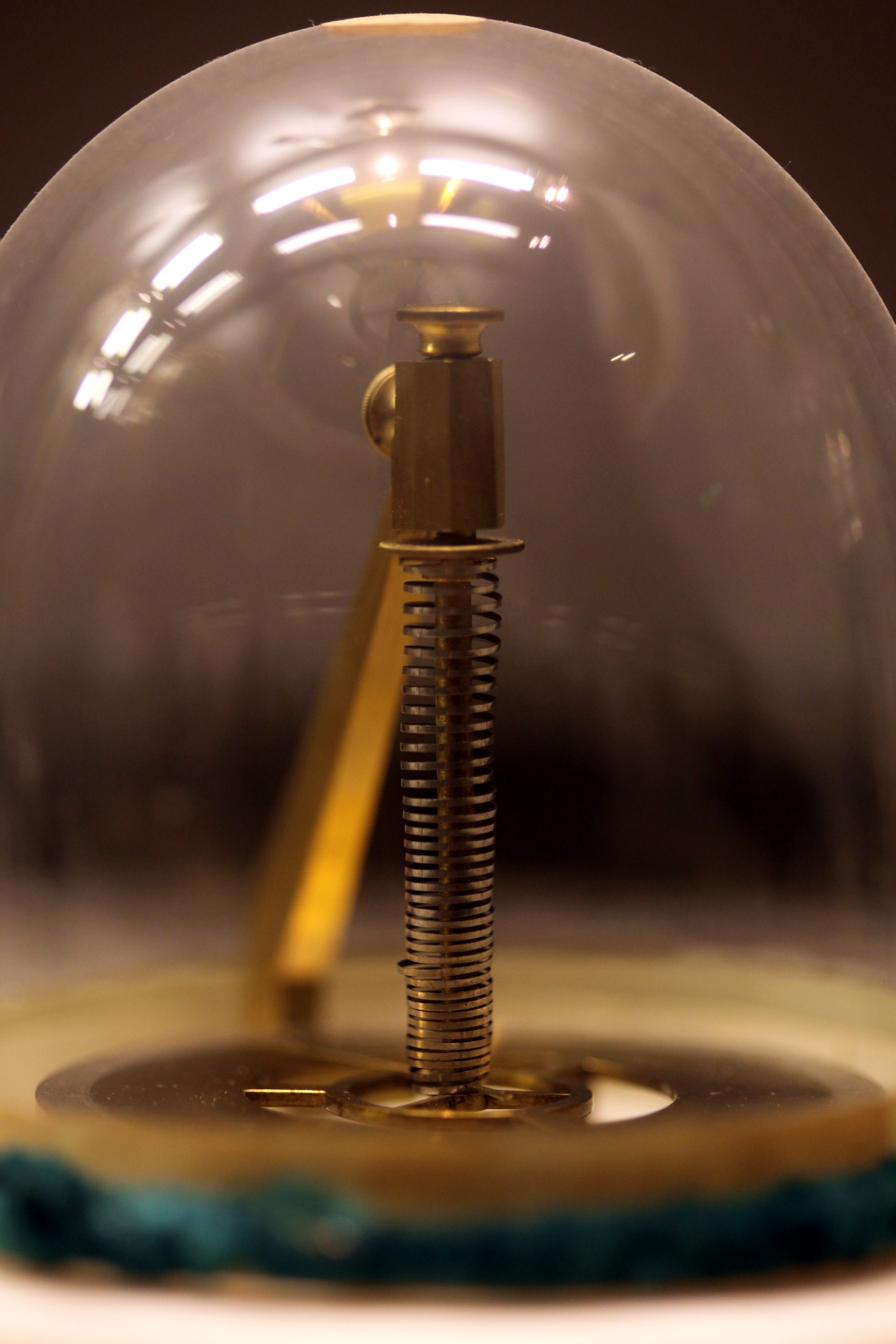
Figure 1. Breguet metallic thermometer, Musée des Arts et Métiers, CNAM, 04182-0000-, dated 1817–1849. The support for the top of the helix and the scale below are visible. Photograph by Rama, “Breguet thermometer-CnAM 4182 6620.jpg”, 2016, unchanged. Wikimedia Commons file Original collection record CC BY-SA 3.0 France

Strip, helix and pointer#
Three metals acting as one strip#
Three thin sheets of metal are bonded along their length and rolled into a fine strip. In the 1887 reproduction at Météo-France, silver is inside the helix, platinum outside and gold between them. Silver expands more than platinum as temperature rises, while gold’s expansion lies between them. Météo-France explains that the gold layer helps relieve stress between the bonded materials. 1
Separate pieces would each expand freely. Bonding the surfaces constrains their expansion and changes the curvature of the strip. The effect accumulates across the turns of the helix, translating a length change that is hard to see into a change in pointer angle. Prony’s report published in 1824 describes this as measuring an angle in place of a length. 2
Fixed at the top, read at the bottom#
The helix stands upright, with the top fixed to a support. A light pointer fitted at the lower end moves above a horizontal scale. Its cylindrical form, with turns at successive heights, differs from the flat spiral of a watch balance spring. Louis-Clément Breguet’s manual of telegraphy illustrates a trimetallic helix suspended from a support, with the pointer and scale below. 2 4
Temperature changes the strip’s curvature and the orientation of its free end. The deformation moves the pointer directly. The second, thicker pointer on the Météo-France instrument is set by hand to retain a reference position. Two pointers alone do not establish automatic recording of the maximum and minimum. 1 4
Why use a thin strip?#
Fast response and calibration#
The very thin metal is directly exposed to the medium being measured, such as air, so it can respond quickly. Prony’s 1824 report gives a maximum combined thickness of 1/25 mm, about 40 micrometres, and credits the instrument with a faster response than a mercury thermometer. 2
A large pointer movement and an accurate temperature reading are separate properties. Relating the scale to temperature requires a reference thermometer. Prony reports comparing the instrument with a Fortin mercury thermometer for about two years, including the winter of 1819–1820. He observed that the pointer returned to the same position at the same temperature and examined the relationship between angle and temperature. The account gives no modern calibration uncertainty or error limits across the full range. 2
Air currents and shocks can move the sensor#
The helix is thin and light. A little pressure or a shock can deform it and change the relationship between pointer position and temperature. Prony advised careful handling and keeping it in still air, since even a slight breeze could make it oscillate. The glass cover protects the mechanism. Suitability for meteorological observations depends on the conditions. 2
In his 1832 report for the British Association for the Advancement of Science, James D. Forbes judged that Breguet’s metallic thermometer had seen less use than expected and suited delicate thermal experiments better than ordinary weather observations. The Whipple Museum in Cambridge likewise notes its sensitivity to the slightest air currents. Météo-France describes its reproduction as fragile and the readings as approximate, qualities compatible with fast response. Response speed alone gives no measure of durability or overall accuracy. 5 6 1
Origins and laboratory use#
The Whipple Museum cites David Rittenhouse’s 1767 description of a portable bimetallic thermometer and a bonded copper–iron strip in Lambert’s work of 1779 as precedents. It says invention of the trimetallic thermometer with a helix of platinum, gold and silver is generally attributed to Abraham-Louis Breguet. 6
Météo-France dates the invention to 1817. Metallic thermometers bearing the Breguet name include portable, experimental and recording instruments with different designs. Each surviving instrument needs to be identified from its maker, date and construction records. No contemporary patent publication for the trimetallic design was confirmed for this article, so 1817 is an invention date reported by the institution. 1 6 7
A contemporary application appears in Sadi Carnot’s Reflections on the Motive Power of Fire of 1824. Discussing the cooling that follows rapid expansion of a gas, he notes the large drop on a Breguet thermometer inside a vacuum pump vessel. Experiments are described with temperature changes exceeding 40 to 50 degrees. Capturing a rapid change was valuable for thermal research. 8
Recorders combined with clockwork#
Marking temperatures on paper at set times#
Louis-Clément Breguet combined a metallic thermometer with clockwork in a thermométrographe horaire, an hourly temperature recorder. Breguet’s company history dates its development to 1840. 3
Boquillon’s report on the 1844 French Industrial Exhibition describes its operation. Below the thermometer pointer is a moving plate marked with 24 graduated arcs. The clockwork makes a black dot on paper at regular times. Moving the plate puts the next reading on another arc. With a change of paper each day, temperatures could be recorded without an observer present each hour. 9
The report describes an instrument that worked for more than two years at the meteorological observation room in Kazan and recorded 42 degrees below zero. It also describes a different design in which clockwork feeds a paper tape and the apparatus runs for more than a month without attention. 9
Indicating heat from an electric current#
Another application used the heat produced when current flowed through the metal strip. In his 1862 manual of telegraphy, Louis-Clément Breguet explains that de la Rive put a contact dipping into mercury at the bottom of the helix. Current through the support, helix and contact moved the pointer. Breguet calls it a galvanoscope for detecting a current or showing differences in strength. The thermometer principle was thus used to compare the electrical effects that produced the heat. 4
Surviving instruments#
No. 04182-0000- at the Musée des Arts et Métiers, Conservatoire national des arts et métiers (CNAM), Paris, is a surviving Breguet metallic thermometer. The collection record dates it to 1817–1849 and records its acquisition from Charles’s collection in 1849. The inscription means “For Monsieur Charles / Breguet’s eleventh thermometer”. The scale names Réaumur and includes words for cold, temperate and warm. The number alone does not establish its production sequence or the total made. 7
Météo-France’s 1887 reproduction shows the three-metal strip and manually placed reference pointer. The Whipple Museum describes a thermometer by Breguet of about 1845, Wh.5184, but also calls it bimetallic in part of its account. 1 6
Breguet’s trimetallic thermometer turned differences in expansion into motion of a thin helix and made rapid changes visible. Adding clockwork made it possible to retain temperature readings linked to time. A sensitive sensor, calibration, protection from disturbances and recording were distinct design tasks brought together in a scientific instrument. 2 4 9
Chronology#
| Date | Event and significance |
|---|---|
| 1767 | Rittenhouse describes a portable bimetallic thermometer, a predecessor of the trimetallic helix. 6 |
| 1779 | Lambert describes a copper–iron strip in Pyrometrie. 6 |
| 1817 | Météo-France’s date for the invention of Breguet’s trimetallic thermometer. 1 |
| c. 1819–1820 | The winter of 1819–1820 falls within Prony’s comparison observations. 2 |
| 1824 | Prony’s report appears in German. Carnot mentions the Breguet thermometer in a vacuum-pump experiment. 2 8 |
| 1832 | Forbes finds it better suited to delicate thermal experiments than general meteorological observations. 5 |
| 1840 | Breguet’s company history dates Louis-Clément’s timed temperature recorder to this year. 3 |
| 1844 exhibition, report published 1845 | The exhibition report describes hourly dots, long-running tape recording and use at Kazan. 9 |
| 1849 | CNAM acquires its current object 04182-0000- from Charles’s collection. 7 |
| 1862 | The fourth edition of Louis-Clément’s telegraphy manual explains a current indicator with a trimetallic helix. 4 |
| 1887 | Date of the reproduction at Météo-France. 1 |
| 1905 | CNAM’s official physics catalogue lists the ordinary Breguet thermometer and a separate instrument for measuring heat from current. 10 |
| Present | Collections and descriptions at CNAM, Météo-France and the Whipple Museum document structure and use. 1 6 7 |
References#
- Météo-France, Perin, “Thermomètre métallique Breguet”, collection entry INV00000434. Layers, rolling, pointers, 1887 reproduction and assessment of use. Accessed 19 October 2026.
2. Gaspard de Prony, “Ueber das Metall-Thermometer des Hrn. Bréguet, und über Herstellung einer Correspondenz mit anderen thermometrischen Instrumenten”, Polytechnisches Journal, vol. 13, 1824, article LI, p. 251 onwards. German account via the February 1824 Repertory of Arts, Manufactures and Agriculture, p. 184. Construction, thickness, comparisons and handling. Accessed 19 October 2026.
3. Montres Breguet, “Invention du «thermométrographe horaire»”, manufacturer’s history entry for 1840. Accessed 19 October 2026.
4. Louis-François-Clément Bréguet, Manuel de télégraphie électrique, 4th ed., 1862, pp. 16–18, Fig. 7. Trimetallic thermometer and de la Rive’s current indicator. CNAM digital library. Accessed 19 October 2026.
5. James D. Forbes, “Report upon the Recent Progress and Present State of Meteorology”, Report of the British Association for the Advancement of Science, meetings of 1831 and 1832, published 1833, p. 210. Darwin Online text. Accessed 19 October 2026.
6. Allison Ksiazkiewicz, Whipple Museum of the History of Science, University of Cambridge, “Thermometer Designs”, especially “Deformation thermometers” and Wh.5184. Earlier bimetallic thermometers, attribution of the trimetallic type and effects of drafts. Accessed 19 October 2026.
7. Musée des Arts et Métiers, “Thermomètre métallique de Breguet”, No. 04182-0000-, updated 4 July 2012. Dates of manufacture, acquisition from Charles’s collection in 1849, engraving and scale. Accessed 19 October 2026.
8. Sadi Carnot, Réflexions sur la puissance motrice du feu et sur les machines propres à développer cette puissance, 1824, note 13. Rapid gas expansion and the Breguet thermometer. Text at Wikisource. Accessed 19 October 2026.
9. Nicolas Boquillon, Études techniques sur l’exposition des produits de l’industrie française en 1844, 1845, part one, pp. 260–262. Louis Breguet’s recorder, use in Kazan and the paper-tape design. CNAM digital library. Accessed 19 October 2026.
10. Conservatoire national des arts et métiers, Catalogue officiel des collections. 2 : Physique, 1905, pp. 51–52, entries 4182, 7518 and others. Catalogue distinguishing the thermometer from the instrument for measuring heating due to current. Accessed 19 October 2026.