This article was translated from Japanese using AI. Read the Japanese original
A coupling that lets the hands be set without damaging the movement#
The cannon pinion carries the minute hand and transmits motion to the hour hand through the minute wheel. In a typical arrangement, it is friction-fitted to the centre-wheel arbor, which turns once an hour. It turns with the arbor in normal operation and slips relative to it when the hands are set. This lets the hands move without forcing the going train to run backwards. 1 2
The friction is deliberate. The fit must transmit enough torque to drive the hands during normal operation and allow slipping during time setting. A fit that is too loose can let the display fall behind while the train keeps moving. A fit that is too tight can require excessive force to set the time and risk damaging the mechanism. 1
How motion is transmitted and where slipping occurs#
In a typical design, energy from the barrel drives the centre wheel through the train. Friction makes the centre-wheel arbor and cannon pinion rotate together, and the cannon pinion’s teeth drive the minute wheel. The reduction from the minute wheel to the hour wheel makes the hour hand turn more slowly than the minute hand. During time setting, the crown drives the motion work and the cannon pinion moves relative to the arbor. 1 2
Depending on the wheel layout and how centre seconds is arranged, a movement can have the friction coupling on a different arbor or wheel. The cannon pinion’s shape alone does not locate it. Examine the construction of the particular movement. 1
Providing grip and allowing slip#
Contact between the arbor and tube requires a force pressing them together. When the tube is locally indented, the inward projection comes into contact at or near a groove or shoulder on the arbor. Friction depends on contact pressure, surfaces, lubrication and the condition of the materials. The torque the coupling can hold also depends on the contact point’s distance from the axis of rotation. 3
The torque at which slipping starts must exceed the torque needed to drive the motion work in normal use, while remaining below the input available when setting the hands. Temperature, oil, wear and dimensional variation also matter, so a single figure cannot be applied to every watch. The fit has to prevent unwanted slip in normal running and allow it at an appropriate torque when setting the time. 1 3
Slots and indentations#
US patent US345800A, issued in 1886, shows a cannon pinion with a diametrical slit at the end, extending a short distance axially and allowing it to fit elastically over a conical boss on the centre-wheel arbor. The end is spread as it is fitted on the boss, creating friction. The patent also mentions an earlier method using a different slot and projection, so this document alone cannot identify the inventor or first use of the friction coupling. 4
Another method pinches the tube from the outside, deforming it permanently so that two inward projections contact the arbor. US20220155726A1, published in 2022, proposes making the indentations before hardening the part. The application addresses how manufacturing variation affects friction torque. 3
The application reports a standard deviation of 0.20 mN·m around a nominal 2.0 mN·m for more than 500 assemblies. These figures apply to a particular example given by the applicant and do not establish a general specification for watches or use in a commercial product. 3
US3789691A, issued in 1974, shows a different coupling using a split spring washer between an off-centre centre-wheel arbor and the pinion fitted to it. The washer’s projections engage a groove on the arbor and a catch on the pinion side to form a thin friction coupling. The patent’s statements about wear resistance and related properties are the applicant’s claims. They do not establish adoption in production. 5
Adjustment and maintenance#
Insufficient friction can make the display lose time, but that symptom alone does not establish the cause. The hand fit, train and other friction couplings also need inspection. When tightening an indent, applying force in the wrong place or with the wrong profile can deform or damage the component. Choose a tightening tool and method to suit the construction of the particular cannon pinion. 1
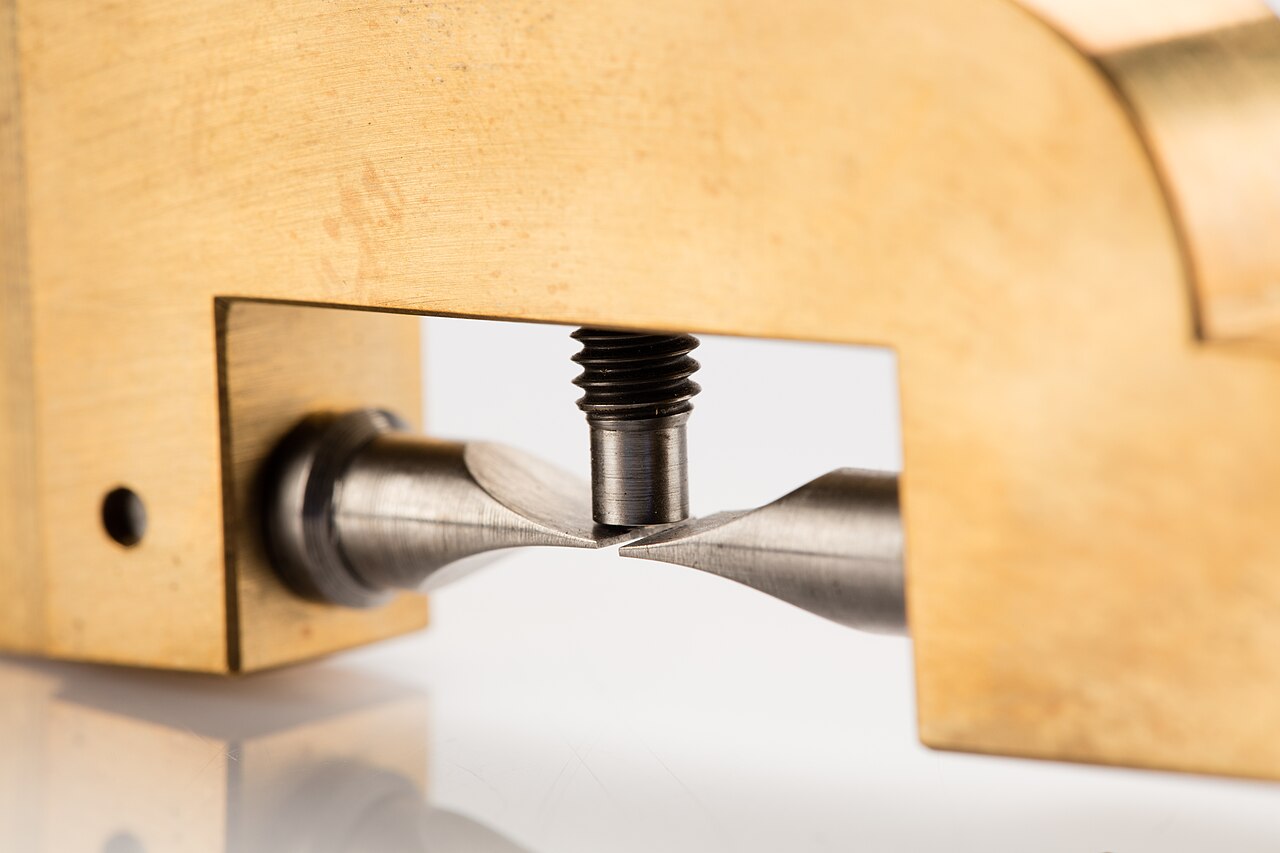
Figure. Tip of a Bergeon 30001 tool used to adjust a cannon pinion. Photograph: Auckland Museum Collections (photographer Bong Errazo). Collection of Auckland Museum Tāmaki Paenga Hira, 2004.51.9. Source: Wikimedia Commons. CC BY 2.0. Reduced in size.

Lubrication affects both torque transmission and slipping. Follow the service information for the movement for the type and quantity of oil and adjustment values. The friction coupling makes it possible to set the time. The escapement and regulator govern how steadily the train advances.
Chronology#
| Date | Documented events |
|---|---|
| July 1886 | US345800A describes fitting a slotted cannon pinion over a boss on the centre-wheel arbor. 4 |
| February 1974 | US3789691A is issued for a different method using a spring washer. 5 |
| May 2004 | An AWCI technical article describes the friction fit, time setting, loose and over-tight fits, and variations in construction. 1 |
| September 2018 | Priority date stated in US20220155726A1, concerning indentation before hardening. 3 |
| May 2022 | The US application is published. The corresponding US patent US11507021B2 is issued in November. 3 |
The chronology gives examples from the sources consulted. It does not establish when each design was first used or became common.
References#
[1] Jack Kurdzionak, “Cannon Pinions”, Horological Times, AWCI, May 2004, p. 29. Article, PDF (accessed 6 November 2026).
[2] British Horological Institute, Technician Grade Lesson 10, pp. 11, 18. Course material, PDF (accessed 6 November 2026).
[3] J. Javet and C. Prenez, “Method for producing friction by indenting”, US20220155726A1, published 19 May 2022. Patent publication (accessed 6 November 2026).
[4] G. G. Moor, US345800A, issued 20 July 1886. Patent publication (accessed 6 November 2026).
[5] Roland Zaugg, “Frictional coupling device for watch movement”, US3789691A, issued 5 February 1974. Patent publication (accessed 6 November 2026).