This article was translated from Japanese using AI. Read the Japanese original
The escapement rides on a rotating platform#
A carrousel, also spelled karrusel, places the balance, balance spring and escapement on a platform that turns inside the watch. The rotation is intended to average out rate differences between vertical positions. A tourbillon serves much the same purpose, but uses a different set of gears to drive the escapement and rotate the platform. 1 2
In a typical tourbillon, a wheel fixed to the mainplate meshes with the escape-wheel pinion on the rotating carriage. In a Bonniksen carrousel, the pinion meshes with a wheel that also turns. One path leads from the train to the escapement and another to the rotating platform. Both share a common mainspring and train. 1 2
The two are difficult to tell apart by appearance. Whether the balance is central or offset, or whether a revolution takes a minute or tens of minutes, is inconclusive. To identify a carrousel, look for which parts move, which remain stationary and how power reaches them.
The problem Bonniksen set out to solve#
The British patent of 1892 and the US patent of 1895#
Bahne Bonniksen, who worked in Coventry, England, devised the mechanism known from British patent No. 21,421, dated 24 November 1892. His US patent US549287 refers explicitly to the British patent and records a US application date of 18 January 1894 and an issue date of 5 November 1895. 1 3
The patent addresses the gains and losses of a hanging pocket watch and of the same watch with 3, 6 or 9 o’clock uppermost. Any unevenness in the distribution of mass around the balance axis lets the direction of gravity influence its motion. Bonniksen sought to preserve the relationship between the balance and escapement while rotating the platform carrying them, so that the watch would pass through several orientations in succession. 1
An important predecessor was Abraham-Louis Breguet’s tourbillon, patented on 26 June 1801. Bonniksen himself claimed novelty for his means of rotating the escapement and acknowledged the earlier idea. 1 4
A mechanism made through the British division of labour#
Alan A. Myers’s study of surviving watches and production ledgers shows that several British firms took unfinished or partly finished movements from Bonniksen and completed them. 3
The R. Thorneloe deck watch in the Science Museum Group collection, object 1952-255, has an 1897 Chester hallmark on its case. Its wooden box shows one way the carrousel was put to practical use. 5
Greenwich object ZAA0153, No. 57006, has an open-face silver case, centre seconds, a lever escapement and a compensation balance. The catalogue dates the case to 1902–1903 and records the watch as a deck watch in a wooden box. 6
Tracing power through the patent drawings#
Two paths from the same train#
In figures 1 and 2 of the US patent, third wheel A and its pinion H rotate on the same arbor. The teeth of A drive fourth-wheel pinion B, and fourth wheel C on the same arbor as B transmits power to escape-wheel pinion J and escape wheel L. Meanwhile, H drives platform wheel G and turns platform D, which is fixed to G. The fourth-wheel arbor runs independently through the centre of the platform, and the escapement on the platform receives power from the turning wheel C. 1
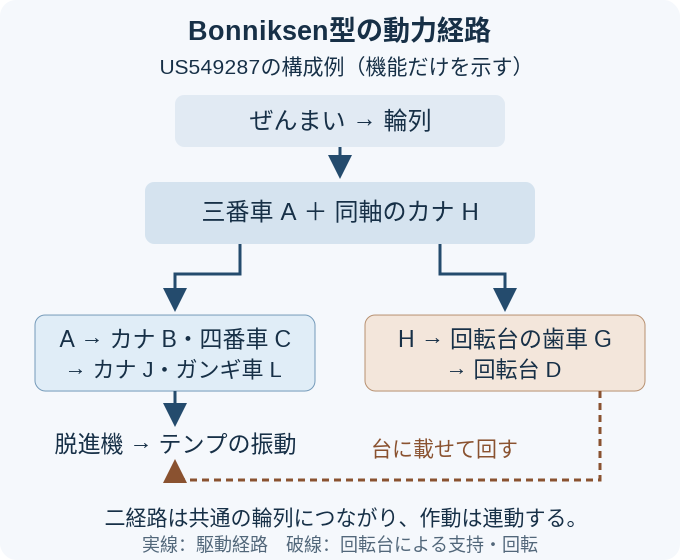
Figure 1. Schematic of the power paths using the component letters of US549287. It omits the original tooth profiles, arbor positions and dimensions. Principle from 1. Diagram produced for this site without reproducing or tracing third-party illustrations.
The platform rotates slowly while the balance oscillates several times a second. In the patent example the third wheel turns once in 7 minutes 30 seconds, and a 7:1 reduction makes the platform turn once in 52 minutes 30 seconds. The patent also describes driving the platform from another wheel and choosing a different speed through the tooth counts. The 52-minute 30-second period is one design value. 1
Calculating speed from the platform’s frame of reference#
The escape wheel turns on its own arbor and travels around the central wheel with the platform. The wheel speeds seen from the mainplate give only part of the information needed to determine how often the escapement operates. The calculation must include the relative rotation of the platform and the central wheel that meshes with the escape-wheel pinion. 2
Joseph Flores dismantled and compared two examples, a 52-minute 30-second version with subsidiary seconds and a 34-minute version with centre seconds. In the latter, the platform has teeth around its perimeter, and the paths to the seconds display and the escapement differ. Mechanisms bearing the same patent number therefore varied in construction as well as speed. Flores’s analysis treats the platform speed and escapement cycle as parts of a single gearing problem. 2
A test sometimes proposed for identifying a carrousel is to stop the platform and see whether the watch continues to run. Flores notes that restraining the platform of the 52-minute 30-second version stops the watch. Blancpain describes disconnecting one path, an operation distinct from immobilising a component meshed with the common train. Establish the construction before attempting to classify a surviving example, and avoid forcibly arresting its platform. 2 7
Comparing the carrousel and tourbillon#
| Feature | Typical tourbillon | Bonniksen carrousel |
|---|---|---|
| Shared purpose | Rotate the regulating mechanism to average positional rate differences | Same |
| Escapement drive | The escape-wheel pinion on the carriage meshes with a fixed wheel | The escape-wheel pinion on the platform meshes with a moving wheel |
| Power path | Carriage rotation is part of the train’s transmission | One path leads to the escapement and another rotates the platform |
| Time per revolution | Varies by design and can exceed or fall short of a minute | Historical examples of 52 minutes 30 seconds and 34 minutes, and modern examples of one minute |
| Visual identification | The balance position and presence of an upper bridge alone are inconclusive | Same |
The comparison describes the Breguet and Bonniksen arrangements. Blancpain’s 2008 design account likewise emphasises whether there is a fixed wheel and how power is transmitted. Its own carrousel has a balance at the centre of the platform. 2 7
“Flying” describes the support. A flying platform is supported from below, with no upper bridge. Both a tourbillon and a carrousel can use this construction. 8
What averaging gravitational errors means#
When a pocket watch stands vertically, the rotating platform changes the orientation of the balance, spring and escapement relative to gravity. A component of error that makes the watch gain in one direction and lose in another can be averaged over a revolution. Gravity still acts on the mechanism. The rotation reduces the accumulation of a bias from one position held over a long period. 1 4
The circumstances needed for averaging follow from the mechanism. If positional errors stay stable, the platform spends about the same time in each direction and observations cover at least one revolution, the direction-dependent component approaches its mean. That mean can differ from zero. A watch that gains in every position, for example, still needs adjusting.
When a single-axis platform rotates parallel to the dial, turning it with the dial horizontal cannot change the balance axis to the orientation it has with the dial vertical. A wristwatch case also moves in more complex ways, so an average over one cycle in a stationary vertical position cannot directly predict improvement on the wrist. These are consequences of the geometry of rotation. They give no measured performance figures for any particular product.
Rotation alone also gives no assurance against changes caused by magnetism, temperature, lubrication, wear, shocks or declining mainspring torque. A comparison requires measurements of positional and mean rates, amplitude and running time under the same conditions. Historical trials and manufacturers’ successes document the particular objects and conditions tested and give no proof of universal superiority for the design. 3 9
Building a small and stable rotating assembly#
A carrousel requires no particular alloy. The design has to provide stable platform support, proper gear mesh and adjustment of the balance and escapement. Bonniksen’s patent gives the platform its own supporting arbor so that the fourth-wheel arbor does not carry its weight directly. 1
A historical deck watch with a compensation balance and a modern wristwatch with a silicon balance spring differ in both manufacturing methods and sources of positional error. On its current listing for the Villeret Carrousel Volant Une Minute, Ref. 66228 3642 MMB, Blancpain specifies self-winding calibre 228, 3 Hz, 35 jewels, 209 components, a 120-hour power reserve and a silicon balance spring. The listed specifications were checked on 4 November 2026. 6 8
The distribution of weight on the platform, friction at its bearings, gear heights and clearances, and the positions of the escape wheel, lever and balance all affect one another. A report from Blancpain’s workshop describes trial assembly, adjustment, dismantling and cleaning, and reassembly. The operating noise of the carrousel interferes with acoustic timing measurements, so the workshop checks the rate against a reference clock. Cleanliness, lubrication and testing remain part of producing the rotating mechanism. 9
Redesign for the wrist and recent developments#
In 2008 Blancpain introduced the Carrousel Volant Une Minute, developed with Vincent Calabrese and others. Its launch account describes a one-minute revolution with a 3 Hz balance, support from below, automatic winding and a 100-hour power reserve. The manufacturer’s claim of a “world first” refers to achievements such as adapting the mechanism to a wristwatch and its one-minute flying construction. The original carrousel dates to 1892. 7
The 2013 Tourbillon Carrousel combined two regulating systems in one watch. The tourbillon and carrousel each have their own barrel. A differential averages the two rates feeding the display. This device links two timekeeping systems, whereas the “differential effect” within a single carrousel describes relative rotation between gears and platform. 10
In 2026 the new watchmaker Bonniksen was founded in connection with the Time Æon Foundation’s Naissance d’une Montre 4. The Federation of the Swiss Watch Industry FH reported on 13 May that year on plans for a wristwatch with a 30-second carrousel. The manufacturer’s own description, checked in November of that year, also presents it as a future project. 11 12
Part of the carrousel’s present significance is that it brings together the idea of compensating for gravity, gearing calculations in a moving frame of reference, lightweight rotating supports and fine assembly. Understanding its timekeeping performance takes both a look at the construction and results from adjustment and testing, alongside the visible complexity and the nominal period of rotation.
Timeline#
| Date | Event and significance |
|---|---|
| 26 June 1801 | Breguet receives the patent for the tourbillon, an important precedent for averaging positional differences by rotation. 4 |
| 24 November 1892 | Date of Bonniksen’s British patent No. 21,421, also cited in the US specification. 1 |
| 18 January 1894 / 5 November 1895 | US filing and issue of US549287, which describes the 52-minute 30-second example and its power paths. 1 |
| 1897 | Hallmark year of the surviving Thorneloe deck-watch case. 5 |
| 1902–1903 | Case date for Greenwich watch No. 57006, a practical example with centre seconds. 6 |
| 2008 | Blancpain introduces its one-minute flying carrousel in a wristwatch. 7 |
| 2013 | The Tourbillon Carrousel links two regulators to a differential display. 10 |
| May 2026 | The FH introduces the new watchmaker Bonniksen and its 30-second carrousel project. 11 |
| Checked November 2026 | Blancpain lists the Villeret one-minute carrousel with calibre 228 on its official website. 8 |
References#
Web sources checked on 4 November 2026. Patent examples, published examinations of objects, and manufacturers’ product accounts are used within their respective scope.
- Bahne Bonniksen, Watch, US549287A, 5 November 1895, US application filed on 18 January 1894. Four-page original patent, especially figures 1 and 2, parts A–P and the 52½-minute period in the specification, and the claims. Explicitly cites British patent No. 21,421 of 24 November 1892. Text and drawings checked in a copy of the original patent.
- Joseph Flores, « Le carrousel : dispositif tournant méconnu », Bulletin SSC, No. 89, June 2020, pp. 43–50. Dismantling of the 52-minute 30-second and 34-minute types, fixed wheels and the differential effect. Used for the author’s analysis of the mechanisms.
- Alan A. Myers, “Bonniksen and his Karrusel Watches: Inventor and Innovator”, Horological Journal, January 2025, pp. 24–35, especially pp. 24–25 and 28–29. Study of supply and finishing firms from surviving pieces and production ledgers.
- Breguet, “Patent granted for a completely new type of regulator called the ‘Tourbillon’”. The 26 June 1801 patent, vertical positions and the purpose of rotation. The manufacturer’s history.
- Science Museum Group, “‘Karrusel’ deck watch”, object 1952-255. R. Thorneloe, 1897 Chester hallmark, wooden box.
- Royal Museums Greenwich, “57006”, ZAA0153. Collection record for mechanism, materials and case date. The full collection entry was consulted.
- Jeffrey S. Kingston, “No Holds Barred II”, Lettres du Brassus, No. 4, 2008, pp. 4–15, especially pp. 10–15. The development team and power paths at launch, one-minute rotation at 3 Hz, and 100-hour power reserve. Manufacturer publication.
- Blancpain, “Villeret Carrousel Volant Une Minute — 66228 3642 MMB”. Current calibre 228 specifications and flying construction.
- Michel Jeannot, “Where Blancpain’s Tourbillons and Carrousels Come to Life”, Lettres du Brassus, No. 13, 2013. Workshop interviews, assembly, cleaning, lubrication and carrousel timing.
- Jeffrey S. Kingston, « Le Brassus Tourbillon Carrousel », Lettres du Brassus, No. 14, 2013. Two barrels and the display differential, introduced in 2013. French edition.
- Federation of the Swiss Watch Industry FH, “Naissance d’une Montre 4”, 13 May 2026. Founding of the new manufacturer and the planned 30-second carrousel.
- Bonniksen, « Naissance d’une Montre 4 », section of that name on the official site. Account of the 2026 founding and description in French of the project aiming for a 30-second revolution.