This article was translated from Japanese using AI. Read the Japanese original
The cross-beat escapement, or Kreuzschlaghemmung in German, regulates a clock with two oscillating members that move in opposite directions about separate axes. Jost Bürgi is known for introducing it into astronomical clocks in the late sixteenth century. It modifies the verge escapement, in which two pallets are fixed to a single axis, so that two arms move across one another. 1 2
The design illustrates efforts to improve timekeeping before the pendulum and balance spring came into use. Two arms alone do not produce a constant period. The escapement has to be understood alongside arrangements for controlling the driving force, the manufacture of gears and arbors, and adjustment of the mesh. 3 4
Measuring short intervals in astronomy#
At the court of Landgrave Wilhelm IV of Hesse in Kassel, measuring the positions of stars required both observing instruments and accurate time. Bürgi was hired as court clockmaker in 1579 and took part in making instruments and in making observations. His clock improvements served researchers measuring the time it took celestial objects to move, as well as allowing finer divisions of ordinary time. 3
A conventional foliot is a crossbar with weights at both ends. It oscillates with the verge, and the escape-wheel teeth sustain its motion by pushing alternately on the upper and lower pallets. Its behaviour depends on driving force, collisions and friction. A later pendulum, by contrast, has a period governed by gravity and length. A study of verge and foliot dynamics also points to significant losses of energy through collisions and friction. 5
The two-axis mechanism#
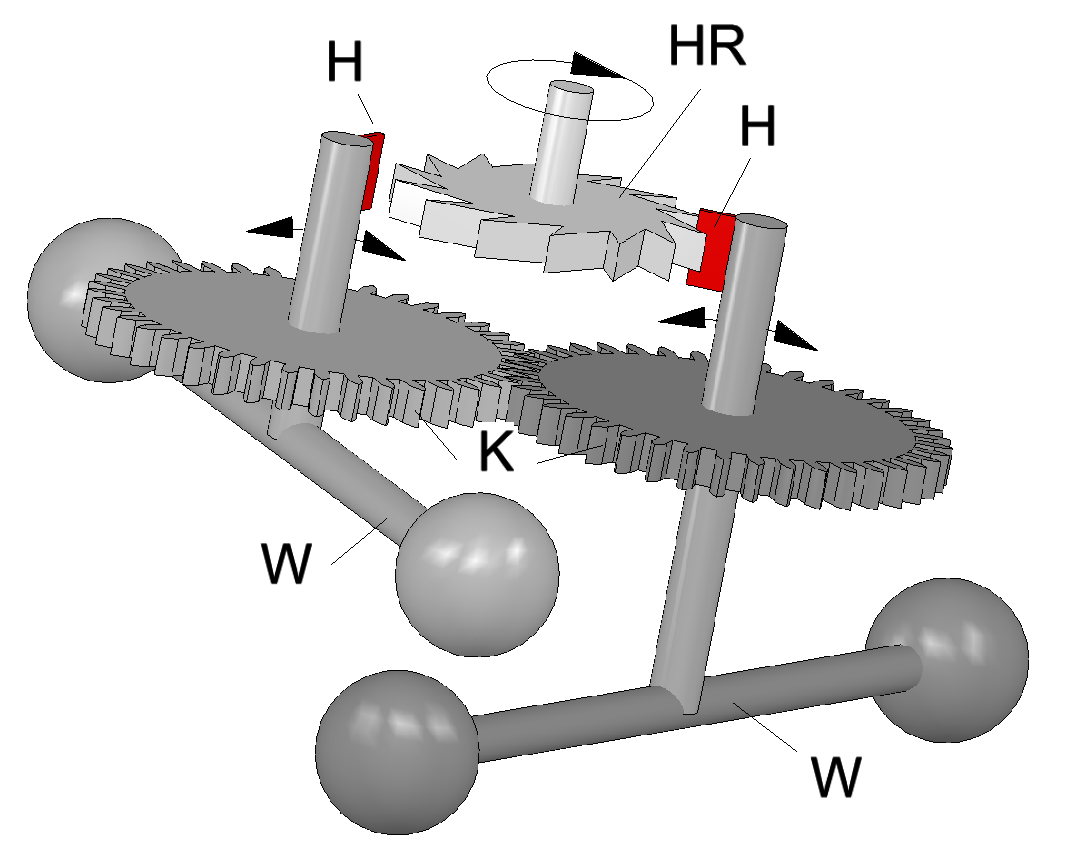
Figure. Diagram of Bürgi’s design. H = locking and impulse elements, HR = escape wheel, K = coupling, W = weighted arms. By Manfredgoellner (2016). Source “Bürgi.tif”, Wikimedia Commons. Licence CC BY-SA 4.0. Converted from TIFF to PNG only. The displayed image carries the same licence.
From the escape wheel to the two arms#
In the diagram of Bürgi’s design, the two locking and impulse elements H that contact escape wheel HR are on separate axes and are each connected to a weighted arm W. Coupling K links the motion of the two axes. When one turns, the other moves in the opposite direction. The paired elements form one mechanism controlling a shared escape wheel. 2
An escape-wheel tooth acts on one element H and moves its arm. The motion of the arm and the coupling release the contact, letting the wheel advance until the other element H receives a tooth. The two sides take turns. The contact elements were fixed to the same arbor in the ordinary verge and move about separate axes here. The coupling, gears and arms can differ among escapements that share this principle. 1 2
Arms and rings, escapement and remontoire#
The arm weights of the surviving Dresden clock are shaped like winged angels’ heads. The rock-crystal astronomical table clock in Vienna uses a variant with two ring-shaped oscillators in place of arms. “Cross-beat” is a historical name for a family of mechanisms that includes variants of this kind alongside those with visibly crossing bars. 1
A remontoire uses the main power source to rewind a small spring or lift a weight periodically to regulate the force reaching the escapement. The cross-beat changes the relationship between oscillation and tooth release, while the remontoire acts on the supply of power. In the Kassel clock with a spring remontoire, a weak spring is rewound every hour. A symposium report on the clock notes that the centre wheel receives no power at the instant of rewinding. Repeatedly using the force from a short range of the spring’s travel still leaves interruptions in delivery. 4
Dating the invention and its precedents#
Bürgi is widely credited with inventing the cross-beat escapement. Chandler and Vincent’s 1980 study dates it to shortly before 1590 and cites an earlier example in a footnote, a water-lifting mechanism in a book on machinery published by Jacques Besson in 1569. 1
A 2019 study of early Nuremberg clocks also gives this precedent weight. Besson’s plate 44 shows a mechanism that transmits crossing reciprocating motion to turn a pump. A clock drives reciprocating motion from the rotating side, reversing the direction in which power is used. Devising the principle of crossing motion and applying it to escapement and regulation are distinct contributions. The precedent alone does not show that Bürgi copied a particular book directly. 6
Dating a mechanism from this period requires comparing surviving clocks, treatises on machinery, observation records and later examinations of the objects. There is no modern patent filing date to establish when it originated.
What surviving timepieces show#
| Example | What the mechanism and records show |
|---|---|
| Kassel precision clock APK U 43 attributed to Bürgi | Combines crossing arms and a spring remontoire. The date and attribution reflect the museum’s assessment. 7 |
| Bürgi’s clock in Dresden | A large wheel with fine teeth and two arms weighted with angel-head figures are visible. 1 |
| Rock-crystal astronomical table clock in Vienna | Recorded as made in Prague in 1622–1627, it uses a variant with two ring-shaped oscillators. 1 |
| Clock attributed to Bürgi in the Patek Philippe Museum | The museum describes a large escape wheel and a 12-second period of oscillation for this object. 8 |
The design also survives in small seventeenth-century watches, including Johann Pestdorffer’s portable watch in a rock-crystal case. Routes of transmission between makers remain poorly understood. Examples in several cities establish that the idea reached different places, while the extent of production and everyday use requires other evidence. 1
Assessing precision#
The Kassel collection record draws attention to a clock with a “double crossbar” in sixteenth-century observation records. The museum infers a possible connection with a one-second period from an account of counting sounds to measure intervals shorter than a minute on a clock without minute or seconds hands. This interpretation connects the written record with the mechanism of a surviving clock. The 12-second period is documented for a different collection object. 7 8
Improvements in accuracy had several causes. In addition to the remontoire and cross-beat, a 2025 study of Bürgi identifies the craftsmanship required to finish large iron gears precisely. Surviving clocks also differ in gearing, adjustment mechanisms and power supply. 3
Materials and maintenance need to be considered for each object. Museum object APK U 43 uses wood, brass, iron, glass and gut line. That list applies to this clock. The rock-crystal cases and decorative weights of later examples are manufacturing and artistic choices distinct from the principle of regulation. The sources consulted give no manufacturing specifications for the tolerances, lubricants or magnetic resistance of the surviving objects. 7
Timeline and historical significance#
| Period | Event |
|---|---|
| 1569 / 1578 edition | Besson’s book of machines shows a mechanism using crossing motion to drive a pump. 6 |
| 1579 | Bürgi becomes court clockmaker in Kassel. 3 |
| Late sixteenth century | Bürgi introduces the cross-beat into astronomical clocks. The precise date of his first example is uncertain. 1 |
| Seventeenth century | Examples appear in small watches by other makers. 1 |
| Second half of the seventeenth century | Pendulums and balances with balance springs come into wide use and the cross-beat recedes. 1 |
| From 1953 | Hans von Bertele and others study surviving mechanisms and reassess their historical significance. 1 |
| 2019–2025 | Research continues into earlier mechanical precedents and the interaction between the maker’s craft and mathematics. 3 6 |
The cross-beat shows that clockmakers were already finding ways around some constraints of pre-pendulum clocks. Two axes, a regulated supply of power and precise workmanship were combined to meet the needs of astronomical observation. Its achievements and limitations help explain the changes later brought by the pendulum and balance spring.
References#
Sources checked on 8 November 2026. This account includes performance figures and apprenticeship relationships only where supported by the sources.
- Bruce Chandler / Clare Vincent, “A Rock Crystal Watch with a Cross-Beat Escapement”, Metropolitan Museum Journal 15 (1980), pp. 193–201, especially the text, figs. 1–12 and notes 4 and 8.
- Manfredgoellner, “Bürgi.tif”, 2016. Labelled diagram of Bürgi’s principle. It represents the mechanism schematically.
- Damian Moosbrugger, “A clockmaker’s mathematics: a technology-based approach to the mathematical works of Jost Bürgi (1552–1632)”, Archive for History of Exact Sciences, 2025, §2.
- Michael Beck, “Jost Bürgis Uhren im Astronomisch-Physikalischen Kabinett Kassel”, 3. Internationales Jost-Bürgi-Symposium, 2019, p. 13, “Die Uhr mit Kreuzschlaghemmung und Federremontoire”.
- Aaron S. Blumenthal / Michael Nosonovsky, “Friction and Dynamics of Verge and Foliot: How the Invention of the Pendulum Made Clocks Much More Accurate”, 2020, §2. Study of the dynamics of the conventional verge.
- Dietrich Matthes / Rocío Sánchez-Barrios, “Some further early clocks from Nuremberg”, Antiquarian Horology 40/2, June 2019, pp. 215–230. See pp. 228–229, fig. 18 and note 63.
- Hessen Kassel Heritage, “Präzisionsuhr mit Kreuzschlaghemmung und Federremontoire”, APK U 43, collection entry by Karsten Gaulke.
- Patek Philippe Museum, Treasures from the Antique Collection, “Science Revolutionizes Timekeeping”, pp. 30–31.