This article was translated from Japanese using AI. Read the Japanese original
A cycloidal pendulum has a bob that follows a cycloid instead of a circular arc. Christiaan Huygens devised it in 1659 to achieve ideal isochronism, in which large and small swings have the same period. It is an example of clockmaking drawing directly on the mathematics of curves and falling bodies. 1 2
The problem with a circular arc#
A bob suspended from a string of fixed length travels along part of a circle. At small angles the period is nearly constant, but it lengthens as the amplitude increases. In a clock, the driving power, air resistance and the state of the escapement can all change the amplitude. The relationship between amplitude and period therefore causes variations in rate. 1
A pendulum stops at either end of its swing and moves quickly through the middle. Isochronism means that the time for a complete oscillation remains constant as the amplitude changes. This is the property the cycloidal pendulum is designed to achieve. 1
The curve and the device#
A cycloid is the curve traced by a point on the circumference of a circle rolling along a straight line without slipping. Invert the curve to form a trough and let a body slide along it without friction. From wherever it is released from rest, it takes the same time to reach the lowest point. This property is called tautochronism. 2 3
Huygens used a cycloidal guide, or cheek, on either side of the suspension string, so the bob could trace the curve without sliding on a track. The string wraps onto a cheek, reducing its free length as the swing grows. As a result, the bob itself follows a cycloid. The cheeks and the bob’s path use the same curve at different positions. 1 4
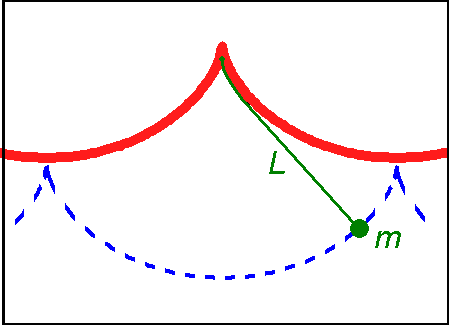
Figure 1. The string wraps onto the cheeks, changing the bob’s path. By 3piecesuits, 2011. Source Wikimedia Commons file. Licence CC0 1.0. Reproduced unchanged.

The principle in modern notation#
This idealised model assumes a uniform gravitational field, a massless and inextensible string and a point-mass bob. It omits friction, air resistance and forces from an escapement. An actual clock’s rate depends on factors outside the model. 1
Let \( s \) be the signed arc length along the curve from its lowest point, \( a \) the radius of the circle that generates the cycloid, and \( y \) the height above the lowest point. For this curve,
The potential energy \( mgy \) is therefore proportional to \( s^2 \). The tangential component of gravity is proportional to \( s \) and draws the bob back towards the centre. The equation of motion and its period are
Here \( m \) is mass, \( t \) is time in seconds, \( g \) is gravitational acceleration, and \( T \) is the period of a full oscillation. Using metres for \( a \) and metres per second squared for \( g \) gives \( T \) in seconds. The cycloidal pendulum obeys the simple harmonic motion equation without the small-angle approximation required for a circular arc. This restates Borghi’s condition, in which tangential acceleration is proportional to arc length, in terms of the generating circle’s radius. 1
If the length of the string when it hangs vertically from the cheeks is \( L=4a \), the period can also be written as \( T=2\pi\sqrt{L/g} \). When comparing formulas, check whether \( L \) denotes the generating circle’s radius, the total string length or the actual free length. Different notation can give the appearance of a different coefficient. 1 4
Original sources and development#
Part II, Proposition XXV of Huygens’s Horologium Oscillatorium (1673) states that a body released from rest on a cycloid descends to the bottom in the same time regardless of its starting point. Volume XVIII of his collected works, available through DBNL, prints the Latin and French translation side by side, with figure 51 and the geometric proof. The historical proof uses geometry where a modern explanation can use the equations for harmonic motion. 3
Records of British work also survive. Royal Society RBC/1/39, p. 161, shows William Brouncker’s diagrams on the tautochronism of the cycloid and related questions. His work was read at the meeting of 22 January 1662, where it was agreed that a copy should be sent to Huygens. The development involved an exchange of geometric results and experiments. 5
Ideal isochronism and clockmaking#
A clock’s isochronism depends on more than the profile of the cheeks. The ideal equation omits the string’s thickness, stretch and resistance to bending, its contact with the cheeks, air resistance and deformation at the suspension point. The force from the escapement that sustains the oscillation is also outside the free-oscillation model.
In choosing materials and making the parts, consider deviations from the ideal curve separately from the elastic properties of the string when it bends. The string has thickness and bending stiffness, so the shape of the surface alone cannot determine the point of contact. 1 4
In his nineteenth-century work on experimental mechanics, Robert Stawell Ball describes the difficulty of making a curved track with no sliding friction, and explains a demonstration apparatus that uses a string and two cheeks. The idea also served as a teaching tool that made the properties of the curve visible in motion. Museo Galileo describes a demonstration in which balls released from different heights reach the bottom together. 2 4
Timeline and present-day context#
| Date | Development |
|---|---|
| 1659 | The museum account and research paper date Huygens’s discovery of cycloidal isochronism to this year. |
| January 1662 | Brouncker’s work is reported to the Royal Society and communicated to Huygens. |
| 1673 | Huygens publishes his geometric argument in Horologium Oscillatorium. |
| Eighteenth and nineteenth centuries | Experimental physics apparatus and textbooks demonstrate isochronism. |
| 1934 | Volume XVIII of the collected works is published. DBNL now provides the original text and its French translation. |
| 2020–2022 | Borghi presents an elementary derivation in a paper for research and teaching. |
| 2026 | The principle is documented in museum descriptions and openly available papers. Its use in mass-produced contemporary clocks remains unverified. |
References#
- Riccardo Borghi, Huygens’ cycloidal pendulum: an elementary derivation, arXiv:2004.06401v2, 2022, §§I–IV. Accessed 22 October 2026.
2. Museo Galileo, Tautochronism of the cycloid, apparatus description. Accessed 22 October 2026.
3. Christiaan Huygens, De la Chute des Corps pesants et de leur Mouvement cycloïdal, Oeuvres complètes, tome XVIII, 1934, pp. 184–186, Proposition XXV, fig. 51. Accessed 22 October 2026.
4. Robert Stawell Ball, Experimental Mechanics, 1888 edition, §§616–619, cycloid demonstration, Project Gutenberg. Accessed 22 October 2026.
5. Royal Society, Diagrams on the pendulum, 1662 document, RBC/1/39 p. 161, RS.14442. Accessed 22 October 2026.