Dipleidoscope#
This article was translated from Japanese using AI. Read the Japanese original
A dipleidoscope is an optical instrument that shows when the Sun or another celestial object crosses the observer’s meridian by bringing two reflected images together. Nineteenth-century clockmakers and users recorded the time shown by their clock at that instant and compared it with astronomical tables to determine its gain or loss. The instrument provided an external reference for checking a timepiece against the motion of celestial objects. 1
Why observe the Sun?#
A mechanical clock drifts from reference time as it runs. Observing a meridian transit lets the user compare the clock with an external reference. The meridian is the plane through the local north and south directions and the zenith. The Sun’s transit marks local apparent noon. It need not occur at 12 o’clock in mean solar time, which uses a day of constant length. The difference varies with the season and can be converted using a table of the equation of time. 1
In his 1845 manual, clockmaker Edward John Dent presented the device as a way to make observation easier for clockmakers far from observatories and users in the provinces. He said it could also be used for stellar meridian transits, although the detailed observing instructions in the book cover the Sun. 1
How the two images coincide#
A typical instrument combines a transparent flat glass plate with two plane mirrors set at an angle inside it. Some sunlight reflects once from the front glass. Another portion passes through the glass, reflects successively from both mirrors and returns. The observer sees two images of the same Sun. As the Sun moves across the sky, the once-reflected and twice-reflected images approach, coincide and separate. In an instrument correctly aligned to the meridian, their coincidence marks the transit. 12
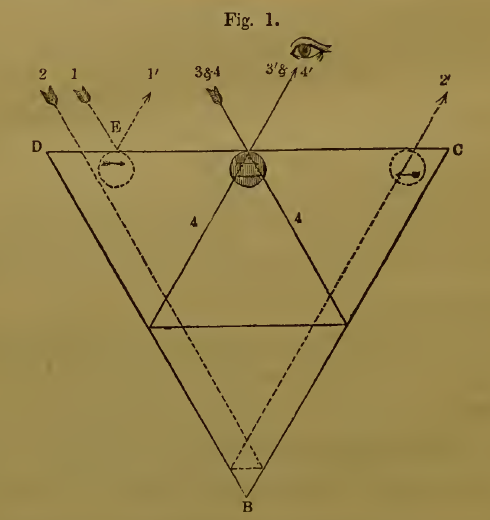
Figure. Reflected light paths in Dent’s 1845 manual. The illustrator is uncredited. Edward J. Dent wrote the manual. Source: Wellcome Collection, public-domain record on Wikimedia Commons. Cropped to the diagram in the original.
In Carl August von Steinheil’s 1846 account, the two mirrors form a 60-degree angle and make a triangular arrangement with the front glass. The coincidence depends on the instrument’s orientation. Observed coincidence indicates noon only with correct alignment to the meridian and the vertical. 2
Setting up and observing#
Dent explains how to place the instrument on a stable level surface and use a correctly set chronometer and the day’s equation of time to orient it so that the images coincide at the Sun’s meridian transit. He uses double images of a plumb line suspended in front to check the tilt, correcting it where necessary with a thin metal shim under the base. With the instrument tilted, changes in the Sun’s altitude through the seasons would change its time indication. 1
With the instrument installed, the observer records three times: when the edges of the Sun’s images first touch, when the images coincide throughout, and when the edges part after the transit. In Dent’s example of 2 October 1843, contact and separation occurred at 11:48:25.5 and 11:50:34.7. Their mean, 11:49:30.1, matches the central coincidence. If cloud leaves only one of the two edge events visible, a table of the time for the Sun’s radius to pass can be used to estimate the coincidence. Dent found the first and last contact easier to judge than the instant of complete overlap. 1
Never look directly at the Sun or view it through a telescope. The smoked glass described in the manual is a historical method and is unsafe for solar viewing.
Converting the reading to a time and its limits#
The instrument directly indicates when the Sun crosses the local meridian. If a clock shows local mean time, for example, use the equation-of-time table to find when local apparent noon occurs in mean time that day, then compare it with the clock reading at transit. Comparison with standard time also requires accounting for the difference in longitude and the time system in use. Dent gives the example of Dover, east of Greenwich, where local time is about 5 minutes and 16 seconds ahead. 1
Steinheil noted that the once-reflected image was dim, making it unsuitable for faint stars, and that beginners could have difficulty finding the images. 2 Clouds can prevent observations, while orientation, levelling, the observer’s judgment of the images and reading the clock all introduce error. Dent’s manual claims accuracy to less than one second. The Whipple Museum of the History of Science at the University of Cambridge gives accuracy within ten seconds for the instrument in its collection. 13
Invention and surviving instruments#
In the manual’s postscript, Dent recalls devising a shadow-based meridian instrument in 1840 and telling James Mackenzie Bloxam about it. Bloxam already had a different idea using single and double reflection. Dent adopted the optical method and undertook manufacture, selling the instrument after about two years of development. In Dent’s account, the patent was taken out in Bloxam’s name and its rights assigned to Dent. The original patent specification could not be verified, so this history follows Dent’s account and later descriptions. 15
The Whipple Museum’s example, dated to about 1845, is made of oxidised brass and glass and has three levelling screws. The optical assembly can turn about an axis parallel to the Earth’s axis, moving a dial through gears. The hand is missing and the glass is cracked. This surviving instrument shows that designs also included a clock-style indication in addition to simple fixed instruments. 3
The Science Museum Group in London also holds a Dent instrument with a clock-style dial, dated to 1870–1890. It is made of brass and glass and is recorded as having been used to determine noon for checking mechanical clocks. 4
Timeline#
- 1840 — Dent recalls telling Bloxam about his idea for a shadow-based instrument. 1
- 1843 — A later account dates the patent in Bloxam’s name to this year. Dent’s instrument went on sale around this time. 15
- 1845 — The fourth edition of Dent’s manual appears with setup and observing instructions and an equation-of-time table. 1
- 1846 — Steinheil explains the optical layout and adjustments in German. 2
- Around 1870–1890 — The museum dates the Dent instrument with a clock-style dial to this period. 4
- 1928 — C. V. Boys reports using a solid prism based on the hollow instrument and discusses applications in optical measurement and astronomical instruments. 6
References#
1. Edward J. Dent, A Description of the Dipleidoscope, fourth edition, 1845, pp. 6–19 and 24. Wellcome Collection (accessed 28 October 2026).
2. C. A. Steinheil, “Ueber Beobachtungsmittel zur Erkennung des Ganges der Uhren, insbesondere über das Passage-Prisma,” Polytechnisches Journal, 1846. Text (accessed 28 October 2026).
3. Whipple Museum of the History of Science, “Dipleidoscope meridian instrument,” accession no. 1314. Collection record (accessed 28 October 2026).
4. Science Museum Group, “Dipleidoscope with mechanical clock dial, British 1870–1890,” object no. 1917-98. Collection record (accessed 28 October 2026).
5. Orwell Astronomical Society, “The Dipleidoscope: A Solid State Transit Instrument,” Newsletter, April 2012. PDF (accessed 28 October 2026).
6. “Societies and Academies,” Nature, vol. 121, pp. 1040–1044, 30 June 1928. Article (accessed 28 October 2026).