This article was translated from Japanese using AI. Read the Japanese original
Élaboré is a grade of specification for a mechanical movement. For ETA’s 2824-2 it sits between Standard and Top and specifies the number of positions for adjustment and the permitted rate range. Sellita uses the spelling Elaboré in its technical documents, and Ronda also used the name when announcing its R01. The specifications depend on the manufacturer, calibre and edition of the documentation. 1235
The name can be understood through the positions in which the movement is adjusted, the conditions in which its rate is measured, and the combination of parts and decoration. The watch brand also publishes specifications for the accuracy and finish of the complete watch. 236
Several specifications for the same calibre#
The ETA 2824-2 documentation effective from 1 January 2003 lists four grades, Standard, Élaboré, Top and Chronomètre. They share a basic construction with 25 jewels, automatic winding and 28,800 half-oscillations per hour, with options for regulating components, shock protection, mainspring and decoration. 1
Watch brands can use the same overall dimensions and indications for products at different price points and with different appearance and accuracy. The grades group together the specifications available to those brands. The 2010 manufacturing document for the 2824-2 presents components and adjustment conditions for the same four grades in a table. 2
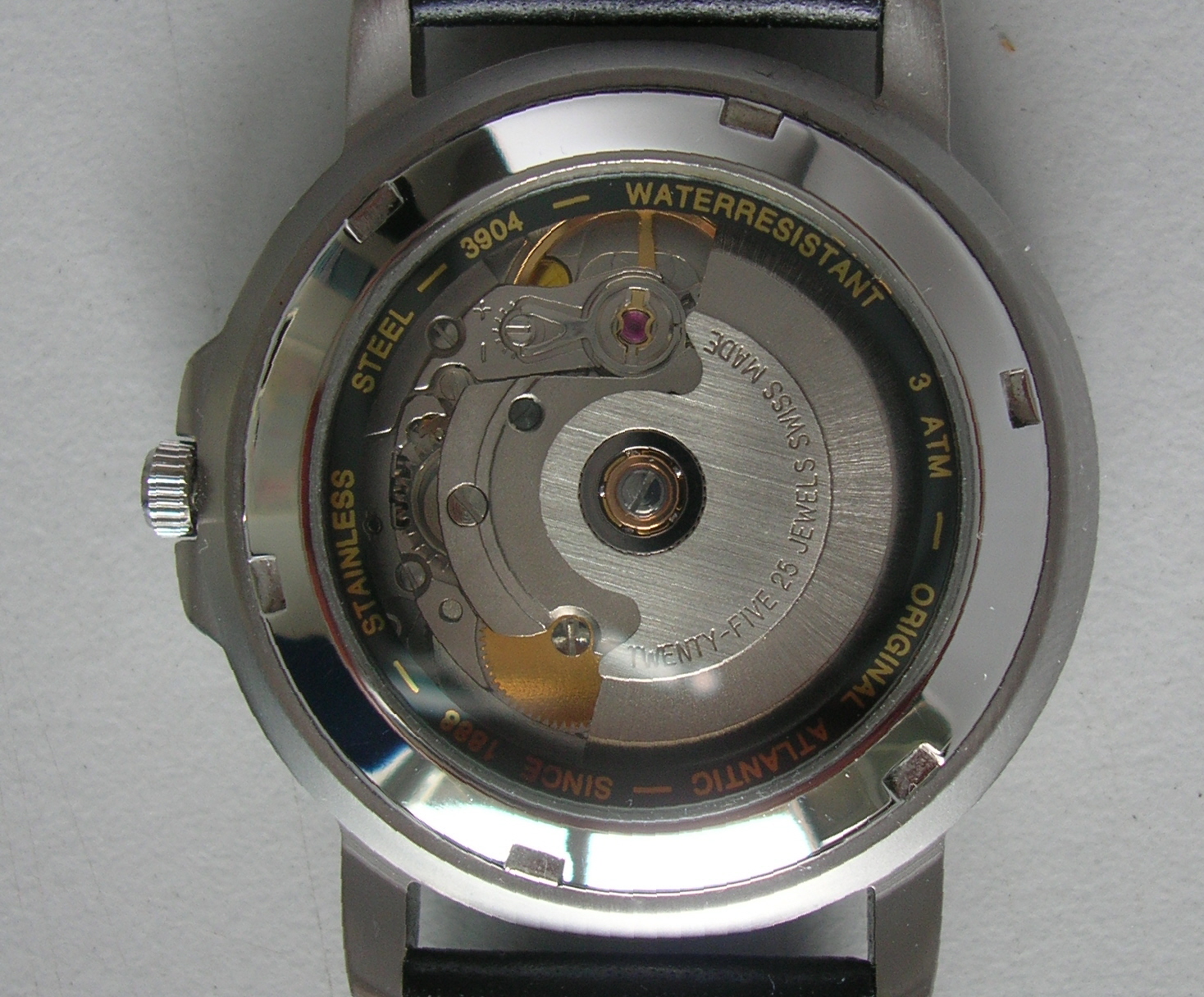
Figure 1. ETA 2824-2 installed in an Atlantic Worldmaster. The rotor is in the centre and the balance cock above it. Photograph by Jpr, 3 April 2008. Source “ETA-2824-A2-WP-de.JPG”, Wikimedia Commons. Licence CC BY-SA 3.0. Unmodified.

The positions included in adjustment#
ETA’s 2010 document for the 2824-2 gives two positions for Standard, three for Elaboré and five for Top. It defines the position codes as follows. 2
| Code | Watch orientation | Grades using the position |
|---|---|---|
| CH | Horizontal, dial up | Standard, Elaboré and Top |
| 6H | Vertical, six o’clock side up | Standard, Elaboré and Top |
| 9H | Vertical, nine o’clock side up | Elaboré and Top |
| FH | Horizontal, caseback up | Top |
| 3H | Vertical, three o’clock side up | Top |
A wristwatch changes orientation between sitting on a desk and being worn. Adjustment by position means measuring its gain or loss in the different orientations and adjusting the rate across the specified positions. The three Elaboré positions combine the horizontal dial-up position with the vertical six o’clock up and nine o’clock up positions. 23
Measuring more positions makes it easier to see variation by position as well as the mean. The data sheet uses separate rows for the mean rate and the greatest difference across positions, so each can be assessed independently. 23
Three measures in the rate table#
Mean rate and maximum difference between positions#
ETA’s 2010 document for the 2824-2 gives the figures below. Seconds per day expresses the measured gain or loss as a daily equivalent. A positive value indicates a gain. 2
| Grade | Adjustment positions | Mean rate at 0 h | Maximum difference across positions at 0 h | Isochronism, CH at 0 h to 24 h |
|---|---|---|---|---|
| Standard | 2 | 12 ± 12 s/day | 30 s/day | ±20 s/day |
| Elaboré | 3 | 7 ± 7 s/day | 20 s/day | ±15 s/day |
| Top | 5 | 4 ± 4 s/day | 15 s/day | ±10 s/day |
| Chronomètre | 5 | COSC criteria | COSC criteria | COSC criteria |
A mean rate of 7 ± 7 is centred on +7 seconds per day, with a tolerance of seven seconds per day either way. That gives a range from 0 to +14 seconds per day. If the rates in three positions were +2, +7 and +12 seconds per day, for example, the mean would be +7 and the maximum difference would be 10 seconds per day. The example shows the two quantities the table measures.
Time after winding and isochronism#
In the same document, 0 h means the highly wound state after the movement has been fully wound and run for one to three hours. The instructions include conditions such as measuring while the calendar is inactive. The isochronism row gives the difference between rates at 0 h and 24 h in the dial-up position. 2
As the mainspring unwinds and the driving conditions change, the rate is checked after an interval as well as across positions soon after winding. The ±15 seconds per day in the Elaboré isochronism row is the permitted change in rate between those two times. 23
ETA describes the figures as indicative values corresponding to its price list at the time. A footnote specifies that 95% of the delivery batch must fall within the prescribed limits. ETA also takes into account the effects of measuring equipment, temperature and atmospheric pressure. These measurement conditions are part of what makes the grade figures comparable. 2
Materials, shock protection and decoration#
In ETA’s 2010 documentation for the 2824-2, Standard and Elaboré share a gold-plated nickel balance, Nivarox 2 balance spring, Etachocs shock protection and Nivaflex NO mainspring. Top and Chronomètre list a Glucydur balance, Anachron balance spring, Incabloc shock protection and Nivaflex NM mainspring. 2
Moving from Standard to Elaboré in this table changes the adjustment positions and rate limits. The material changes appear at Top. The Elaboré grade illustrates how the same basic components can be subject to different adjustment requirements. 2
ETA’s 2003 documentation illustrates finishes such as straight graining, spiral patterns, perlage and Geneva stripes for specific parts including the rotor and bridges. The 2824-2 grade table gives the basic decoration as “none” for Standard and “5.N” for Élaboré and above. It also gives an approval procedure for drawings and samples of customer engravings. 1
In the 2010 manufacturing document, the decoration entry for Elaboré is also “5N”. Finishing determines the appearance, while positional adjustment and measurement establish the rate conditions. The grade table brings both into the order specification. 2
Elaboré in Sellita’s technical documentation#
Edition 07 of the Sellita SW200-1 document, dated 2 September 2024, lists Elaboré, Top and Chronomètre. Elaboré uses three positions, CH, 6H and 9H, a mean rate of 7 ± 7 seconds per day, a maximum difference between positions of 20 seconds per day, and isochronism of ±15 seconds per day between 0 h and 24 h in CH. Top lists five positions, a mean rate of 4 ± 4 seconds per day, a maximum difference of 15 seconds per day and isochronism of ±10 seconds per day. 3
The parts list in this edition specifies Incabloc shock protection for all three grades. The ETA 2824-2 documentation of 2010 specifies Etachocs for Elaboré. The parts are determined by the manufacturer, calibre and edition. 23
Sellita’s specifications likewise need to be checked by calibre. Edition 06 for the SW220-1 with day and date, dated 22 August 2025, gives the same position counts, mean rates and differences between positions for Elaboré and Top. It applies a shared grading system to movements with different functions. 4
Use by Ronda and in a finished watch#
R01 grades at announcement#
The Ronda R01 announcement published by Swiss Watch Passport on 10 June 2026 gives four grades, Élaboré, Top, COSC and COSC Excellence. The accuracy figures in its table are ±15 seconds per day, ±10 seconds per day, −4 to +6 seconds per day and −2 to +4 seconds per day respectively. Ronda used the Élaboré designation for a grade in its own range. 5
The announcement describes a silicon balance spring, pallet fork and escape wheel, and a balance with inertia adjustment screws. It lists matte, brushed and Geneva stripe finishes for the bridges and rotor. Construction and materials remain specific to the calibre family even when the grade name is shared. 5
The finished C63 Sealander Automatic#
Christopher Ward’s 2026 manual for the C63 Sealander Automatic specifies an SW200-2 Power+, 60–65 hours of power reserve and an accuracy of −5 to +12 seconds per day. The same page identifies an Elaboré grade with a spiral finish and a rotor engraved with the brand’s flag emblem. 6
The watch brand’s specifications document the calibre, rate and decoration of the finished watch. Read alongside the movement maker’s delivery grades, they connect the movement specification to the watch that uses it.
The relationship to Chronomètre#
The ETA and Sellita tables give COSC criteria for the rate of the Chronomètre grade. COSC’s official description of its mechanical wristwatch testing specifies 15 days, five positions and three temperatures of 8, 23 and 38 °C. It assesses seven criteria, including mean daily rate. The stated range for mean daily rate is −4 to +6 seconds per day. 237
The Chronomètre column connects the work of choosing parts and specifying adjustment conditions to the testing and certification of individual movements. COSC checks the movement’s unique number, assesses the test results and issues a certificate. The process from adjustment to certification helps explain where Elaboré, Top and Chronomètre fit within the system. 7
Timeline of documented uses#
| Date | Documented use or specification |
|---|---|
| January 2003 | The ETA 2824-2 documentation effective from 1 January lists parts and decoration options for Standard, Élaboré, Top and Chronomètre. 1 |
| February 2010 | The ETA 2824-2 manufacturing document dated 26 February lists adjustment positions, rate, isochronism and test conditions for four grades. 2 |
| September 2024 | Edition 07 of the Sellita SW200-1 document dated 2 September lists the specifications of Elaboré, Top and Chronomètre. 3 |
| August 2025 | Edition 06 of the Sellita SW220-1 document dated 22 August includes an adjustment table for the same three grades. 4 |
| June 2026 | The Ronda R01 announcement published on 10 June lists Élaboré, Top, COSC and COSC Excellence. 5 |
| 2026 edition | The C63 Sealander Automatic manual gives the SW200-2 Power+, its Elaboré finish and the rate specification of the finished watch. 6 |
References#
- ETA SA, Exécutions des mouvements mécaniques / Définition des décors traditionnels — ETA 2824-2, effective 1 January 2003, pp. 1–2. ETA PDF hosted by OM Mechanics. Accessed 15 November 2026.
2. ETA SA, Information habillage / Manufacturing Information — ETA 2824-2, IH 2824-2 FDE 478720 10, 26 February 2010, pp. 3–6. ETA PDF hosted by AWCI. Accessed 15 November 2026.
3. Sellita Watch Co S.A., Technical documentation — SW200-1, edition 07, 2 September 2024, pp. 4–5. Official PDF. Accessed 15 November 2026.
4. Sellita Watch Co S.A., Technical documentation — SW220-1, edition 06, 22 August 2025, pp. 3–5. Official PDF. Accessed 15 November 2026.
5. Asha Shaniah Gibson, “Calibre manufacture R01, une étape majeure pour Ronda”, Swiss Watch Passport by JSH, 10 June 2026. Article publishing Ronda’s product announcement. Accessed 15 November 2026.
6. Christopher Ward, C63 Sealander Automatic, 2026 manual, PDF p. 3. Official PDF. Accessed 15 November 2026.
7. COSC, “Chronometer Certified”, certification procedure, seven criteria and FAQ on mechanical wristwatches. Accessed 15 November 2026.