This article was translated from Japanese using AI. Read the Japanese original
An electronic paper watch display uses an electronically rewritable, paper-like reflective surface to show the time or a design. The common electrophoretic method applies an electric field to move charged pigment particles in liquid and change which colour is visible. A written image can persist without power. The timekeeping circuit and display updates still need power. 1 2 3
In watches the technology went from the curved display on Seiko’s Spectrum, announced in 2005 and released in 2006, to a high-resolution active-matrix display in 2010 and Sony’s FES Watch with a reconfigurable face and strap. The developments depended on display materials, electrode layout, low-power drive circuits, the area and frequency of updates, and shapes suitable for wearing. 4 5 6 10
Electronic paper, electrophoretic displays and reflective LCDs#
Electronic paper, or e-paper, covers display technologies that aim for paper-like properties such as readability by reflected light, thinness and portability, rewritability and low energy demand for retaining an image. The approaches studied and put into use have included electrophoresis, other means of moving particles and reflective liquid crystals. This article focuses on the electrophoretic displays (EPDs) used in watches. E Ink is a major supplier and a trademark within this broader field. 1 2
Electrophoresis changes the positions of pigment particles. A liquid-crystal display uses effects such as the orientation of liquid-crystal molecules to control the passage of light. A reflective LCD watch is also readable by ambient light, so reflectivity and the lack of a continuously lit backlight cannot distinguish it from an EPD. Both technologies can use thin-film transistors (TFTs) to select pixels. The presence of TFTs alone cannot identify the display material. 1 2 7
| Feature | Meaning in an electrophoretic watch display |
|---|---|
| Display material | Pigment particles that move in an electric field, suspended in a dispersion medium |
| Segmented display | Switches electrodes of predetermined shapes. This limits the positions and outlines it can display |
| Active matrix | Uses TFTs to select small pixels and combines them to draw letters, numbers and images |
| Flexible | Refers to the display’s ability to bend, independently of how pixels are selected or what is displayed |
| Solar power, radio reception and Bluetooth | Power, time-setting and communications features designed separately from the electronic paper |
The distinction between segments and a matrix comes from Seiko’s technical announcement. The Brightz and FES Watch U specifications illustrate how power and communications are separate from the display. 4 5 11
Moving particles and retaining the image#
Display layer and backplane#
In a two-particle black-and-white system, white and black particles with different charges are dispersed in a transparent liquid. An electric field between the upper and lower electrodes moves white particles to the viewing side for a light appearance and black particles there for a dark one. The difference comes from the ambient light reflected by the surface. Reading it in darkness requires a separate light. 1 2
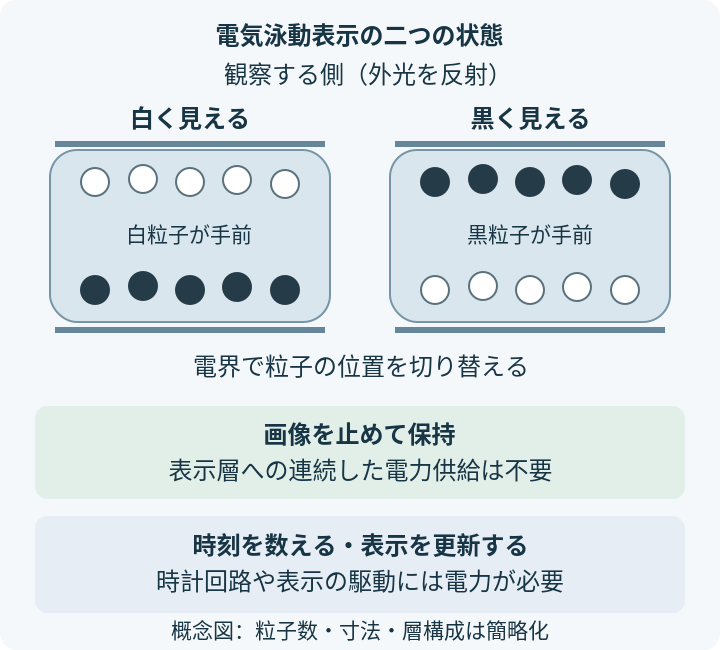
Figure 1. How a two-particle electrophoretic display works. Created for this site (original SVG). CC BY 4.0. Drawn independently of existing figures. The particle count, dimensions and layers are simplified, and the cross-section and signs of the charges do not represent any specific product. Sources for the principle 1 2 3.
Encapsulating particles in tiny capsules helped prevent their accumulation at one side of a screen or clumping. Barrett Comiskey, J. D. Albert, Hidekazu Yoshizawa and Joseph Jacobson published a 1998 paper on microencapsulating electrophoretic dispersions and printing reflective displays. Electrophoretic display research predated the paper, which documents one development among several kinds of electronic paper. 1 8
Manufacture combines the display layer containing the particles with electrodes and a backplane. For higher resolution, a film is laminated onto a substrate with a TFT for each pixel. A control IC and driver submit a sequence of voltages. Besides microcapsules, structures to contain the particles include tiny cup-shaped compartments. A thin display layer alone also does not make the finished watch freely bendable. 1 2
Bistability and total watch power use#
Bistability allows the display to retain its white or black state after removal of the electric field. A static image takes no power to hold, while the watch still uses power to run. A quartz oscillator and timekeeping circuit count time, a controller determines when to update the image and the update moves particles. Illumination and wireless communication, when used, also draw power. An old image remaining after the battery runs out no longer establishes the current time. 3 7 11
The FES Watch U help guide quantifies this difference. Under specified conditions the watch lasts about two weeks when it shows the time only upon a button press and about 24 hours when the time is always displayed. The first estimate assumes one pattern change, one pattern addition and 25 time displays a day. The ability to hold a static design cannot directly predict battery life during repeated time updates. 11
Update waveforms, ghosting and partial updates#
A single application of voltage does not always give the same result. An update waveform combines voltages and timings to clear the previous state, make the particles easier to move and reach the intended shade. A development report for a watch also describes balancing the direct-current component to limit charge imbalance. Prioritising speed alone can keep whites or blacks from reaching their targets or leave a trace of the earlier image. 7
Seiko Epson’s 2013 report says that on the EPD watch it studied, a drive sequence that let reflectance reach saturation took about 2.8 seconds per update. For a button-activated change, adjusting the reflectance target cut this to about 0.8 seconds. These timings apply to that panel and its drive conditions. 7
With a time display that changes every minute, updating only the digits that have changed reduces how much of the display needs to be rewritten. Areas updated at very different frequencies can age differently, changing their reflectance and potentially causing visible ghosting. The same report describes evaluating and selecting material batches in addition to controlling driving conditions. Reducing power thus involves validating the material’s stability and long-term display quality alongside limiting updates in software. 7
Bringing the technology to watches#
Spectrum’s 2005 announcement and 2006 release#
Seiko presented an electronic paper wristwatch at Baselworld in 2005. It went on sale as the Spectrum in 2006. The manufacturer’s 2010 announcement looks back at the 2005 presentation, and a 2007 technical review records the limited release in January 2006. The review was written by an engineer at Toppan Printing, a company involved in display materials. 1 4 6
The Spectrum incorporated the display into a curved bracelet shape, giving it space beyond a small flat window. The display switched segments of predetermined shapes and positions. Later pixel displays allowed photographs or text to be placed more freely. 4 6
The 2010 active-matrix EPD watch#
Seiko announced an active-matrix EPD prototype watch on 18 March 2010. The prototype was described as having about 80,000 pixels at 300 dpi and four levels of grey. The move from fixed shapes to pixels allowed changes in text size and layout. The announcement names an E Ink film and Seiko Epson’s TFTs and low-power control and drive circuits. 4
Product models including the Brightz SDGA001, announced in September, were specified at about 72,000 pixels, 300 dpi and four levels of grey, with release planned for 3 December. The March prototype had its own pixel count. The production model combined solar charging and standard radio time-signal reception and could show the time in two cities and calendar information. The display material’s low power requirements had to be combined with circuits and a power supply that kept the watch running. 5 7
Seiko’s “world first” claim in 2010 concerned the use of an active-matrix EPD in a wristwatch. It applied to a different set of conditions from the 2005 EPD watch announcement or later claims for flexible active-matrix products. 4 10
Smart Canvas designs that change with time#
Seiko Epson used a high-resolution EPD in its Smart Canvas, a wristwatch whose graphics or stories changed with the time. The 2017 development report dates the concept display to 2010 and commercialisation to fiscal 2013. Layering display elements that changed on different cycles, including hours, minutes, weekdays and dates, allowed changes beyond choosing a different clock font. 9
The same report explains that the design used a coin cell and omitted solar generation and radio time setting to leave more room for the display. It illustrates one way to power an EPD watch. Although the screen and band were treated as one visual design, the patterns on the Smart Canvas band differ from Sony’s electronically reconfigurable band. 9 10
FES Watch and FES Watch U#
The first FES Watch from Sony’s Fashion Entertainments changed the pattern on the strap as well as on the face. Its November 2015 announcement for general in-store sales described 24 selectable designs. Earlier crowdfunding and made-to-order sales were separate stages. 12
Crowdfunding for the succeeding FES Watch U began in August 2016, and commercial sales began on 12 June 2017. It used flexible active-matrix e-paper in the shape of a wristwatch. At release the FES Closet app allowed users to create designs from photographs and other material and transfer them to the face and strap. The thin, bendable display and pixel-addressed graphics offered a way to wear designs as well as read information. 10 13
Sony’s “world first” claim was specific to a product with flexible active-matrix electronic paper in the shape of a wristwatch. Seiko’s 2010 active-matrix EPD wristwatch claim had different conditions. 4 10
Benefits, limits and remaining challenges#
Reflective displays are readable by ambient light and avoid continuous drive to hold a still image. Control of segments or pixels allows the same surface to show numbers, designs, shades and scenes that change with time. In darkness they require illumination. Update delays, inversion or flicker, ghosting and changes in display quality with temperature or use also matter. The stated operating temperature for the FES Watch U is 5–35 °C. 1 7 11
Flexibility has limits. The FES Watch U instructions say to avoid bending, twisting or crushing the strap beyond the conditions of ordinary wear. The display material, electrodes, wiring, protective outer layer and connection to the watch body must all work together as a wearable object. 11
Researchers from Fuzhou University and elsewhere used a 10.3-inch experimental EPD and driver board in 2024 to compare update consumption, flicker and ghosting with different voltage sequences and periods without voltage. The experiment shows how the updates affect consumption and image quality even for a display that holds a still image. Improvement figures from the large panel cannot be applied directly to a watch’s battery life. 14
The length of time an image remains visible and the useful life of a watch as a product also differ. Sony announced the end of repair and support for the FES Watch series and distribution of the FES Closet app on 31 December 2022. As of 4 November 2026, new buyers cannot be assumed to have access to the original design-adding features under the same conditions. The help guide still gives a procedure for setting time on the watch itself, independently of app distribution and support. 11 15
An electronic paper watch display must integrate a material that holds an image into a device whose time continually changes. The design must balance readability, update speed, form, power supply and long-term image quality. 7 9
Timeline#
| Date | Development and source context |
|---|---|
| Late 1960s to the 1970s | Research on electrophoretic displays and Xerox’s paper-like displays. A technical review identifies this work as preceding the 1998 paper. 1 |
| July 1998 | Comiskey and colleagues publish work on microencapsulated electrophoretic ink and printed reflective displays. 8 |
| 2005 | Seiko presents an electronic paper wristwatch at Baselworld. 6 |
| January 2006 | Limited release of the Spectrum with a curved segmented EPD. 1 4 |
| March 2010 | Seiko announces an active-matrix EPD prototype watch with about 80,000 pixels. 4 |
| September 2010 | Seiko announces a Brightz watch with about 72,000 pixels and a planned release on 3 December. 5 |
| Fiscal 2013 | Commercialisation of Smart Canvas, with designs changing on different time cycles. 9 |
| November 2015 | General in-store sales of the first FES Watch begin, after made-to-order and crowdfunding sales. 12 |
| August 2016 and June 2017 | FES Watch U crowdfunding begins, followed by commercial sales. 10 13 |
| December 2022 | Repair and support for the FES Watch series and distribution of the FES Closet app end. 15 |
| August 2024 | Publication of an experimental study of EPD update waveforms, power consumption and image quality, separate from a watch product announcement. 14 |
| November 2026 | Sources checked for this article, including historical specifications and the current support status. |
Sources on the principles and products#
Early research, announcements from watch companies, development reports from the engineers and product instructions describe the principle of electronic paper and its use in watches. The publisher’s public abstract and bibliographical information were consulted for the 1998 paper. 8
References#
All sources were accessed on 4 November 2026. Developer reports and manufacturer announcements were consulted as primary sources from the parties involved, distinct from independent testing.
- Hidetoshi Danjo, “Electrophoretic Electronic Paper Displays”, Journal of Printing Science and Technology, vol. 44, no. 5, 2007, pp. 257–261. Review by an engineer at Toppan Printing.
2. E Ink, “Electronic Ink — How it works”. Undated technical account from the manufacturer, covering two-particle systems, microcapsules and Microcup structures.
3. E Ink, “Benefits”. Undated manufacturer’s explanation of bistability and reflective displays.
4. Seiko Watch, “Prototype: The world’s first active-matrix EPD watch”, 18 March 2010. Prototype announcement.
5. Seiko Watch, “New Seiko Brightz models open a new era for digital watches”, 7 September 2010. Models, planned sales date and display specifications.
6. Seiko Watch, “SEIKO’s ‘Future Now’ project delivers a new generation E-Ink watch,” 18 March 2010, p. 4. Manufacturer’s announcement preserved by a third party. Covers the 2005 presentation and compares segmented and matrix displays.
7. Tetsuro Murayama, Tsuyoshi Kogoshi and Shigeaki Seki, “Development of active matrix EPD watch”, Micromechatronics, vol. 57, no. 208, 2013, pp. 26–32. Full text (PDF). Report by the developers.
8. Barrett Comiskey, J. D. Albert, Hidekazu Yoshizawa and Joseph Jacobson, “An electrophoretic ink for all-printed reflective electronic displays,” Nature, 394, 253–255, 16 July 1998, DOI 10.1038/28349. Public abstract and bibliographical information consulted.
9. Tetsuya Miyake and Tsuyoshi Kogoshi, “Development of New Concept Wearable Watch with Active Matrix EPD”, Micromechatronics, vol. 61, no. 216, 15 June 2017, pp. 2–10. Full text (PDF). Report by the Smart Canvas developers.
10. Sony, “Introducing FES Watch U, a watch for collecting and changing designs”, 29 August 2016. Crowdfunding announcement.
11. Sony, “FES Watch U / FES Watch UL Help Guide”, document 4-698-869-01(5), copyright 2017. Time display and battery life on pp. 18–21, handling precautions and specifications on pp. 40–45. Covers both models.
12. Sony, “General in-store sales of FES Watch begin”, 16 November 2015.
13. Sony, “FES Watch U goes on sale, with smartphone connectivity for customised designs”, 12 June 2017.
14. Shanling Lin et al., “Low-Power Driving Waveform Design for Improving the Display Effect of Electrophoretic Electronic Paper,” Micromachines, 15(9), 1076, 26 August 2024, DOI 10.3390/mi15091076. Experimental conditions in §3.1, waveform and image quality in §§3.3–3.6.
15. Sony, “FES Watch / FES Watch U repair enquiries”, notice dated 10 January 2023. Announces the end of repair, support and app distribution on 31 December 2022.