This article was translated from Japanese using AI. Read the Japanese original
Elinvar, or élinvar in French, is an iron–nickel–chromium alloy whose composition keeps Young’s modulus nearly constant as temperature changes. The name comes from élasticité invariable, meaning invariable elasticity. It grew out of research by Charles-Édouard Guillaume. Used for a balance spring, it let the spring material account for much of the temperature compensation. 1 2 3
What changes as a watch warms?#
When the balance turns in a mechanical watch, the balance spring flexes and applies a restoring force. A weaker restoring force makes the balance oscillate more slowly. Heating also expands the balance, moving mass farther from the axis, increasing its moment of inertia and slowing oscillation. In his 1920 lecture Guillaume gives an example of a watch with a steel spring and brass balance that loses about 11 seconds per day for each increase of 1 °C, attributing most of the loss to the decrease in the steel’s Young’s modulus. 1
The arcs of a conventional cut bimetallic balance had steel inside and brass outside. On warming, the outer metal expands more and the arcs curve towards the axis, reducing the moment of inertia and offsetting the loss from the softening steel spring. Matching the rate at two temperatures can still leave a curved deviation between them. This residual is known as secondary error, especially as middle temperature error. 1 2
Young’s modulus and spring stiffness#
At small amplitudes, if the restoring torque of the spring is proportional to the rotation angle, the frequency is \( f=(2\pi)^{-1}\sqrt{\kappa/I} \). Here \( \kappa \) is the spring’s torsional stiffness (N·m/rad), \( I \) is the balance’s moment of inertia (kg·m²), and \( f \) is the number of complete oscillations per second (Hz). In this model, which neglects spring mass and forces from the escapement, temperature compensation requires matching the relative changes in \( \kappa \) and \( I \). 1 11
Young’s modulus measures a material’s resistance to elastic deformation. A spring’s stiffness also depends on cross section and active length. Thermal expansion changes its dimensions even if the temperature coefficient of Young’s modulus is near zero. Guillaume paired a spring whose modulus changed little with a monometallic balance of a suitable expansion coefficient. In a low-expansion Invar pendulum, the rod’s length is the principal quantity to adjust. In an Elinvar balance system, the period depends on the spring and balance together. 1 2
From alloy research to production#
Some iron–nickel alloys also showed little change in modulus near certain compositions and temperatures. Guillaume recalled the idea of using a third element around 1912. In 1913 he varied the nickel content in two series with 5% and 10% chromium. A 1923 US Bureau of Standards report describes about 36% nickel and about 12% chromium or an equivalent addition. Its Fig. 48 compares alloys at 20 °C. The chromium and other additions broaden the range of nickel contents for which the temperature coefficient of Young’s modulus is near zero. 1 2
Earlier, Paul Perret patented compensation for the increased inertia of an uncut balance with a nickel-steel spring whose elasticity increased as it warmed. Guillaume’s 1914 US patent cites that approach and claims a spring of an iron alloy with 27–31% nickel and additions such as chromium to raise the elastic limit. The later Elinvar design focused on reducing changes in modulus over a broader temperature range. 1 2 3 4 5
The steelworks at Imphy in France and Fabriques de Spiraux Réunies (FSR), a group of Swiss balance spring manufacturers, supplied samples and took part in production. Letters studied by Johann Boillat show segregation and cracking in early nickel steel and problems supplying uniform ingots. Guillaume and FSR jointly filed for a Swiss patent for a compensating balance spring in June 1918, and Boillat dates sales of Elinvar springs from 1919. The joint patent claims a spring made of iron and nickel alloyed with elements such as chromium. Example compositions also use tungsten, carbon, manganese and silicon. Imphy metallurgist Pierre Chevenard measured the alloy’s torsional elasticity and examined the effects of temperature and processing. 2 3 6
Adjusting residual temperature error at the balance#
The US Bureau of Standards reports a watch combining a compensating spring with a monometallic balance. Daily rates at the ends of the 0–30 °C range differed by several seconds, and the rate–temperature relationship was approximately linear to within 0.5 seconds per day. With little curvature, the remaining slope can be adjusted at the balance. Guillaume noted that fine temperature correction is difficult with a plain monometallic balance once the materials have been chosen. 1 2
In a Swiss patent published in 1921, Paul Ditisheim showed small bimetallic appendages, or affixes, fitted to the balance rim. As they bend with temperature, they change the moment of inertia. The amount of compensation depends on which holes along the appendage receive the adjustment screws. A US patent published in 1934 explains that even springs made from the same melt can differ because of drawing, rolling and forming. It also describes making several compensating pieces to match the rim curvature from a long strip of bonded bimetal. 7 8 16
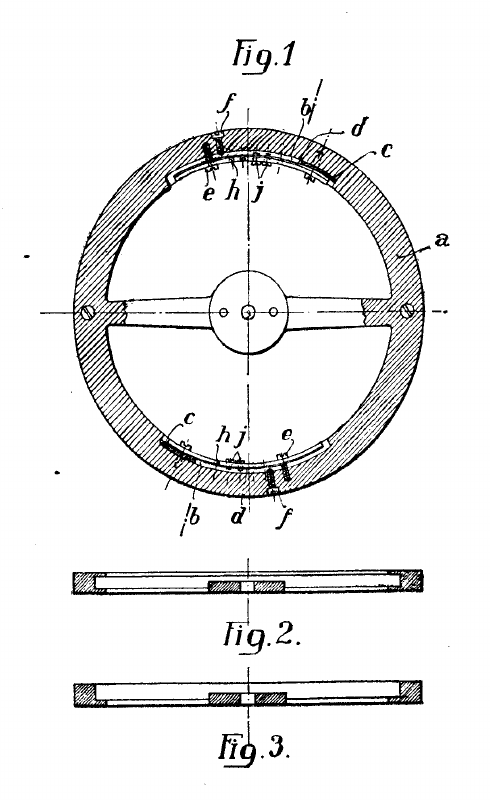
Figure 1. Compensating balance by Paul Ditisheim S.A. Patent Fig. 1 shows bimetallic appendages (d) inside the uncut rim (a). Figs. 2 and 3 below are sections of alternative designs. Applicant, Paul Ditisheim S.A. The margins alone were cropped. Swiss patent CH91169A, 1921 Public domain under Article 5 of Swiss copyright law
Science Museum Group object 1925-193 in London includes a spare chronometer cage supplied by Ditisheim. The museum records a detent escapement and Elinvar balance spring in this cage. The cage in the main instrument has a lever escapement, Guillaume balance and steel spring. The two regulating arrangements can be compared in one collection item. 9
Adjusting the material and extending its use#
Even with the same main elements, details of composition affect a spring’s properties. In experiments published in 1961, Masatoshi Toyama adjusted the carbon content from 0.16% to 0.50% in an iron alloy based on about 36% nickel and 10% chromium and found changes in the temperature coefficients of Young’s modulus and shear modulus. In another experiment, a sample of 36% nickel, 12% chromium and 52% iron had a Curie point of 74 °C and exhibited about a 0.3% change in Young’s modulus in passing through the vicinity of that point. Composition and magnetic state affect the elastic response to temperature. 2 10 12
Hamilton adopted Elinvar for American railroad watches. Its 1931 booklet says that the 992 Elinvar replaced the bimetallic balance and steel spring with a monometallic balance and Elinvar spring. Watch component specialist Bill Thomas reports that Elinvar Extra, an improved material addressing deformation of early springs during servicing, was used in the 992B introduced in 1940. For the marine Hamilton Model 21, the Mariners’ Museum records a special compensation balance and an Elinvar spring in a display panel of parts received from Hamilton. 13 14 17
Reinhard Straumann’s work in the 1930s leading to Nivarox addressed deformation, oxidation and magnetism as well as temperature compensation. A German patent filed in 1931 describes a nickel–iron spring alloy with added beryllium and a hardening treatment. A recent European patent describes a different approach, a silicon spring coated with silicon dioxide. The coating thickness tunes the combined stiffness response to temperature to match expansion of the balance. Both designs address the same problem of pairing spring properties with balance expansion to adjust the rate against temperature. 3 11 15
Chronology#
| Date | Event |
|---|---|
| March 1901 | Publication of Perret’s US patent for a nickel-steel spring. 4 |
| 1912–1913 | Guillaume conceives a ternary alloy and tests two series with different chromium contents. 1 |
| August 1914 | Publication of Guillaume’s US patent for a nickel-steel spring with a high elastic limit. 5 |
| June 1918–September 1919 | Guillaume and FSR file their Swiss patent for a compensating spring, published the following year. 3 6 |
| December 1920 | Guillaume explains the pairing of Elinvar and a monometallic balance in his Nobel lecture. 1 |
| October 1921 | Swiss patent publication for the Ditisheim company’s balance with compensating appendages. 16 |
| June 1923 | US Bureau of Standards reports on alloy composition, elastic behaviour and temperature testing in watches. 2 |
| 1931 | Hamilton introduces the Elinvar railroad 992. Straumann files a German patent for a hardenable nickel–iron alloy spring. 15 17 |
| December 1934 | US patent publication for Ditisheim’s method of making bimetallic compensating appendages. 8 |
| 1940 | Hamilton introduces the 992B with Elinvar Extra. 13 |
| 1959–1961 | Experiments measure elastic behaviour near the magnetic transition and the relationship between carbon addition and the temperature coefficient of modulus. 10 12 |
| February 2019 | European grant publication for a silicon spring compensated with a silicon dioxide coating. 11 |
References#
- Charles-Édouard Guillaume, “Invar and elinvar”, Nobel Lecture, 11 December 1920, especially pp. 469–472. English translation.
- U.S. Bureau of Standards, Invar and Related Nickel Steels, Circular No. 58, 2nd ed., 1923, pp. 69–73, Figs. 46 and 48.
- Johann Boillat, “Des alliances pour des alliages III : le béryllium des spiraux”, Bulletin SSC 88, December 2019, pp. 29–35, Figs. 3 and 4 and notes 23 and 42.
- Paul Perret, US669763A, “Compensation watch balance and hair spring”, published 12 March 1901.
- Charles-Édouard Guillaume, US1106207A, “Balance-spring having elasticity increasing with rise in temperature”, published 4 August 1914. Specification and claims.
- Charles-Édouard Guillaume and Société des Fabriques de Spiraux Réunies, CH82081A, “Spiral compensateur pour chronomètres et montres”, filed 4 June 1918, published 1 September 1919. Facsimile of the Swiss patent.
- Werner Albert Dubois, US1859866A, “Regulating device for clockworks”, published 24 May 1932, Figs. 1–3 and specification.
- Paul Ditisheim, US1982726A, “Process of manufacturing bimetallic appendixes for monometallic balances”, published 4 December 1934. Specification and Figs. 1–6.
- Science Museum Group, “Chronometer movement in brass cage”, accession No. 1925-193, record of the spare cage.
- Masatoshi Toyama, “A property of the temperature coefficient of the modulus of elasticity of Elinvar”, Journal of the Japan Institute of Metals 25(9), 1961, pp. 607–610.
- European Patent Office, EP3056948B1, “Silicon hairspring”, published 20 February 2019, paragraph [0075] onwards.
- K. P. Belov, G. I. Kataev and R. Z. Levitin, “Anomalies in internal friction and modulus of elasticity in ferromagnetics near the Curie point”, Soviet Physics JETP 10(4), 1960, pp. 670–673, Fig. 1a.
- Bill Thomas, “The Hamilton 992B”, Horological Times, October 2012, “In a Material World”.
- The Mariners’ Museum, “Panel of Marine Chronometer Parts”, CL3290, accession No. 1946.0039.000001.
- Reinhard Straumann, DE578390C, “Feder aus Nickeleisenlegierung, insbesondere für thermokompensierte Schwingsysteme”, filed 19 April 1931, published 13 June 1933. Specification and claims.
- Paul Ditisheim S.A., CH91169A, “Balancier”, filed 31 August 1920, published 17 October 1921, pp. 1–2 and plate.
- Hamilton Watch Co., Elinvar in Your Watch, 1931, imprint and pp. 4–5 and 10–12.
Online sources accessed on 20 November 2026.