This article was translated from Japanese using AI. Read the Japanese original
A thin film that keeps oil in place#
Epilame treatment forms a very thin film on a watch component to limit the spread of lubricating oil beyond the intended area. The French word for the treatment is épilamage, while épilame refers to the treatment agent or film. The English term is epilame treatment. It covers surface treatments with a common purpose, limiting oil migration, across different compounds and brands. 12
In a watch, tiny quantities of oil lubricate points of contact. Oil that spreads into a thin film around a contact leaves less where it is needed. If it reaches adjacent parts that need to move freely, it can impede their movement. Epilame uses surface chemistry to keep this small amount of oil where intended. 3 For lubrication more generally, see Watch lubrication and metal surface treatment.
Wetting and contact angle#
Three interfaces determine the shape of an oil drop#
Whether an oil drop placed on a solid spreads out flat or retains its thickness depends on more than the oil’s viscosity. The properties of three interfaces matter, namely solid–gas, solid–oil and oil–gas. The contact angle is the angle between the solid surface and the tangent to the liquid surface at the edge of the drop, measured through the liquid. The smaller the contact angle, the more readily the liquid spreads. 4
Young’s equation describes a liquid in partial wetting equilibrium on an ideally smooth, chemically uniform and non-deformable solid. 4
Here \( \theta \) is the contact angle measured through the liquid, \( \gamma_{SV} \) is the surface free energy of the solid–gas interface, \( \gamma_{SL} \) is the interfacial free energy of the solid–liquid interface, and \( \gamma_{LV} \) is the surface tension at the liquid–gas interface. The subscripts S, L and V denote the solid, liquid and vapour phases. The unit of surface energy, J/m², has the same dimensions as N/m, the unit of surface tension. In practice, mJ/m² and mN/m are used. 4
Epilame primarily changes the solid surface that the oil encounters. The treatment creates a low-surface-energy layer on which the oil spreads less readily. The equation also includes the solid–oil interfacial term, so comparing the oil’s surface tension to the surface energy of the solid alone cannot establish whether the oil will stay in place. 14
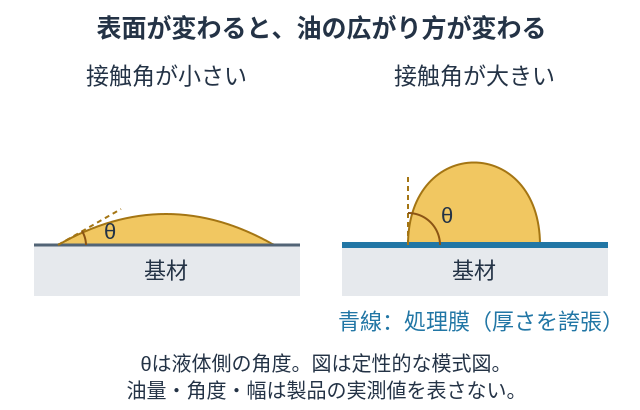
Figure 1. Original schematic illustrating oil wetting and contact angle, drawn by this site’s editorial team. The film thickness is exaggerated. The diagram gives no measurements or performance figures for a particular product, and uses no reproduced or adapted illustrations. Principle explained by Kyowa Interface Science
Contact angles depend on test conditions#
A surface that repels water can give a different contact angle with watch oil. Replacing water with oil changes both the liquid’s surface tension and the interface with the solid. Manufacturers therefore test treated surfaces with watch oil. 45
Actual components can have roughness, plating, oxide films, contamination and uneven treatment. The advancing contact angle as a drop spreads can differ from the receding contact angle as the contact area shrinks. The angle of a stationary drop also differs from the conditions under which an incline or an external force sets it in motion. Contact angle is useful for testing. Oil retention under shock and the watch’s service interval depend on further factors. 4
Lubrication, cleaning and surface treatment#
Lubricating oil controls friction and wear between surfaces moving relative to each other. Cleaning removes old oil and contaminants. Epilame treatment then changes how the cleaned surface wets. The treatment serves a distinct purpose and required lubrication still needs to be applied. 13
The treatment liquid and the film that remains on the part differ in composition. Moebius identifies a fluorinated polyester as the active component in Fixodrop ES and a partially fluorinated solvent as the carrier. After the carrier leaves, a thin layer of the active component remains. The document’s film thickness of roughly 3–5 nm is a guide for this product range. Other epilame treatments can have other thicknesses. 2
Other bonding methods have also been investigated. Rolex patent EP2084252B1 proposes molecules with a catechol group that binds to the substrate and a fluorinated terminal group that provides water and oil repellency. This design gives the part of the molecule that anchors it to the surface a different function from the exposed end. The published patent’s examples describe a technical proposal and tests. Establishing use in a particular production watch would require other evidence. 1
Cleaning and epilame treatment can appear to work at cross purposes. Removing contamination can leave a surface that oil wets more readily, yet a clean surface before treatment is important for forming a uniform film. Manufacturer documentation also notes that cleanliness and dryness strongly affect the film’s behaviour. Oil retention depends both on cleaning and on the design of the surface created afterwards. 15
Where it works in a watch#
Typical applications are the pallet jewels and escape wheel in a Swiss lever escapement, bearing jewels and other parts where small amounts of oil need to remain at the contact. In a 2009 account of workshop practice, Stoeber lists jewels, escape wheels, mainplates, wheels, levers and arbors as examples of parts treated in production and explains that the parts needing retreatment are selected during servicing. 3
The same account cautions against treating an entire assembled mechanism indiscriminately. Repeated treatment of the whole pallet fork had caused film to accumulate at the pivot shoulders and fork slot, affecting amplitude and rate. The observation reflects products and practices of that time. It illustrates the importance of deciding which surfaces of a part to treat, even among parts that come into contact with oil. 3
Materials and resistance to cleaning#
An oil drop beading up immediately after treatment and the retention of that effect after subsequent cleaning are separate performance criteria. Moebius documentation dated 2019 describes different applications within its Fixodrop range. 567
| Product range in the documentation | Active component and carrier | Characteristics and notes for comparison |
|---|---|---|
| ES/WR-S 7060–7062 | Fluorinated polymer and EcoSolv | Aimed at improving cleaning resistance on standard materials such as steel, ruby and copper. Test results are listed by material |
| ES/WR-P 7070–7072 | Fluorinated polymer and EcoSolv | Developed mainly for gold, rhodium plating, nickel and DLC |
| W 8970 and 8971 | Fluorinated polymer and demineralised water | Water-based. Described as forming a film that water- and alcohol-based cleaning can remove |
The WR-S and WR-P documentation compares the contact angle of Moebius 9010 synthetic watch oil after treatment and after three successive cleanings with a Rubisol-type cleaner. A comparison requires the same oil, substrate, cleaner and number of cleaning cycles. “Cleaning resistance” alone gives no assurance of durability with every cleaning fluid or over any number of services. 56
The table gives examples of product designs from published technical documentation. Components of the same base material can present different surfaces to the film if their plating or finish differs. The specifications for the watch model and the specific materials and processes take precedence over general product descriptions. 34
Origins and development#
Epilame grew out of advances in cleaning, oils and surface chemistry. Paul Woog’s treatment with stearic acid is central to its history, but later sources differ on the date. Watchmaker Stoeber dates the invention to 1925, during Woog’s collaboration with Paul Ditisheim, while Rolex’s patent account gives 1930. The original invention records have not been checked for this article, so neither is presented as a definitive date for the first invention. 13
| Period | Developments documented by the sources |
|---|---|
| 1925 or 1930 | A later account of workshop practice and a patent history give different dates for Woog’s stearic-acid treatment. 13 |
| 1970s | The historical account in the Rolex patent places the introduction of products using fluorinated polymers in this decade. 1 |
| 2006–2017 | Patent EP2084252 for a thin film anchored to the surface by catechol groups has a priority date of 1 December 2006. The A1 publication appeared on 5 August 2009 and the B1 on 29 March 2017. These are patent publication dates, distinct from practical implementation. 1 |
| 2019 | Moebius technical documentation describes cleaning-resistant epilames for different substrates and a water-based epilame. 567 |
| End of 2025 | 3M reports that it completed its own exit from PFAS manufacturing. The statement concerns the company’s manufacturing policy. 9 |
Fluorinated materials and recent developments#
Changes in materials can concern either the oil-repellent film or its carrier. The documentation for water-based Fixodrop W specifies demineralised water as the carrier and a fluorinated polymer as the active component. The catechol patent also proposes non-fluorinated solvents while using fluorinated groups in the film-forming molecules. “Water-based” or “non-fluorinated solvent” therefore describes the carrier and gives no assurance of a fluorine-free film. 17
A safety data sheet serves a different purpose from a material specification listing every ingredient. The 2018 safety data sheet for Fixodrop W-10 8971 states that it was not classified under the CLP criteria then in force, while the technical documentation identifies a fluorinated polymer. A hazard classification in an older data sheet cannot establish the absence of PFAS or describe the composition of the current product. 78
PFAS supply is also changing. 3M announced its planned exit from manufacturing in December 2022 and reports completing it at the end of 2025. A single company’s policy cannot establish that watch epilames are going out of production in general or that all regions or products are subject to a ban on their use. 9 In watchmaking, the challenge is to assess the film ingredients and the carrier individually while retaining oil, adhesion to the substrate and resistance to cleaning.
Evaluating a treatment#
Epilame controls how oil wets a surface. Its performance is assessed for each product and substrate. The figures here are examples from the dates of the cited documents. The choice of treatment agent and process for a particular job depends on the part and the manufacturer’s specifications.
References#
[1] Rolex SA, “Ultra-thin water and oil repellent layer, manufacturing method and use in watchmaking as epilame”, EP2084252B1, description, examples and bibliographic information, 2017. https://patents.google.com/patent/EP2084252B1/en (accessed 4 November 2026)
[2] Moebius, “Technical Information FIXODROP ES”, pp. 2–3, dated 12 June 2014 at the end. Manufacturer documentation hosted by H. S. Walsh. https://www.hswalsh.com/usercontent/doc/24261/Information%20Fixodrop%20ES_INT_0.PDF (accessed 4 November 2026)
[3] Bernhard Stoeber, “Epilame and the Modern Watch Service”, Horological Times, April 2009, pp. 12–16 (PDF pp. 14–18). The author worked in technical service at Rolex Watch USA at the time. https://www.awci.com/wp-content/uploads/ht/2009/2009-04-web.pdf (accessed 4 November 2026)
[4] Kyowa Interface Science, “Contact angle and dynamic contact angle”, on Young’s equation, surface condition and static and dynamic measurement, undated. https://www.face-kyowa.co.jp/science/theory/what_contact_angle/ English version at https://www.face-kyowa.co.jp/english/en_science/en_what_contact_angle.html (accessed 4 November 2026)
[5] Moebius, “Technical Data: FIXODROP ES/WR-S 7060-7061-7062”, 12 November 2019, pp. 1–2. Manufacturer documentation hosted by Brütsch/Rüegger. https://static.brw.ch/pdf/123232532.pdf (accessed 4 November 2026)
[6] Moebius, “Technical Data: FIXODROP ES/WR-P 7070-7071-7072”, 12 November 2019, pp. 1–2. Manufacturer documentation hosted by Brütsch/Rüegger. https://static.brw.ch/pdf/123232531.pdf (accessed 4 November 2026)
[7] Moebius, “Technical Data: FIXODROP W 8970-8971”, 12 November 2019. Manufacturer documentation hosted by Horotec. https://horotec.ch/medias/article/documents/698c016a49a1d_TECH_MSA28.8970-8971_EN.pdf (accessed 4 November 2026)
[8] The Swatch Group Research and Development Ltd., Division Moebius, “Safety data sheet: Fixodrop W-10 8971”, version 8, revised 5 December 2018, sections 1–3. Hosted by Brütsch/Rüegger. https://static.brw.ch/pdf/737190.0100_EN.pdf (accessed 4 November 2026)
[9] 3M, “Operations and innovation”, the company’s account of its exit from PFAS manufacturing, undated. https://www.3m.com/3M/en_US/pfas-stewardship/operations-innovation/ (accessed 4 November 2026)