This article was translated from Japanese using AI. Read the Japanese original
What makes a tourbillon “flying”#
A flying tourbillon, or fliegendes Tourbillon in German and tourbillon volant in French, supports its rotating carriage from one side. The carriage is the frame that carries the balance, balance spring and escapement as it turns. A fixed bridge across the visible side can therefore be omitted, making the assembly look as if it floats. 1 2
The cantilevered support is for the complete carriage. The balance oscillating within it still needs a staff and bearings, and some designs retain a balance bridge within the rotating frame. Identifying a flying tourbillon requires checking how the fixed parts of the movement support the carriage. A bridge-like part visible in a photograph can be part of the carriage itself. 2
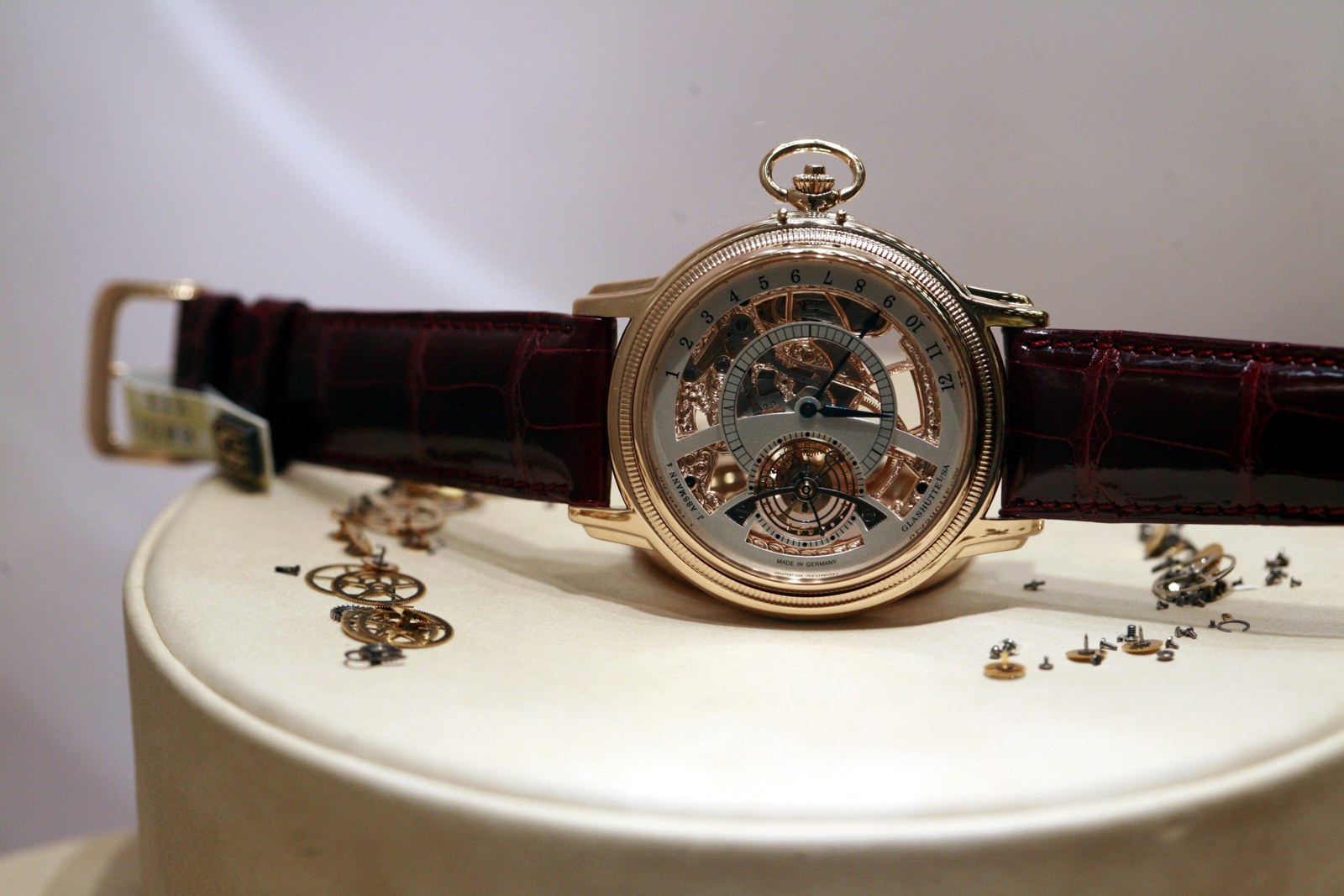
Figure 1. Glashütte Original Julius Assmann 4, a later use of the flying tourbillon. Photograph by Rama, 15 April 2007. Source Glasshuette MG 2614.jpg, Wikimedia Commons. Licence CC BY-SA 2.0 France. Resized and recompressed as a JPEG only. The displayed image carries the same licence.

Why the carriage rotates#
In a mechanical watch the balance oscillates and the escapement lets the train advance in step with that oscillation. The rate of a watch held vertically varies with orientation for reasons including imbalance of the regulating assembly. A conventional tourbillon rotates the regulator and escapement together. It moves them through different orientations to average positional differences over a cycle. 3
That purpose is a separate design question from which side supports the carriage. A flying tourbillon still needs energy to keep the balance oscillating and turn the carriage. Removing the fixed upper bridge alone gives no evidence that all gravity-related errors are eliminated. 2 3
A wristwatch changes orientation as it is worn, whereas a pocket watch can remain nearly vertical for long periods. Technical documentation from Moritz Grossmann describes the modern tourbillon as a challenge for skilled watchmakers. Its construction and its measured accuracy can be assessed separately. 5
Development and Alfred Helwig#
Work at the watchmaking school in Glashütte#
The flying tourbillon is generally associated with the German watchmaker Alfred Helwig (1886–1974). Glashütte Original’s history says Helwig, a teacher at the German Watchmaking School, worked with his students to achieve one-sided support in 1920. The development took place through the school’s teaching and workshop practice. 1
Moritz Grossmann’s 2013 documentation dates Helwig’s teaching at the school to 1913–1954 and mentions a patent application in 1920 and a five-minute tourbillon associated with his master qualification in 1922. It does not give the original 1920 filing number. The account of the application here comes from that later source rather than the original patent publication. 5
Priority for cantilevered supports#
The date 1920 cannot establish the earliest use of every kind of one-sided support for a rotating regulator. The prior-art discussion in WO2001018611A1, published in 2001, identifies a cantilevered arrangement in British patent GB 21,421 from 1892 and a ball-bearing support in CH 353,679 from 1961. It separately cites Helwig’s Drehganguhren, published in 1927, for the flying tourbillon. 2
A cantilevered support is a broader mechanical principle. Helwig’s flying tourbillon and later applications of ball bearings are distinct developments in watchmaking. The earliest working example and the first use of the present name remain open, since the account here does not compare all the surviving objects with the original 1892 patent. 2
Construction and transmission of power#
The carriage and its bearings#
There are three levels to consider, the stationary mainplate and bridges, the rotating carriage and the balance oscillating within it. The stationary assembly supports the carriage from one side. Within the carriage, the balance staff, pallet fork and escape wheel are held in their working positions. The carriage rotates as the parts it carries oscillate or turn relative to it. 2
In the implementation described in WO2001018611A1, pillars connect the carriage base to the balance bridge and a cantilevered ball bearing supports the complete assembly. The escape-wheel pinion meshes with a fixed internally toothed wheel, so rotation of the carriage causes the escape wheel to turn on its own axis. 2
Support and rotation period#
| Feature | What to distinguish |
|---|---|
| Carriage support | Support from both sides or from one side determines whether the design is flying. |
| Balance support within the carriage | The bearings and bridge inside the carriage are separate from the cantilevered support outside it. |
| Rotation period | Periods can be one, three or five minutes, among others. The flying designation leaves the period unspecified. |
| Escapement | A lever escapement is one way of transmitting power, independent of how the carriage is supported. |
| Display | The mechanism can be visible from the dial side or back, or serve another indication. The display is only one feature of the design. |
The 2013 documentation for Moritz Grossmann’s BENU Tourbillon, for example, describes a 16 mm carriage making one revolution in three minutes. It draws on Helwig’s tradition and combines its own rotation period with a V-shaped balance bridge and a stop mechanism. 5
Materials, manufacture and adjustment#
Support and inertia#
One-sided support makes the location of the bearing and the mass distribution of the rotating parts design considerations. WO2001018611A1 places the ball bearing near the rotating assembly’s centre of mass to reduce its sensitivity to shocks. It also proposes assembling the mechanism as an independent ball-bearing module that can be removed from the movement for adjustment. That proposal documents a design. Evidence of use in a specific retail watch would have to come from the watch or its documentation. 2
The BENU documentation explains that a three-minute carriage reduces its kinetic energy and the load on the escapement. It also specifies materials for particular parts, including German silver bridges and ARCAP alloy for the train. The materials describe this product’s construction. 5
A lighter frame and greater rigidity are only part of the design. The mechanism requires considering deformation, arbor positions, rotational balance and required power together. The public documentation provides no standardised figures for wear life or friction losses across all designs. Lubrication intervals and shock performance depend on the individual implementation.
Stopping and setting the time#
Carriage pillars complicate bringing a brake to the balance to stop it. The BENU documentation describes a brush with flexible bristles that can avoid the pillars and stop the balance at its rim. This separate mechanism provides the stop function. 5
Glashütte Original’s Senator Chronometer Tourbillon is a modern example pairing a flying tourbillon with a stop, zero reset and minute setting. Using the crown stops the mechanism and then returns the carriage to zero for setting the time. In the current calibre 58-06, zero reset is synchronised with movement of the minute hand to the minute marker. These functions add a setting mechanism to the one-sided carriage support. 1 4
Effects on accuracy and limits#
The flying design improves visibility of the mechanism. The rate of the finished watch also depends on the balance poise, balance spring, condition of the escapement, power supply, position and temperature. Rate testing provides evidence of performance. 3 5
The Senator Chronometer Tourbillon specifications list tests over 15 days, in five positions and at three temperatures, and specify a silicon balance spring. These details document the tests and material selected for this finished watch. 4
Showing the moving parts and making them accessible for disassembly and adjustment pose separate design problems. The module patent discussed above aims to simplify adjustment and replacement, while surviving watches have different constructions. Servicing details depend on the drawings and service documentation for the individual movement. 2
Timeline#
| Year | Development |
|---|---|
| 1801 | Breguet’s tourbillon patent. The aim of addressing rate differences in vertical positions forms part of the background. |
| 1920 | Helwig and his students develop a one-sided support according to Glashütte Original’s history. |
| 1922 | Later Moritz Grossmann documentation connects Helwig’s five-minute tourbillon with his master qualification. |
| 1927 | Helwig publishes Drehganguhren, later cited as a source on the flying tourbillon in a patent. |
| 1999–2001 | WO2001018611A1 has a priority date of 2 September 1999, is filed on 31 August 2000 and published on 15 March 2001. It proposes a ball-bearing and separate module. |
| 2007 | The photograph in Fig. 1 shows the Julius Assmann 4. The date is that of the photograph. |
| November 2013 | Moritz Grossmann publishes documentation on the BENU Tourbillon explaining the three-minute cycle and stop mechanism. |
| 2020s–October 2026 | Glashütte Original documentation shows modern examples with stop and zero-reset functions, among others. |
The timeline draws on a museum’s account of the principle, manufacturers’ historical and technical documentation, patent records and a photograph. The dates record different events, including development, filing, publication and photography. 1–5
References#
- Glashütte Original, “180 Jahre Glashütter Uhrmacherkunst”, “1920” and the Flyback Tourbillon account, 2025 anniversary materials. Accessed 22 October 2026.
2. Elmar Mock, Begona Guerry and Elio Mariotto, WO2001018611A1, Indicateur de temps à régulation mécanique, priority 2 September 1999, filed 31 August 2000, published 15 March 2001. Prior art, implementation and explanation of figs. 2–6. French text accessed 22 October 2026.
3. Deutsches Uhrenmuseum Glashütte, “Silver men’s pocket watch with tourbillon”, entry for a 1939 A. Lange & Söhne watch, used for the general purpose of a tourbillon. Accessed 22 October 2026.
4. Glashütte Original, “Senator Chronometer Tourbillon 1-58-06-01-03-61”, current technical information in English, test conditions and functions. Accessed 22 October 2026.
5. Grossmann Uhren GmbH, Moritz Grossmann presents the first manufacture calibre with a tourbillon – the third-generation BENU, November 2013, especially pp. 2–4. Accessed 22 October 2026.