This article was translated from Japanese using AI. Read the Japanese original
The Greenwich Time Service used astronomical observations at the Royal Observatory to determine the time, adjust clocks and distribute the time to ships, watchmakers and railways, among others. Time balls, hand-carried chronometers, telegraphy and radio broadcasts carried it over different distances. 1 2
Visible signals and hand-carried clocks#
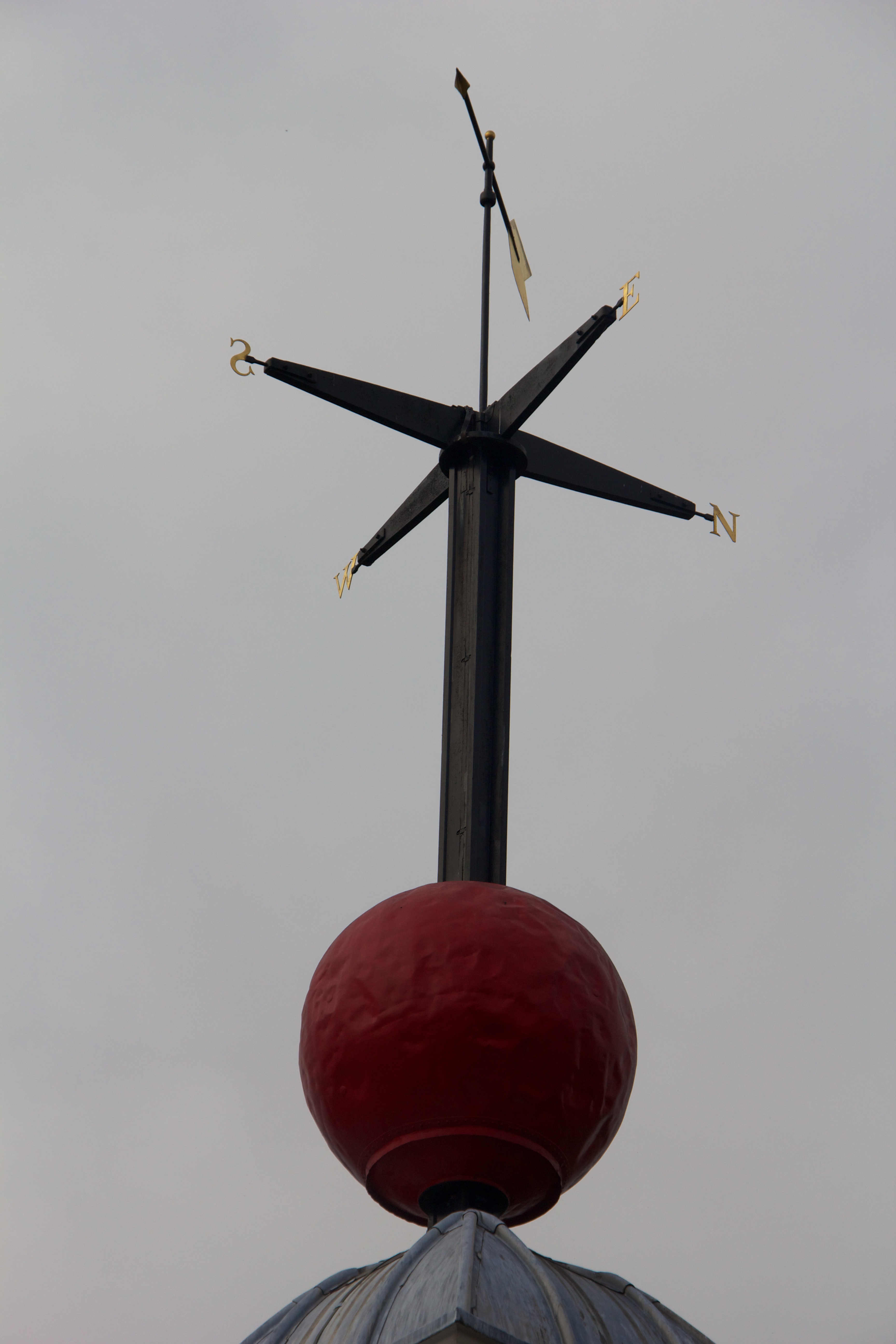
The time ball at the Royal Observatory, Greenwich. Photograph by Mike Peel (www.mikepeel.net). Source: Wikimedia Commons, CC BY-SA 4.0. Reproduced unchanged.

Ships needed to compare their marine chronometers with reference time in port to determine their error. The time ball installed on the Greenwich Observatory building in 1833 marked 1 p.m. by dropping, signalling the time to ships on the Thames and other observers. It was useful only to those watching at the moment of the drop, and visibility and weather affected the signal. 2 3
People who could not see the time ball had another option. John Henry Belville, an observatory assistant, carried a portable chronometer set at the observatory to watchmakers and other clients in London, charging for a service that let them compare it with their own clocks. Demand continued after telegraphic time signals began. After his death his wife Maria took over, followed by his daughter Ruth. The portable chronometer was repeatedly compared against the reference to establish its own gain or loss. 2 4
From astronomical observations to a standard clock#
The observatory used a transit instrument to observe the moment a star crossed the meridian and determine the error of a transit clock that showed sidereal time. Its readings were then compared with those of the standard clock, which kept mean solar time, to calculate the standard clock’s error. Sidereal time is based on the apparent motion of the stars, while mean solar time, used in daily life, follows an average of the Sun’s motion. They run at different rates. 5
The electric master clock made by Charles Shepherd and introduced in 1852 had a pendulum and used electric current to operate secondary clocks and time-signal equipment inside and outside the observatory. In a later arrangement, an assistant compared clocks in the computing room and used a switch to speed up or slow down the master clock’s pendulum temporarily, correcting the displayed time. The secondary clocks followed a common master clock. Observations, comparisons and corrections established the time that was distributed. 1 5
Distributing time by telegraph#
Astronomer Royal George Biddell Airy worked with Charles V. Walker, the South Eastern Railway’s telegraph engineer, and the telegraph companies to connect the observatory to the wires towards London Bridge. The annual report of 1853 records the use of the dial at the observatory gate, clocks in the building, a secondary clock at a railway station and a signal to London. The Greenwich and Strand time balls were also dropped electrically. A return signal confirmed that the Strand time ball had operated. 1
An electromagnet in a relay responded to the signal from the master clock’s contacts, closing a separate circuit to send current outside. This allowed one clock to send signals over several lines. The hourly signal relay installed in 1861–62 separated the external connections from the observatory’s internal and time-ball circuits and could connect as many as six external circuits. The 1862 record describes three connections, to the Electric Telegraph Company, the South Eastern Railway and the London District Telegraph Company. Use of all six remains unconfirmed. 5 6
The 1862 account says the South Eastern Railway circuit also connected to the time ball at Deal. In later years, watchmakers also used the hourly signal sent to the London District Telegraph Company. 7 Return signals from time balls and controlled clocks confirmed that the receiving equipment had operated. Damage to a wire, for example, could interrupt distribution even when the reference clock was correct. 5 7
The Post Office network and broadcasting#
Distribution by telegraph extended beyond the observatory. In 1876, Nature described how a switching and relay device called the chronopher at the Post Office Central Office took the signal from Greenwich and relayed it over several lines. The London circuits and provincial lines of varying lengths were divided into four groups, each with its own batteries and relays. A weak incoming signal operated separate power supplies, distributing the signal to several lines at once. 8
In the twentieth century, distribution extended to wireless. The BBC’s six pips began on 5 February 1924, with the final pip marking the hour or another designated time. A wireless time signal for navigation began in 1927. It sent 61 signals per minute. Users determined the error of their chronometers by observing where the signals coincided with the beats. A speaking clock by telephone was introduced in 1936. Research on more accurate standard clocks continued, and in 1939 the observatory installed a quartz clock to compare its performance with that of pendulum clocks. 9
As the means of receiving time signals changed, the work still involved establishing a reference, checking its error, sending a signal and using it to compare clocks at the receiving end. A time ball served only those who could see it, and telegraphy relied on lines and repeaters. Broadcasting reached many people at once, who needed to know which instant marked the reference time.
Timeline#
| Year | Event |
|---|---|
| 1833 | The Greenwich time ball is installed. 3 |
| 1836 | Belville begins distributing time using a portable chronometer. 2 |
| 1852–1853 | The Shepherd master and secondary clocks, time balls, and railway and telegraph connections come into operation. 1 5 |
| 1861–1862 | A relay is installed to distribute hourly signals outside the observatory. 5 6 |
| 1870s | Distribution expands over the Post Office telegraph network. 8 9 |
| 1924 | The BBC’s six-pip signal begins. 9 |
| 1927 | Wireless time signals for navigation begin via the Rugby transmitting station. 9 |
| 1936–1939 | The telephone speaking clock begins, and a quartz clock is installed at the observatory. 9 |
References#
1. George B. Airy, annual report of the observatory, 4 June 1853, transcript including section XIII, Royal Observatory Greenwich, accessed 2 November 2026.
2. Graham Dolan, The Greenwich Time Service, accessed 2 November 2026.
3. Royal Museums Greenwich, The Greenwich Time Ball and one time for all, accessed 2 November 2026.
4. Graham Dolan, Distribution of time by the Belvilles, accessed 2 November 2026.
5. Science Museum Group Journal, Revealing observatory networks through object stories: Instrumental networks, 2023, accessed 2 November 2026.
6. Royal Museums Greenwich, Time signal relay, collection record, accessed 2 November 2026.
7. George B. Airy, transcripts of observatory annual reports documenting signals and returns in the 1860s, Royal Observatory Greenwich, accessed 2 November 2026.
8. “The Greenwich Time Signal System,” Nature 14, 110–113, 1876, public preview accessed 2 November 2026.
9. Royal Greenwich Observatory, A brief history of the Time Department from 1923 to 1948, transcribed from an annual report, accessed 2 November 2026.