This article was translated from Japanese using AI. Read the Japanese original
Suspend a horizontal disk from three threads and turn it slightly around a vertical axis: the threads tilt and lift the disk. Release it, and the disk descends under gravity while turning in the opposite direction, passes its lowest point, and rises again. In December 1683, Christiaan Huygens sought to use this back-and-forth rotation to regulate a marine clock. In his manuscript he called it a pendulum cylindricum trichordon, or cylindrical pendulum with three cords. 1 2
A restoring force to replace the balance spring#
A marine clock carries the time of a reference place aboard ship. A one-hour difference from local time corresponds to 15 degrees of longitude. If the clock’s rate changes, the error in the longitude estimate accumulates; if it stops in rough weather, the continuity of the reference time is lost. In December 1682, the Amsterdam chamber of the Dutch East India Company (VOC) asked Huygens to investigate a longitude clock. In a letter to Bernardus Fullenius dated 12 December the following year, he said he aimed for a clock with the steady rate of a three-foot pendulum clock that could also withstand the motion of the sea. 2 3
The balance spring Huygens had applied to clocks in 1675 elastically returned the balance to its original angle. A manuscript dated 4 December 1683 records that he had noticed clocks with balance springs gaining in cold weather; this observation prompted the trifilar idea. In the trifilar arrangement, gravity supplies the restoring action that turns the disk back. The driving power of the clock and the force that returns the disk and sets its oscillation period are separate functions. 1 3
Three threads turn rotation into vertical motion#
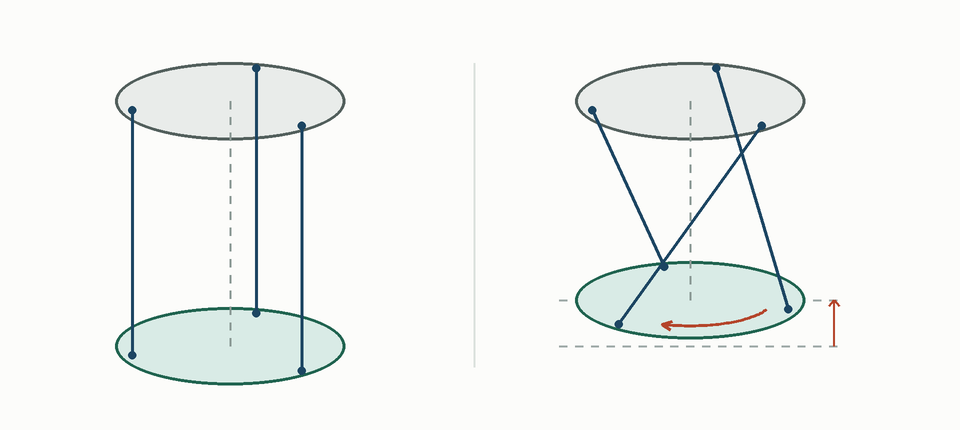
Figure 1. Diagram of the fixed upper support and suspended disk. On the right, the disk has turned, the three threads tilt, and the disk rises. Drawn for this article from figures 22–23 in Huygens’s manuscript and a modern geometric model. 1 7
A horizontal disk hangs directly below a fixed support. The threads have equal lengths, and their attachment points at both ends are evenly spaced on circles of the same radius. When the disk is at rest, the threads are vertical; in a symmetrical arrangement each carries one third of the weight. Turning the disk shifts the lower ends sideways and shortens the vertical component of the threads. The horizontal components of their tension turn the disk back towards its original position. Its rotational speed is greatest at the lowest point, and its inertia carries it past that point to the other side. 1 7
In an ordinary pendulum clock, a bob swings in a vertical plane. In this oscillator, the disk turns alternately around a vertical axis. Huygens separately tested a triangular pendulum, in which threads slanting from two supports suspended a weight and constrained its plane of swing. In his June 1684 trifilar proposal, he suggested attaching long threads to the outer edge of a ring and passing the ring’s spindle through a hole in the fixed part to accommodate a ship’s motion. The manuscript gives example thread lengths of 9½ or 38 inches. 1 6
Why does the period stay regular?#
Small angles produce simple harmonic motion#
Let the thread length be \( L \), the attachment radius \( r \), and the disk’s rotation angle \( \theta \). The horizontal distance between the ends of a thread is the absolute value of the chord length \( 2r\sin(\theta/2) \). Assuming inextensible threads and symmetrical rotation that keeps the disk horizontal, the rise from the lowest point is given by the following expression. 7
The right-hand expression is an approximation for small angles measured in radians. For mass \( m \) and gravitational acceleration \( g \), the gravitational potential energy \( mgh \) is approximately proportional to the square of the angle. Differentiating with respect to angle and reversing the sign gives a restoring torque close to \( -mgr^2\theta/L \). For moment of inertia \( I \) about the vertical axis, a model that omits thread mass and stiffness, resistance, and the escapement’s action gives the following period for one complete oscillation. 1 7
With length in metres, mass in kilograms, moment of inertia in kilogram square metres, and gravitational acceleration in metres per second squared, the period is in seconds. For the same disk, quadrupling the thread length doubles the period; doubling only the attachment radius halves it. Moving a small weight on the ring towards the centre reduces the moment of inertia, a measure of resistance to rotation, and shortens the period. Huygens’s manuscript describes the direction of these adjustments in concrete terms. 1 7 8
The manuscript’s parabola and sine curve#
Huygens studied the spatial curve traced by the lower end of a thread attached to the disk by unrolling the cylindrical surface onto a plane. He reasoned that if height followed a parabola with respect to distance around the circumference, the restoring action could be made proportional to displacement. In an example where the thread length equalled the disk’s diameter, the manuscript of 7 December calls the actual developed curve a linea sinuum. In the coordinates of the edited text, with diameter \( D \) and circumferential distance \( x \), the curve is expressed as \( D\cos(x/D) \). 1 4
The manuscript compares the curves at one eighth of the circumference, corresponding to a rotation of 45 degrees. At this point, the height difference between the sine curve and a parabola tangent near its vertex is less than one thousandth of the diameter. This is a geometric comparison of the path; the rate aboard ship would have to be measured separately. At large swings, the relation between height and angle departs from the quadratic approximation, and the vertical motion of the disk also contributes kinetic energy that affects the period. 1 4 7
Van Ceulen’s two clocks and the sea trial#
According to Huygens’s notes, on 17 December 1683 he brought his model to the clockmaker Johannes van Ceulen and asked him to convert two clocks ordered for the VOC to this system. In a report read at a VOC meeting on 28 February 1684, Huygens said the difference between the two clocks’ daily rates had been between one and two seconds. Minutes of 27 July that year record Johannes Hudde reporting that they had not reached the target difference of less than one second a day. These figures refer to the difference between the two clocks. The February minutes do not state which regulating systems the clocks used. The collected-works commentary says they were converted around the end of 1683, but a note attached to the February minutes estimates that they had not yet been converted at that point. 1 3 9
In August 1685, the VOC decided to provide a galiot for sea trials. Huygens tested the clocks on the Zuiderzee in September and wrote to his brother on 3 October that in rough weather one had stopped several times while the other kept running. At the VOC meeting of 17 September, Hudde had reported that further trials were needed. By comparing the minutes with Huygens’s letter, the editors of his collected works treat this trial as an attempt to use the trifilar system. The surviving records do not establish the details of van Ceulen’s clock construction; the editors consider it likely that the train used an auxiliary spring in a remontoire arrangement. 1 3 5 6
Huygens’s marine operating instructions from late 1685 called for two clocks of a different design, fitted with triangular pendulums. The trifilar experiment began with concern about the temperature-related rate changes of the balance spring, then moved through a model, clock conversions, comparison of two clocks and a sea trial. Choosing a different restoring principle still left the problem of keeping a clock running amid the ship’s motion. 1 3 6
The modern trifilar pendulum#
The same principle, in which rotation raises the centre of mass, is now used to measure moment of inertia. An object is placed on a platform of known dimensions and mass, and the periods are measured with and without it. Subtracting the moment of inertia of the platform alone from the combined value gives the object’s contribution. In a 2024 study, Martin Meywerk and Tobias Hellberg used three steel wire ropes about 11 metres long and examined the effects of vertical motion at large amplitudes as well as the ropes’ extension and bending stiffness. Huygens adjusted shape and weights to tune the period; modern experiments use the period to determine the moment of inertia about the vertical axis. 7
Chronology#
| Date | Event |
|---|---|
| 1673 | Huygens publishes Horologium Oscillatorium, discussing the isochronism of the pendulum and compound pendulums. 3 |
| January 1675 | Huygens applies the balance spring to regulate a balance. 3 |
| December 1682 | The Amsterdam chamber of the VOC commissions research into a longitude clock. 3 |
| December 1683 | He records the trifilar idea on the 4th and analyses its path on the 7th. On the 12th he tells Fullenius about the longitude-clock research, and on the 17th shows his model to van Ceulen. 1 2 |
| February–July 1684 | In February he reports the daily rate difference between two clocks. In June he records a proposal for long threads and a spindle; in July Hudde reports progress to the VOC. 1 3 |
| August–December 1685 | The VOC provides a ship for trials, and Huygens tests the clocks on the Zuiderzee in September. At year’s end he prepares operating instructions for the triangular-pendulum design. 1 5 6 |
| 2024 | An experimental study of moment-of-inertia measurement with a trifilar pendulum examines large amplitudes and thread properties. 7 |
Related articles#
References#
- Christiaan Huygens, “L’application de décembre 1683 des vibrations de torsion aux horloges marines (pendulum cylindricum trichordon),” Œuvres complètes, vol. 18, 1934, pp. 527–535. Manuscript F, §§1–6, figs. 22–29, and VOC minutes. Accessed 24 November 2026.
- Christiaan Huygens, “À B. Fullenius, 12 décembre 1683,” Œuvres complètes, vol. 8, 1899, letter 2327, pp. 474–478, especially p. 475 and note 3. Accessed 24 November 2026.
- J. A. Vollgraff, ed., “Application pratique aux horloges de différents mouvements vibratoires plus ou moins isochrones,” Œuvres complètes, vol. 18, 1934, pp. 501–503, 508–514. Accessed 24 November 2026.
- Christiaan Huygens / J. A. Vollgraff, ed., “À propos du ‘Pendulum cylindricum trichordon’ (Sinusoïde et parabole, courbes osculatrices),” Œuvres complètes, vol. 20, 1940, pp. 453–454. Accessed 24 November 2026.
- Christiaan Huygens, “À Constantyn Huygens, frère, 3 octobre 1685,” Œuvres complètes, vol. 9, 1901, letter 2401, pp. 30–32. Accessed 24 November 2026.
- Christiaan Huygens / Amsterdam chamber of the VOC, “L’application du pendule triangulaire, datant déjà de 1671, à une horloge marine construite vers 1685,” Œuvres complètes, vol. 18, 1934, pp. 539–545, VOC minutes and marine instructions. Accessed 24 November 2026.
- Martin Meywerk and Tobias Hellberg, “Numerical and Experimental Considerations of Non-linearities for a Trifilar Pendulum,” Technische Mechanik 44(2), 2024, pp. 110–121, especially §§2–4 and fig. 3. Accessed 24 November 2026.
- J. A. Vollgraff, ed., “Additions et corrections,” Œuvres complètes, vol. 20, 1940, p. 621, correction to vol. 18, p. 532, note 3. Accessed 24 November 2026.
- VOC Amsterdam, minutes of 28 February 1684, Œuvres complètes, vol. 18, 1934, p. 526 and note 1. Minutes. Accessed 24 November 2026.