This article was translated from Japanese using AI. Read the Japanese original
Overview#
The Innate escapement was designed by watch engineer Mathieu Cleguer and adopted in calibre I1, which powers independent brand CLEGUER Horology’s first wristwatch, the Inspiration One Souscription. In its official announcement of 1 April 2026, the company describes a self-starting mechanism that combines the natural escapement’s two-wheel layout with Charles Fasoldt’s principle of transmitting tangential impulse through a lever. 1 2
The wheel count alone tells only part of the story. The two escape wheels act on locking and impulse jewels on the central lever, which conveys energy to the balance through its fork. In the natural escapement, the escape wheels deliver impulse directly to jewels on the balance side. Specialist publications classify the Innate as a two-wheel escapement with indirect tangential impulse. 3 4
The maker’s description of a “friction-free escapement” refers to reducing sliding at the impulse surfaces. The mechanism is also designed to start the balance when a stopped watch is wound and to keep the escapement safely locked during free oscillation. Losses elsewhere in the watch remain possible. 1 5
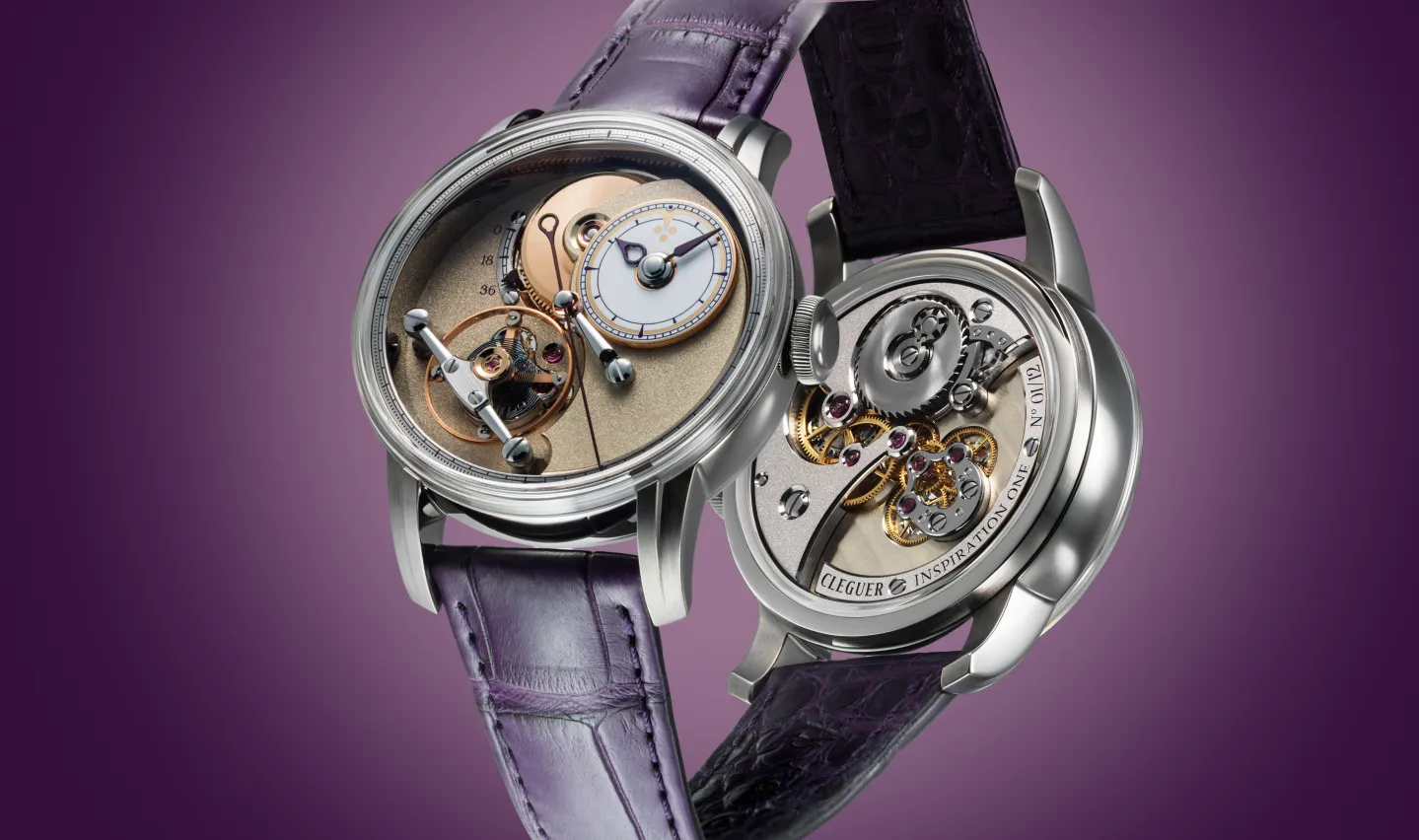 Image: CLEGUER Horology. The official Press page permits editorial use of product photographs with credit to the brand. 6
Name and precedents#
Innate as a proprietary name#
Innate names a particular CLEGUER escapement. The name applies specifically to this mechanism and is distinct from generic watch escapements, inertia escapements and natural escapements. The official product page takes the natural escapement’s difficulty with self-starting as its point of departure and describes an arrangement with locking and impulse pallets on a central lever. Self-starting means that the balance begins to move once winding restores torque to the train. Rate accuracy in motion and shock resistance are separate performance questions. 1
Breguet’s natural escapement#
Breguet’s natural escapement delivers direct tangential impulse from an escape wheel on each swing of the balance. Tangential impulse applies force at the point of contact in the direction that advances the rotation of the balance. A lever can serve to lock and unlock the escapement independently of how impulse is transmitted. Breguet’s French-language patent EP4053643B1 identifies direct transmission, impulse in both directions and freedom of the balance through most of its oscillation as advantages. It also notes gear backlash, instability in the position of the last escape wheel, and difficulty accessing and adjusting components. The 2023 patent for a refinement explains the historical mechanism and concerns an invention separate from the Innate. 7
One specific precedent is pocket watch No. 1135. According to Christie’s catalogue, the Duke of Infantado ordered it on 23 March 1802. Escapement maker Charles Bernaudat delivered the first escapement in March 1803 and made changes in 1804 and 1805. The watch was delivered in January 1806. The first escape wheel, in brass, drives the second, in steel, and a pivoted detent between the wheels locks them alternately. The order and completion dates record different stages of the first application. 8
What the Innate borrows from Fasoldt#
Fasoldt’s US patent No. 22,791, dated 1 February 1859, describes a straight lever and a hook pivoted on the same centre. The escape wheel moves the lever once the balance unlocks it. The three balances shown in the drawing represent different operating positions of the same balance. 9
Patent No. 46,652, dated 7 March 1865, improves on this design. Two escape wheels of different sizes share an arbor. The smaller wheel delivers impulse to the end of the lever, and the pallet locks the larger wheel. The specification explains that impulse is delivered on one swing, while the balance completes the other under its inertia and the action of the hairspring. Fasoldt uses the pallet for locking and claims that the mechanism requires no oil. The statements about long-term accuracy and shocks are the inventor’s patent claims and lack independent measurements in this source. 10
Fasoldt’s two coaxial wheels differ from the Innate’s two counter-rotating wheels on opposite sides, and the designs deliver a different number of impulses. CLEGUER identifies the idea it adopted as that of transmitting tangential impulse through a lever. Fasoldt’s drawings and claims describe his own mechanisms. They establish neither the dimensions and tooth profiles nor the scope of any claims for the Innate. 2 10
Mechanism and operating cycle#
Components and transmission of power#
The official description and illustration show two escape wheels and a central lever carrying the locking and impulse jewels. In Monochrome’s technical account, the departure from the natural escapement is to move two impulse jewels from the balance roller side to the central lever. Impulse then passes through contact between the fork and the roller jewel. The roller jewel itself stays in place and continues to enter and leave the fork. 1 3
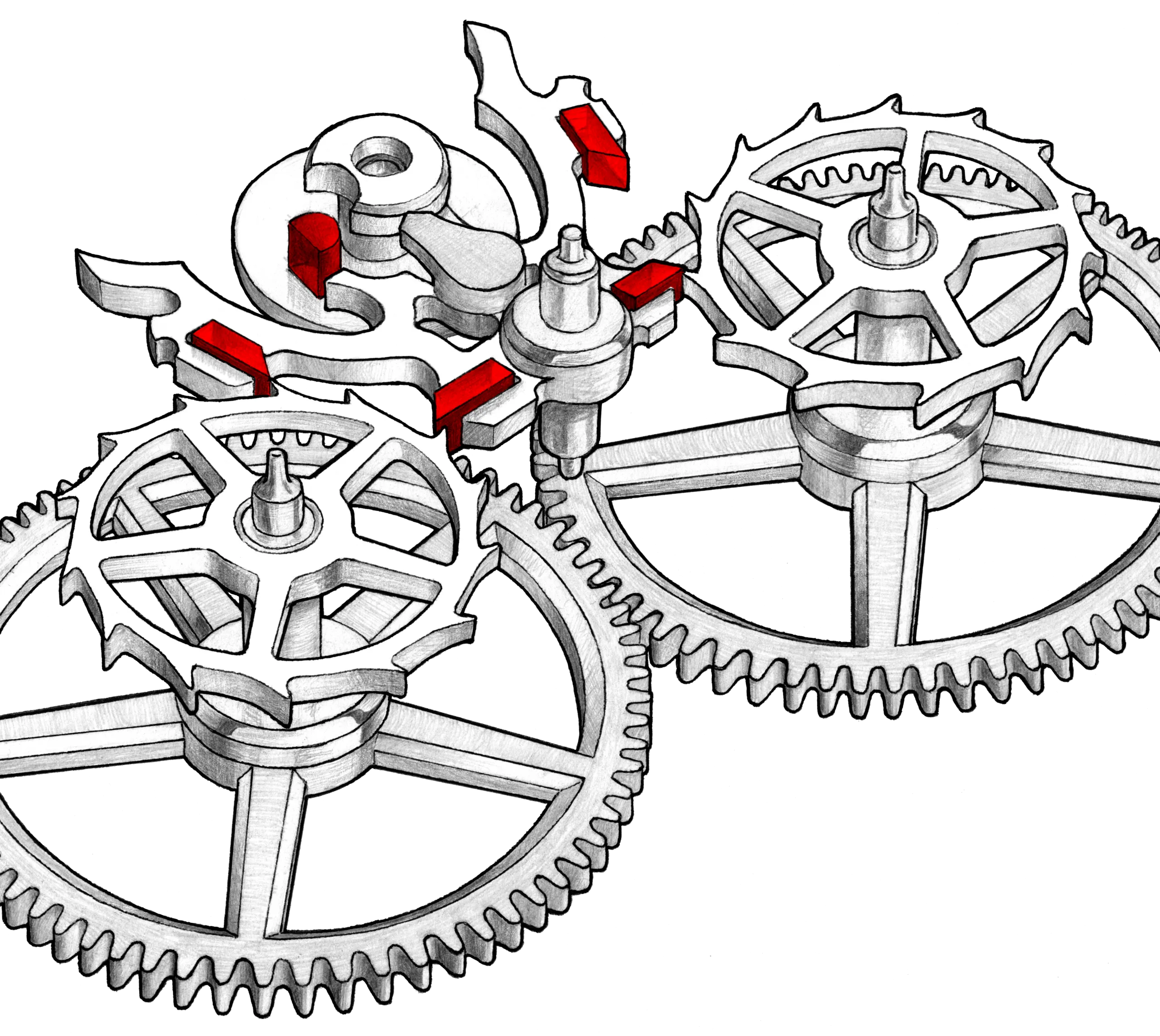 Image: CLEGUER Horology. Official diagram showing the layout of the central lever and the two escape wheels. It provides no machining dimensions or tooth profiles. 1
Revolution explains that power passes from the end of the train through an intermediate wheel to two meshing drive gears, each carrying an escape wheel. The path is mainspring → train → two-wheel drive → escape wheel → impulse jewel on the lever → fork → roller jewel → balance. The two wheels are coupled through a single drive, in contrast to designs with a separate train for each escape wheel. 5
One cycle of operation#
The operating sequence consists of locking, unlocking by the balance, impulse from the train and the next locking event. This functional sequence follows the specialist accounts and leaves unpublished component angles unspecified. 3 5
| Stage | Contact and movement | Effect on the balance |
|---|---|---|
| 1. Locking and free swing | A tooth of one escape wheel rests against a locking jewel, holding the lever against its banking. The roller jewel is outside the fork | The balance continues on the energy of the preceding impulse and reverses under the action of the hairspring |
| 2. Return and unlocking | The roller jewel enters the fork and moves the lever to draw the locking jewel clear of the tooth | The balance supplies the work needed to unlock the wheel |
| 3. Impulse | A tooth of the released escape wheel pushes its corresponding impulse jewel | The lever and fork replenish the balance’s energy on its return swing |
| 4. Next lock | After impulse, the opposite escape wheel locks against the other locking jewel and the lever moves to the opposite banking | The roller jewel leaves the fork and the balance resumes its free swing |
| 5. Swing in the opposite direction | The same sequence takes place with the two sides exchanging roles | There are two impulses per complete oscillation |
The wheel that unlocks then delivers impulse, and the opposite wheel locks next. In two-wheel designs where one wheel unlocks and the other immediately delivers impulse, the contacts follow a different sequence. The direction of transmission reverses between unlocking, when the roller jewel moves the fork, and impulse, when the escape wheel accelerates the balance through the fork. 5
Revolution also describes a guard pin and safety notch that protect the action of the escapement. They prevent unintended lever movement during the free swing and let the escapement unlock only when the roller jewel enters the fork at the correct phase. A wristwatch needs to retain its lock under disturbance as well as to start by itself. Published material gives no shock-test conditions or results. 5
Self-starting and lift angle#
When the balance stops, it returns to the equilibrium position of the hairspring. According to Revolution, the geometry of the Innate allows an escape-wheel tooth to act on an impulse jewel in this position. Once winding restores torque to the train, the lever pushes the balance, initiating oscillation. 5
The same publication gives a balance lift angle of 36°, comprising about 14° of impulse on either side of centre and a further 4° of locking travel on each side. Adding 14° and 4° for both sides gives 36°. The lift angle describes engagement with the escapement. The balance’s total amplitude also encompasses its free swing. The figure comes from the publication’s technical explanation. The manufacturer’s public specifications provide no separate measurement certificate for it. 5
Friction, materials and performance limits#
Tangential impulse and remaining losses#
SJX describes the Innate as having steel chronometer-type escape wheels and ruby impulse and locking jewels. It uses conventional materials, manufacturing methods and finishes in contrast to two-wheel designs with silicon components. 4
Revolution reports that impulse takes place without sliding friction, with slight sliding when the locking jewel is drawn away from the tooth. The official claim “Friction free” concerns impulse and cannot establish an absence of friction at locking surfaces, bearings or gear meshes. 1 5
Coupling two wheels through gears leaves several factors to assess, including the inertia of the wheels and lever, backlash, locking depth and jewel alignment. Manufacturing and adjustment also need enough precision to synchronise the wheels and bring the tooth into contact with the intended jewel immediately after unlocking. Breguet’s improvement patent likewise treats access to the locking jewels and adjustment of locking depth as design problems. 7
The public descriptions give no definitive lubricant type or quantity, surface treatment, hardness, tolerance or wear-test results for the impulse and locking surfaces. Reducing friction, Fasoldt’s idea of operating without oil, and doing without lubrication throughout I1 are three distinct claims. A similar oil-free mechanism offers insufficient evidence to establish the Innate’s lubrication requirements. 1 2 10
Oscillator and energy#
I1 has a 12.9 mm balance running at 18,000 beats per hour. The hourly beat count measures half-oscillations, so the frequency of complete oscillations is 18,000 ÷ 3,600 ÷ 2 = 2.5 Hz, with a period of 0.4 seconds. With one impulse in each direction, the published frequency implies 432,000 impulses per day. 1 3
Approximating the balance and hairspring as a linear torsional oscillator gives the following relationship for the angular frequency of free oscillation. It restates the general period equation for a torsional oscillator in terms of frequency. 15
\[ \omega_0=\sqrt{k/I},\qquad f_0=\frac{1}{2\pi}\sqrt{k/I} \]Here I is the balance’s moment of inertia [kg m²], k is the torsional stiffness of the hairspring [N m/rad] and f₀ is the frequency [Hz]. Greater inertia reduces the change in angular velocity produced by the same angular impulse. Maintaining the same frequency calls for matching that inertia to the stiffness of the hairspring. This engineering approximation provides no quantitative prediction of the Innate’s accuracy. The equation describes a linear torsional model. For a real escapement, the motion must be treated in stages that include contacts and impacts, as in the state-transition approach used in original research on the Swiss lever. 11
Under the same linear approximation, the oscillator’s energy is the sum of rotational kinetic energy and the spring’s potential energy. The latter is obtained by integrating the restoring torque, which is proportional to the angular displacement. 15
\[ E=\frac12I\dot{\theta}^{2}+\frac12k\theta^2 \]Here θ is the angular displacement of the balance [rad], dθ/dt its angular velocity [rad/s] and E the energy [J]. In steady oscillation, the work supplied in each cycle balances losses from friction, air resistance, unlocking and other sources. Tangential impulse alone cannot determine overall efficiency, which also involves the inertia of both wheels and locking losses. Ou and Wu’s 2025 study examines the Swiss lever. Its dimensions, torque and power figures relate to an energy-harvesting model and cannot be applied to the Innate wristwatch escapement. 11
SJX and Monochrome describe a free-sprung balance with no regulator and an overcoil hairspring. Monochrome also identifies four gold adjustment screws, a Phillips outer terminal curve and a Grossmann inner terminal curve. Escapement design and oscillator adjustment interact, with each carried out on different components. Hairspring breathing, position, temperature and driving torque all need separate consideration when evaluating daily rate. 3 4
Stopwork and the 36-hour power reserve#
I1 uses Maltese-cross stopwork to limit the mainspring’s operating range, giving a power reserve of 36 hours. The official press release says the intention is to stabilise the rate by limiting variations in driving torque. Monochrome gives an unrestricted reserve of about 55 hours, of which the design uses 36 hours. The figure of 55 hours comes from the publication rather than the official specifications. 2 3
The stopwork excludes the ends of the spring’s range at full wind and near complete unwinding. A remontoire instead periodically replenishes a set amount of energy, and a constant-torque device is designed to deliver constant torque throughout its working range. Torque can still vary over the narrower range. The 36-hour figure is a design specification for the watch as a whole, including the barrel and operating range, and provides insufficient evidence on its own to assess the Innate’s efficiency. 2 3
Sound and evaluation#
Escapement sounds include impacts from the parts during unlocking, impulse and locking. In original research published in 2007, Su and Du divided a Swiss lever beat into the three phases of unlocking, impulse and drop, and investigated fault diagnosis by combining time-frequency analysis with finite-element analysis of natural modes. The approach matches prominent sounds to the components or contacts that produce them. 12
The study measured a Swiss lever. Comparative measurements would be needed to identify any acoustic signature specific to the two wheels and central lever of the Innate and quantify its sound or losses relative to a Swiss lever. A video of the mechanism can supplement controlled measurements of rate in multiple positions, amplitude, starting conditions, changes with the remaining power reserve, behaviour after shocks and long-term wear. The 2026 announcement describes the watch and its design. A long-term comparative test would require a separate report. 1 2 12
Development and first watch#
Developer, collaborators and manufacturing#
Cleguer’s official biography recounts his encounter with watches at the 2006 Paris Motor Show and the start of his education in watch engineering at HE-ARC in Neuchâtel in 2011. The official press release says designer Lee Yuan-Rapati was involved from 2017 in designing the movement, dial and case. Cleguer originated the idea, and the watch as a whole was a collaborative project. 2 13
In an interview with Revolution, Cleguer says he spent nearly a decade developing the watch, worked through more than twenty versions of the movement, and abandoned an early self-starting design over inertia and instability. After five years of refinement, he chose indirect tangential impulse to achieve reliable starting and safety, giving up direct impulse in the process. The development of the whole watch, the start of the design collaboration and the refinement of the escapement mark separate timelines. The year 2017 marks the collaboration, and the escapement was still under development. 5
Several suppliers make the precision components. The official press release names Christophe Beuchat and Horocraft SA for machining the mainplate, bridges and springs, Dogan Yildiz for turned parts including pinions, arbors and wheels, CIMD for precision jewels and escapement pallet stones, and Atokalpa for the hairspring and double roller. Blandenier makes the enamel dial and Majku Gafurr handles decoration. The choice of manufacturing processes and suppliers for the working contacts is part of realising the mechanism, alongside casework and finishing. 2
The I1 mainplate and bridges are made of nickel silver with champagne-coloured and rhodium-plated finishes. SJX also describes black-polished steel bridges supporting the drive wheels. The polished bridges are visible finishing, while the condition of tooth tips and jewel surfaces affects friction. The public material gives no machining method or dimensional tolerances for the escape-wheel teeth. 1 4
Inspiration One Souscription#
The first watch with the escapement is the titanium-cased Inspiration One Souscription. It measures 38.5 mm in diameter and 12 mm thick, with a hand-wound I1 calibre, 31 jewels, hours, minutes, central seconds and a power-reserve display. It has an off-centre champlevé grand feu enamel dial and displays the balance and escapement on the front. It debuted as a watch designed around the mechanism, including how to put it on view. 1 2
At the announcement in April 2026, the first twelve watches were already reserved, with delivery planned for later that year. The official press release lists twelve in titanium, twelve each in four further case materials, and another twenty movements for bespoke commissions. The planned total is 80 finished watches. 2 4
The subscription model also raises development funding from customers in advance. The official press release quotes Cleguer explaining that advance sales of the first twelve watches funded prototyping. The public material gives no customer names. The official materials examined as of 13 October 2026 consisted of announcements of planned deliveries, with no record confirming delivery of all twelve. 2
Comparison with modern two-wheel escapements#
Rolex’s Dynapulse is also compared with the Innate as a system delivering indirect impulse from a two-wheel arrangement. This functional classification can encompass different constructions and performance characteristics. SJX identifies a shared functional category while drawing attention to the Innate’s use of steel and ruby. Rolex says it introduced Dynapulse in 2025 in the Land-Dweller’s calibre 7135, with silicon components and a frequency of 5 Hz. The Innate’s published frequency is 2.5 Hz, and Dynapulse’s magnetic resistance and efficiency figures cannot be applied to it. 4 14
| Design | Impulse path | Two-wheel layout or other feature | Points to consider |
|---|---|---|---|
| Swiss lever | Escape wheel → pallet → fork → balance | Usually one escape wheel, supplying impulse in both directions | Includes contact, unlocking and impacts. The original research cited treats this design 11 |
| Breguet natural escapement | Escape wheel → impulse jewel on the balance side | Two geared wheels deliver direct impulse in both directions | Later versions refine the design, so issues with the original do not necessarily affect every implementation 7 8 |
| Fasoldt’s 1865 patent | Small wheel → lever → balance | Two wheels on one arbor, with the small wheel for impulse and the large one for locking | Impulse on one swing. The Innate uses two opposed counter-rotating wheels 10 |
| Innate | Two wheels → central lever → fork → balance | The wheels share a drive and the wheel that unlocks delivers the next impulse | Designed for self-starting and reduced friction. The published description and long-term test results are separate matters 1 3 5 |
| Dynapulse | Indirect impulse from a two-wheel arrangement | Modern production design using silicon components | Different materials, geometry and frequency from the Innate 4 14 |
Timeline#
| Date | Precedents, development and public announcements | What the sources establish |
|---|---|---|
| March 1802 | Breguet No. 1135 ordered | Order date 8 |
| March 1803 to December 1805 | Bernaudat makes and refines the escapement for No. 1135 | Account drawing on the workshop register 8 |
| January 1806 | No. 1135 delivered to the Duke of Infantado | The month is given because dates in the record differ 8 |
| 1 February 1859 | Fasoldt’s US patent No. 22,791 | Straight lever and hook 9 |
| 7 March 1865 | Fasoldt’s US patent No. 46,652 | Coaxial wheels and impulse on one swing 10 |
| 2006 | Cleguer encounters watches at the Paris Motor Show | Official personal account 13 |
| 2011 | He begins studying watch engineering at HE-ARC | Official personal account 13 |
| 2017 | Design collaboration with Lee Yuan-Rapati | Start of collaboration 2 |
| March and May 2021 / October 2021 | Priority claims / European filing for Breguet EP4053643 | Separate improvement patent for a direct-impulse escapement 7 |
| 7 September 2022 | Publication of EP4053643A1 | Published application 7 |
| 29 November 2023 | Publication of EP4053643B1 | Patent grant for the same invention as the A1 publication 7 |
| 2025 | Rolex introduces Dynapulse in calibre 7135 | Launch of the comparison model 14 |
| 1 April 2026 | CLEGUER officially announces the Inspiration One Souscription | Unveiling of the first watch with the Innate escapement 2 |
| Second half of 2026 | Planned delivery of the first twelve watches | Delivery schedule 2 |
Scope of the public information#
The manufacturer’s material establishes the announced configuration and the first watch to use it. The detailed operating sequence comes from technical accounts in specialist publications consulted for this article. As of 13 October 2026, English- and French-language searches using the inventor’s name, brand and mechanism name turned up no published patent for the Innate itself. An application or patent could still exist. 1 2 3 5
The available sources leave the scope of any patent claims, unpublished safety mechanisms, tooth-profile measurements and lubrication conditions unconfirmed. They support an account of the mechanism’s published design, its goal of self-starting and its introduction in a watch. Establishing patent priority worldwide or superior long-term performance would require other evidence.
References#
Accessed on 13 October 2026. The references include official announcements, original patents, original research and specialist publications.
- CLEGUER Horology, Inspiration One, 2026, The Escapement / Specifications / The Edition. Manufacturer’s explanation of the design and specifications.
- CLEGUER Horology, Inspiration One Souscription press release, 1 April 2026, pp. 1–3. Announcement, mechanism, collaborators and production plan. The About section still mentions a March debut, and the announcement itself is dated 1 April.
- Xavier Markl, Cleguer Horology Launches with the Inspiration One Souscription and a new “Innate” Escapement Geometry, Monochrome Watches, 1 April 2026. Secondary account of indirect impulse, jewel placement, stopwork and specifications.
- David Ichim, Cleguer Debuts with Proprietary ‘Innate’ Escapement, SJX Watches, 1 April 2026. Secondary account of materials, classification, I1 and production numbers.
- Cheryl Chia, Mathieu Cleguer Makes His Debut with the Inspiration One Souscription, Revolution, 1 April 2026. Interview with Cleguer and operating description in “The Innate Escapement”. The angles, inertia and component contacts are the publication’s account.
- CLEGUER Horology, Press, undated. Terms for editorial use of product photographs with credit.
- Alain Zaugg / Montres Breguet S.A., Original publication of EP4053643B1, Échappement naturel pour mouvement d’horlogerie et mouvement d’horlogerie comprenant un tel échappement, 29 November 2023. Cover, description in paragraphs [0001]–[0021] and fig. 1. French original concerning a separate escapement from the Innate.
- Christie’s, Breguet No.1135, lot 5841885, 2014. Auction account of the watch, provenance and workshop records. The entries give 13 January for sale, 12 January for dispatch and 16 January for delivery in the catalogue text.
- Charles Fasoldt, Original publication of US patent No. 22,791, Escapement for Timekeepers, 1 February 1859, drawings and specification pages. Straight lever, hook and operating positions.
- Charles Fasoldt, Original publication of US patent No. 46,652, Improvement in Chronometer-Escapements, 7 March 1865, figs. 1–4 and complete specification. Two coaxial wheels, impulse on one swing, locking pallet and inventor’s claim that no oil is needed.
- Feng-Ming Ou and Hsu-Chien Wu, Motion and Torque Analyses of Swiss Lever Escapement Mechanism for Energy Harvesting Application, Sensors and Materials 37(5), 2025, pp. 1903–1914, especially pp. 1904–1908. DOI 10.18494/SAM5541. Original research on the states, inertia and stiffness of the Swiss lever. The measurements concern the Swiss lever rather than the Innate.
- S. Su and R. Du, Signature Analysis of Mechanical Watch Movements by Reassigned Spectrogram, 6th WSEAS International Conference on Signal Processing, Robotics and Automation, 16–19 February 2007, pp. 177–182, especially p. 177 and the conclusion. Original acoustic diagnostic research on the Swiss lever.
- CLEGUER Horology, Beneath the Surface, 2026, The Man / The Engineer. Cleguer’s biography.
- Rolex, Dynapulse escapement, undated. Manufacturer’s account of its introduction in calibre 7135 in 2025, silicon components and 5 Hz frequency.
- William Moebs, Samuel J. Ling and Jeff Sanny, University Physics Volume 1, OpenStax, 2016. §15.4 Torsional Pendulum, eq. 15.22 and discussion of restoring torque, and §10.4 Moment of Inertia and Rotational Kinetic Energy, eq. 10.18. Used for the general model. It provides no measurements of the Innate.