Master Chronometer certification#
This article was translated from Japanese using AI. Read the Japanese original
Master Chronometer certification verifies the rate, magnetic resistance, power reserve and water resistance of mechanical watches under requirements set by METAS, the Swiss Federal Institute of Metrology and a certification body. Tests cover the movement and the complete, cased watch. The certification does not specify a particular escapement or material. 1 2
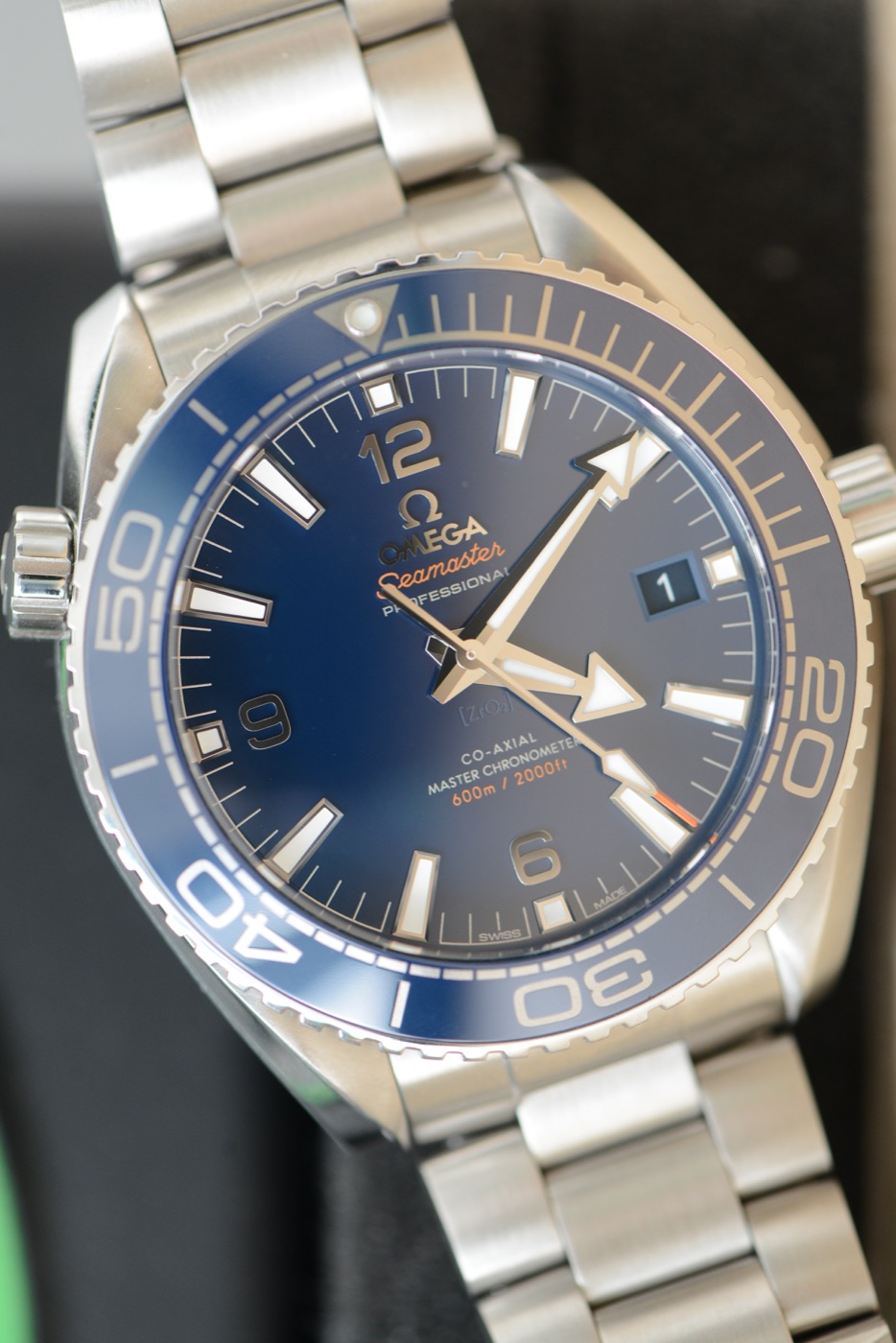
Figure. Omega Seamaster Planet Ocean marked Master Chronometer. Creator: Bjc157. Source: Wikimedia Commons. Licence: CC BY-SA 4.0. Reduced in size and saved again as JPEG. The modified image uses the same licence.

What the certification covers#
The watch must meet the Swiss Made requirements, and the movement must meet the chronometer criteria in ISO 3159:2009. The chronometer test is performed by a laboratory accredited to ISO/IEC 17025. The movement and completed watch then have to pass the tests and acceptance criteria in METAS-N001. The requirements set out performance at completion and how testing is managed, leaving manufacturers free to choose designs and materials. 2
Measurements of every movement and watch submitted for certification are the responsibility of the applicant or its representative. The test laboratory can be in-house or contracted. As the certification body, METAS statistically monitors results, tests samples and audits quality management. It does not measure each watch itself. The requirements also cover instrument calibration, uncertainty of measurement and retention of records. 2
Ten test cycles and the criteria#
The following describes the English version 1.2 of METAS-N001, approved in 2022. Ten cycles yield eight assessment criteria, including whether the movement or watch keeps running, rate, power reserve and water resistance. The daily rate expresses how much the difference from a reference clock changes during a measurement interval, scaled to 24 hours. 2 3
| Test | What is checked |
|---|---|
| Magnetic field | The movement is exposed to a 1.5-tesla magnetic field in two orientations and the completed watch in one, each for at least 30 seconds, to check that it keeps running. The difference in daily rate after exposure and after demagnetisation is also assessed for the cased watch. |
| Mean daily rate | The completed watch is placed at about 33 °C and 23 °C and in several positions. Four daily rates are averaged, including measurements after exposure to the magnetic field and after demagnetisation. |
| Power reserve | The watch is wound and checked at the end of the power reserve declared by the manufacturer. |
| Position and state of wind | Short-term rates are measured in six positions. Evaluation covers the maximum positional difference and the difference in mean rate between full wind and about one-third power reserve. |
| Water resistance | Pressure is applied according to the declared rating and watch category, and checked by a condensation test or an equivalent method. |
One tesla equals 10,000 gauss, so 1.5 tesla equals 15,000 gauss. The movement is demagnetised after its test. The completed watch must continue running in the field during its own test. The absolute difference between its daily rates after exposure and after subsequent demagnetisation must be no more than five seconds per day. The requirement specifies field orientation, duration and flux density. 2
Means and positional differences#
Version 1.2 defines three categories by movement fitting dimensions. Category 1a, for a fitting diameter above 26 mm, allows a mean daily rate of 0 to +5 seconds per day. Category 1b, above 20 mm and up to 26 mm, allows 0 to +6, and category 2, up to 20 mm, allows 0 to +7. Movements such as non-circular ones can also be categorised by fitting area. Tolerances for positional differences and differences by state of wind also vary by category. 2
If the four daily rates for a category 1a watch were +1, +3, −1 and +5 seconds per day, the mean would be +2. The arithmetic example addresses the mean, leaving the other criteria undetermined. A non-negative mean can include negative results in individual positions or on particular days, and the watch can still lose time at some moments in wear. Instantaneous rate is measured for at least 30 seconds in each of six positions. A daily rate is measured over 23–26 hours. The two measurements represent different quantities. 2
Preliminary chronometer testing is a separate test of the movement. METAS describes its mean daily rate as −4 to +6 seconds per day. The N001 mean for the completed watch uses different procedures and conditions, so the width of the ranges alone cannot establish better performance on the same test. 1 2
Introduction and adoption#
METAS and Omega announced their joint project on 9 December 2014 and developed the technical requirements and monitoring arrangements. A contemporary METAS report says the first certified watch was presented at a press conference on 21 October 2015. Horological media attending the event identified it as the Globemaster. 3 4
Certification is open to manufacturers meeting the requirements. For example, TUDOR says its certified watches are Swiss Made and contain a certified chronometer movement, with checks at two temperatures, in six positions and at two states of wind, as well as for magnetic resistance, water resistance and power reserve. Models and declared water resistance vary by product. 1 5
| Year | Event |
|---|---|
| 2009 | ISO 3159:2009 is referenced as a prerequisite. |
| December 2014 | METAS and Omega announce a joint project. |
| October 2015 | The first certified watch is presented at a press conference. |
| December 2022 | The published English version 1.2 of METAS-N001 is approved. |
Interpreting the certification#
Certification demonstrates compliance at the specified point in time and under the specified procedures. The pressure used for water-resistance testing depends on the declared rating, so watches bearing the same certification can be rated for different depths. Shock in use, ageing and condition after servicing cannot be predicted from testing at completion alone. The requirements also prescribe retesting when work is carried out on the movement or case during certification. 2
References#
- Federal Institute of Metrology METAS, Watch certification, accessed 2 November 2026.
- METAS, METAS-N001, version 1.2: Requirements for certification of movements and mechanical watches resistant to magnetic fields of 1.5 T, 2022, pp. 4–16, accessed 2 November 2026. English translation. In case of ambiguity the French text takes precedence.
- Marc Röthlisberger / METAS, La certification «Master Chronometer», METinfo 23(1), 2016, pp. 25–26, accessed 2 November 2026.
- Magnus / WatchProSite, OMEGA presents the 1st METAS-certified Master Chronometer, 27 October 2015, accessed 2 November 2026.
- TUDOR, METAS Certification, accessed 2 November 2026.