Middle-temperature error in chronometers#
This article was translated from Japanese using AI. Read the Japanese original
Middle-temperature error occurs when a temperature-compensated mechanical chronometer adjusted to the same rate at two temperatures runs at a different rate between them. With a typical steel balance spring and split brass-and-steel balance, it gains at intermediate temperatures and tends to lose just outside the two adjustment points. The remaining difference is also called secondary error, because it persists after compensation has reduced the larger change. Secondary compensation is an arrangement for reducing that error.12
Rate is how quickly a clock gains or loses time, for example in seconds per day. A clock with zero rate error at a given temperature can still show a time offset accumulated earlier. Navigation required a reference time for calculating longitude, so changes in the relationship between temperature and rate over a long voyage mattered in practice.3
Primary compensation and the remaining curvature#
The balance and balance spring form an oscillator. As temperature rises, the elastic modulus of an ordinary steel spring falls. It exerts less restoring torque at a given angle, so the period grows longer. Expansion of a brass balance also increases its inertia, tending to make the watch lose time. The spring expands in width and thickness as well as in length, so expansion in length alone does not explain the loss.2
A typical split balance has two arcs of steel on the inside bonded to brass on the outside. As temperature rises, the greater expansion of the brass bends the arcs inward and moves the rim weights nearer the axis. Reducing the moment of inertia makes the balance oscillate faster and can offset the reduction in the spring’s stiffness. Moving the weights along the arcs changes how far their radius shifts when the arcs bend, allowing adjustment of the strength of compensation.1
The spring’s stiffness and the balance’s inertia do not vary in exactly the same way across the full temperature range. Equal rates at low and high temperatures can leave a difference between them. On a plot of rate against temperature the residual has a curved shape. In the nineteenth century, Denison explained that curvature through the relationship between the weights’ radius and the moment of inertia. A modern technical account also emphasises the nonlinear variation of the steel’s elastic modulus with temperature. The error reflects the behaviour of the oscillator as a whole.12
In Denison’s example, a chronometer adjusted to the same rate at 32 °F and 100 °F (about 0 °C and 38 °C) gains between those points. Matching the rates at two temperatures leaves room for a difference elsewhere. Its size depends on the individual chronometer and its adjustment.1
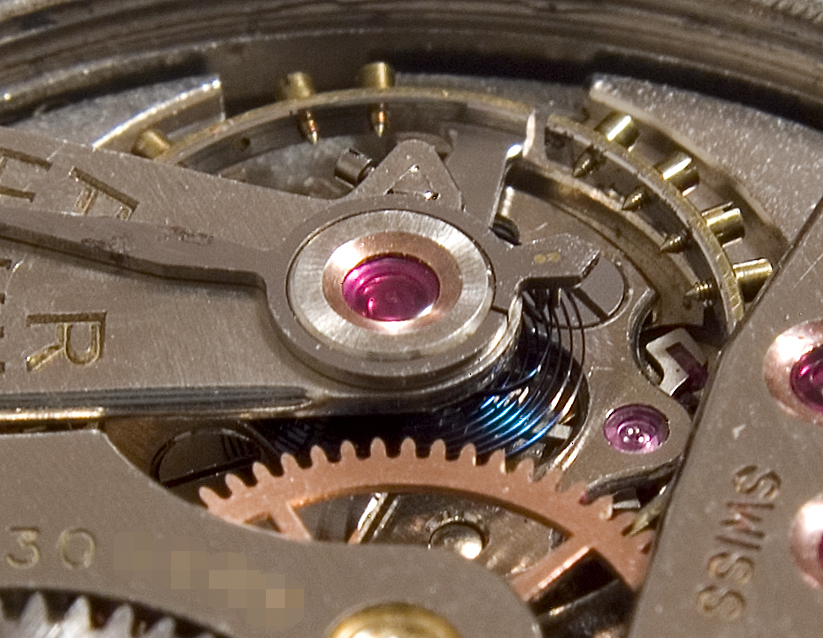
Figure. Split balance and balance spring of an Omega 30t2. The source identifies the balance as bimetallic. Photograph by Duxbelli. Source and rights: Wikimedia Commons file description and creator’s public-domain release. Unmodified.

Arrangements for secondary compensation#
Nineteenth-century designs combined the bending of the arcs with additional movement of weights to bring the relationship between inertia and temperature closer to the desired curve. Denison describes the following arrangements.1
| Design | How the compensation works | Considerations |
|---|---|---|
| Eiffe | At a certain temperature the compensating arc meets a small spring and weight and then moves them farther. | The action changes when contact begins. |
| Dent | A separate bending element mounted on the compensating crossbar moves its weight towards the axis. | The height of the weight and other settings need adjustment. |
| Loseby | Mercury shifts with temperature in a fine tube for secondary compensation, changing the distribution of mass. | The mercury must be sealed in and the device handled accordingly. |
Another design uses contact to change the action. A repair account for Kelvin and James White chronometer No. 7506 describes a Kullberg auxiliary arm. At low temperatures the arm carrying the weight rests against an adjusting screw. At higher temperatures it moves clear of the screw and moves inward. The screw defines the point at which the auxiliary mechanism acts, rather than serving only as a fine rate adjustment. The repairer says the instrument could not be tested over a wide temperature range.4
US patent US311797, granted in 1885 to Johann Ernst Adolph Uhrig, proposed continuous secondary compensation using curved steel springs at the ends of the compensating arcs. They were adjusted to increase the inward movement at higher temperatures. The specification calls for readjusting primary compensation after changing the spring curvature. The patent records the inventor’s design and claims. It provides no evidence of series production or performance at sea.7
Other designs changed the shape of the balance itself. ZBA4371 at the National Maritime Museum in Britain is an experimental triangular brass-and-steel balance intended to address middle-temperature error. The museum gives the maker and date as unknown and suggests late nineteenth-century British manufacture.5
Changing the materials#
A palladium-alloy balance spring paired with an ordinary compensation balance offered another way to reduce middle-temperature error. Pure palladium and its alloys have different properties. An article in the Horological Journal reports that a chronometer with an ordinary balance without auxiliary compensation and a palladium-alloy spring placed fifth at the Greenwich trials in 1883. It also cites Paillard’s comparison of 24 steel-spring chronometers and 16 with alloy springs, in which the alloy group’s middle-temperature error was less than a third of the steel group’s.2
Charles-Édouard Guillaume investigated nickel steels with different thermal expansion characteristics for use in compensation balances. The Guillaume balance substitutes an Invar-type alloy for the conventional steel to reduce middle-temperature error. Alloy balance springs with elasticity less dependent on temperature provided another path that could limit variation without a complex split balance. Errors can still vary with temperature and position.6
Measurement and handling at sea#
Adjusting compensation requires allowing the chronometer to stabilise at different temperatures and comparing it with a reference clock to determine its rate. Testing several temperatures, including intermediate points, reveals deviations that a two-point test misses. Checking the rate again after returning to the original temperature helps distinguish temperature effects from changes in lubrication or changes over time.12
In 1882 American chronometer makers T. S. and J. D. Negus explained that clocks using their ordinary balances were adjusted to run fastest around 70 °F (about 21 °C), and that temperature corrections were applied according to conditions at sea. With t the difference from 70 °F in degrees Fahrenheit, they gave the average temperature correction relative to the maximum rate as −0.0025 × t² seconds per day. This was an empirical guide for their own chronometers. They considered auxiliary devices vulnerable to vibration and handling on ships, distinguishing short observatory trials from stability at sea.3
Improved compensation addresses one part of keeping a chronometer stable. Lubrication, position, shocks, amplitude and changes in adjustment over time also affect the rate. Middle-temperature error should be assessed in the context of measurements at several temperatures.13
Timeline#
- Late eighteenth century – Compensation balances exploiting differential thermal expansion are developed to offset the weakening of the balance spring at higher temperatures.1
- 1833 – According to Denison, Eiffe tells the Astronomer Royal about his method of secondary compensation, and Dent also publishes an explanation of the residual error.1
- 1857 – Denison’s book records the designs of Eiffe, Dent, Loseby and others and discusses test results.1
- 1882 – The Negus brothers publish the thermal behaviour of their ordinary balances and their approach to applying corrections at sea.3
- 1883 – A chronometer with a palladium-alloy spring and ordinary compensation balance places fifth in the Greenwich trials.2
- Twentieth century – Nickel-steel balances and alloy springs with reduced temperature effects offer alternatives to auxiliary compensation devices.6
References#
1. Edmund Beckett Denison, Clocks and Locks, 2nd edition, 1857, pp. 148–158. Digitised copy at the National Library of Scotland. Accessed October 28, 2026.
2. David Boettcher, “Balance Springs, Part 1: The Technical Development of a Principal Watch Component,” Horological Journal, September 2018, pp. 397–403. PDF. Accessed October 28, 2026.
3. T. S. and J. D. Negus, “Rules for the Care and Handling of Chronometers,” Proceedings, April 1882. U.S. Naval Institute. Accessed October 28, 2026.
4. The Mariner’s Chronometer, “A Kelvin and James White chronometer overhauled,” 2020. Repair record. Accessed October 28, 2026.
5. Royal Museums Greenwich, “Chronometer balance,” ZBA4371. Collection record. Accessed October 28, 2026.
6. American Watchmakers-Clockmakers Institute, “Watch Adjustments,” Horological Times, May 1981, pp. 38–39. PDF. Accessed October 28, 2026.
7. Johann Ernst Adolph Uhrig, “Watch-Balance,” US311797A, filed July 23, 1884, granted and published February 3, 1885. US patent specification. Accessed October 28, 2026.