This article was translated from Japanese using AI. Read the Japanese original
A pantograph (pantographe in French) transfers the motion of a point tracing a pattern to another point at a fixed ratio. In watch and clock manufacture it can cut the outline of a small part from a large pattern, reproduce machining positions on a plate, or engrave a fine signature on a dial. The machine reproduces the motion, while making the pattern, choosing the cutter and finishing still call for separate skills. 1 2 3
Transferring a shape at reduced scale#
From drawing instrument to machine tool#
The basic drawing pantograph links two points through arms arranged in a parallelogram. Moving one point makes the other trace a geometrically similar path. The positions of the fixed pivot and the working points determine whether the copy is at the same scale, enlarged or reduced. The brass Elliot Brothers instrument of about 1850 held by the Institution of Mechanical Engineers is a tool for copying drawings in this way. 1
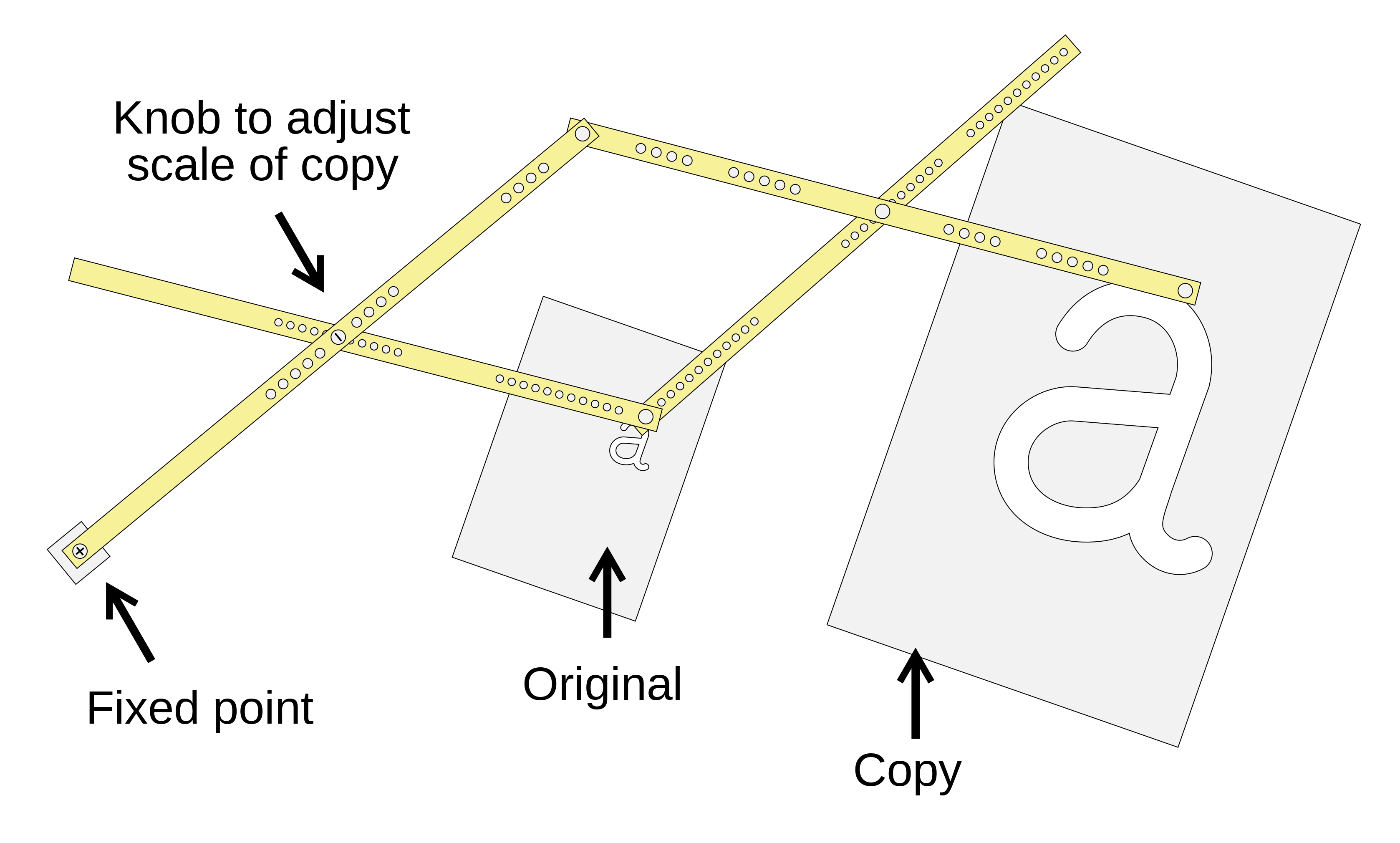
Figure 1. General principle of a drawing pantograph. The diagram shows enlargement. A watchmaking machine set up for reduction uses a different placement and ratio for the tracer and tool. Original by Inigolv, vectorised by Doanri and redrawn by TilmannR. No changes by this site. Wikimedia Commons, “Pantograph in action.svg” (original) CC BY-SA 4.0


In a machine tool, a rotary cutter or similar tool takes the place of the pen, and a stylus at the other point follows the grooves or edges of the pattern. Its motion is transmitted to the tool. The power that spins the cutter and the movement that guides it serve different purposes. A motorised spindle can still be guided by hand. 2 3
In an ideal planar motion, the displacement of the tool from the reference point equals the displacement of the stylus multiplied by the scale factor. At 1:10, for example, moving 10 mm on the pattern moves the tool 1 mm. This describes the geometry. Actual machining accuracy also depends on the machine, cutter radius and depth of cut. The path of the cutter’s centre alone cannot establish the dimensions of the finished surface. 1 3
Pattern, tool and finish#
The pattern carries the shape information. Spindle speed and feed settings cannot correct its errors. The stylus and cutter each have a finite width, which affects the relationship between the profiles. Restoration watchmaker Archie B. Perkins gives specific dimensions for this relationship in his method of making tools. 3
In the workshop described by Henrik Korpela in 2017, a stylus follows grooves in brass or plastic and transfers the motion to a rotary cutter at reduced or original size. Students make enlarged models of clock mechanisms quickly, then finish to final dimensions with files or other machines. Korpela specifies a jig borer for cutting the spokes of his own wheels, an example of work done on a separate machine. 2
Leschot and standardised plates#
The 1839 contract and the account of work in 1841#
In the early nineteenth century, bringing together parts made by specialists still required considerable fitting for individual watches. The plate supports the train, escapement and other mechanisms. Reproducing the outline and machining positions from the same pattern helped reduce work at assembly. 4
The Fondation Haute Horlogerie biography dates Georges-Auguste Leschot’s application of the pantograph to watchmaking to 1839. Its glossary dates the beginning of use at Vacheron Constantin to 1841 and describes marking positions and milling plates from a pattern. The Metropolitan Museum of Art distinguishes the 1839 improvement contract from Leschot joining the firm full-time in 1844. The accounts date different stages of contract, development and use. 4 5 6
Leschot applied an existing principle of geometrically similar motion to the production of watch components. Reproducing plates from one drawing or pattern helped produce movements of a common calibre, with the same dimensions and layout. 1 4
How far did interchangeability go?#
In an 1873 history of Geneva industry, Élie-François Wartmann credited Leschot’s machine tools with improving uniformity and enabling repairers to work away from the place of manufacture if they had spare parts. Contemporary accounts valued machine production for repairs and parts supply alongside price and speed. 7
The Metropolitan Museum of Art distinguishes the reduction in fitting afforded by Leschot’s machinery from later developments that tied true interchangeability to the factory system. Making plates from the same pattern is one step toward replacing every part without selection or adjustment. 4
The museum’s pocket watch of about 1844, accession No. 26.267.49, illustrates the period of standardisation. Presenting the watch in this technical context does not establish the machine on which its plate was made. 4
Applications beyond cutting outlines#
Secret signatures on enamel dials#
Abraham-Louis Breguet’s workshop used the pantograph to engrave fine signatures on dials. The Museo Galileo’s account of its 1816 souscription pocket watch, accession No. 3860, describes guiding a diamond point with a pantograph to engrave the signature. The material worked and the action of the point differ from milling a plate. 8
Breguet gave a modern example in its announcement of the Classique Souscription 2025 on 24 April 2025. The company explains that a diamond-tipped pantograph with articulated arms engraves the secret signature into the enamel between the centre and 6 o’clock, with the watch number and other markings. This is the maker’s description of production, and the signature alone cannot authenticate a watch on the market. 9
Pattern copying and engine turning on cases#
A Lienhard engraving machine from 1904 illustrates the use of geometrically similar motion in watch-case decoration. The French public heritage inventory records the surviving machine from Berthet and testimony from its users. A stylus follows a pattern 14 cm across and transfers a reduced motif to the cutter. Swivelling and cam adjustments allow the machine to work on curved surfaces. 10
The inventory distinguishes a geared ground pattern, decoration copied from a pattern and work that combines both. It also records hand finishing of outlines such as flowers and leaves after copying. A single machine can combine pantograph cutting and engine turning, with different operations contributing to the finished decoration. 10
Making gear cutters for restoration#
The machine Perkins published in 1989 shapes cutters for horological wheels. A spherical support lets the rotary spindle tilt, and a stylus at the end of a long rod follows an enlarged pattern. The smaller movement on the tool side then cuts the cutter blank. 3
The pattern on Perkins’s machine is ten times full size. The stylus radius is also roughly ten times the forming cutter’s radius. If the required tooth curve has a radius of 0.50 mm, for example, the forming cutter must be 1.00 mm in diameter or less. An oversized cutter cannot enter a narrow contour. Both the scale ratio and the shapes of the tracer and cutter matter. 3
The workshop article shows how to make a tool needed for restoration from a pattern. 3
Accuracy and choice of application#
A pantograph reproduces contours from a shared pattern and mechanical ratio. Accuracy depends on the pattern, scale setting, stylus and cutter, workholding, spindle and support, and final dimensional inspection. A faithful reduced tool path is one part of checking that the work meets its required dimensions. 2 3
Korpela’s enlarged models use the pantograph to produce a shape quickly and leave precision finishing to another operation. Leschot used plate copying to make shapes and layouts repeatable in production, Perkins made restoration tools and Breguet uses a modern pantograph for fine engraving on enamel. Each application has a different purpose, from parts standardisation and prototyping to toolmaking and decoration. 2 3 4 9
The patent specification for Leschot’s watchmaking machine and the text corresponding to “PAT. 10388” on the Lienhard machine have not been verified. The description of the Lienhard follows the heritage inventory’s examination of the machine. Establishing the patent’s claims and legal novelty would require the original text. The sources do not quantify machining tolerances across the method or its effect on timekeeping accuracy. 10
Chronology#
| Date | Documented development |
|---|---|
| 1816 | Breguet souscription pocket watch in the Museo Galileo. The museum describes its pantograph-engraved signature. 8 |
| 1839 | Leschot and Vacheron Constantin contract to improve production. The FHH biography dates the application to watchmaking to this year. 4 5 |
| 1841 | The FHH glossary dates the introduction of template-guided marking and milling of plates. 6 |
| 1844 | The Met dates Leschot’s full-time employment to this year and discusses a watch of about 1844 in the context of standardisation. 4 |
| 1845 | Wartmann’s footnote on p. 35 and the FHH biography date the de la Rive award for Leschot’s work to this year. 5 7 |
| c. 1850 | Date of the Elliot Brothers drawing pantograph at the Institution of Mechanical Engineers. 1 |
| 1873 | Wartmann credits Leschot’s machines with improving uniformity and enabling repair at a distance. 7 |
| 1904 | Lienhard makes a watch-case decorating machine. The surviving machine bears the date. 10 |
| 1980s | The heritage inventory dates the addition of an electric motor to the Lienhard machine to this decade. 10 |
| December 1989 | Perkins publishes the pantograph method for making gear cutters. 3 |
| January 2017 | Korpela describes workshop prototyping of models followed by finishing. 2 |
| 24 April 2025 | Breguet announces diamond-point engraving for the Classique Souscription 2025. 9 |
In horology, the pantograph brought shape copying to the scale and tool required by each operation. Reproducing a part depended on the people who made the pattern, set up the machining and finished the work as well as the machine itself. 2 3 4
References#
All sources accessed 25 October 2026. Manufacturer accounts, museum and heritage records, and workshop articles are used for their particular objects and periods.
- Institution of Mechanical Engineers, “The historical device that made copying drawings easier”, 16 June 2023. Linkage, scale and the instrument in the collection.
- Henrik Korpela, “Making a Watch from Conception to Finished Product with Kaj Korpela, Part One”, Horological Times, January 2017, pp. 22–28, especially “Pantograph” on p. 27.
- Archie B. Perkins, “Antique Watch Restoration, Part XLVIII: The Pantograph Method of Making Gear Cutters”, Horological Times, December 1989, pp. 30–34. Workshop-built machine and relationship between the pattern, stylus and cutter.
- The Metropolitan Museum of Art, “Hunter-case pocket watch”, 26.267.49. Research on the watch of c. 1844, Leschot’s contract, plate copying and interchangeability.
- Fondation Haute Horlogerie, “Georges-Auguste Leschot”. The 1839 contract and application to watchmaking, and the 1845 award.
- Fondation Haute Horlogerie, “Pantographe”. French definition and plate machining in 1841.
- Élie-François Wartmann, Notice historique sur les inventions et les perfectionnements faits à Genève dans le champ de l’industrie et dans celui de la médecine, Geneva, H. Georg, 1873, pp. 34–35 and the footnote on p. 35. Original from the University of Geneva.
- Museo Galileo, “Watch, souscription type”, inv. 3860. The 1816 watch and its diamond-point signature.
- Montres Breguet, “Classique Souscription 2025”, 24 April 2025. Position and engraving of the signature on the modern watch.
- Laurent Poupard, Région Bourgogne-Franche-Comté, “Machine à graver (machine à guillocher Lienhard)”, IM25005485, surveyed 2018 and revised 2019, pp. 1–2 and plates pp. 3–6. Object survey and testimony by Gérard and Pierre Berthet.