This article was translated from Japanese using AI. Read the Japanese original
The pirouette, or échappement à pirouette in French, adds gearing between the pallet arbor of a verge escapement and the balance. A small swing of the pallets then makes the balance swing through a larger angle. The arrangement appears in Christiaan Huygens’s drawing of an early sprung balance published in the Journal des Sçavants on 25 February 1675. 1
The balance spring restores the balance to its resting position. The pirouette describes the gearing between it and the escapement. The sprung balance became widely used in modern wristwatches. The pirouette with its additional gears was one of the arrangements tried during its development. 1 2
Why make the balance swing farther?#
A portable alternative to the pendulum#
Improving seventeenth-century clocks required a repeating oscillator as well as a train that advanced regularly. After working with pendulum clocks, Huygens sought an oscillator suited to portable and shipboard use. In his published letter of 1675 he said a small version could serve as a pocket watch and a larger one could be used to determine longitude on land and at sea. These were proposed uses at publication. He gave no results from a completed precision sea clock. 1
When the inner end of the spring is fixed to the balance staff and the outer end to the plate, the balance winds the spring tighter and then lets it open. The restoring force and inertia of the balance produce oscillation in both directions. The published letter envisages a larger, heavier, well-poised balance and says that the spring coils remain free in the air without touching other parts. 1
The limits of the verge and a large amplitude#
In a verge escapement, the crown-wheel teeth act alternately on two pallets attached to an arbor. With the balance mounted directly on that arbor, the geometry that allows the pallets to operate also limits its swing. The pirouette uses separate arbors linked by gears with different tooth counts, allowing a larger swing of the balance with a smaller movement of the pallets. 1 2
A balance swinging slowly through a wide angle characterised the arrangement and gave rise to the name pirouette. Reinier Plomp interprets Huygens’s aim as reducing how often the escapement acted, so it would interfere less with oscillation. This is a later interpretation of the design aim. A large amplitude alone does not guarantee accuracy. 3
Reading the published drawing#
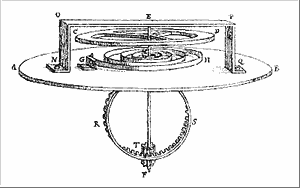
Figure 1. Pirouette regulator published in 1675. Christiaan Huygens (1629–1695). Unchanged. Public domain, published in 1675 and more than a hundred years after the author’s death when reproduced here. Wikimedia Commons file page Rights statement


The published letter describes the labelled parts as follows. 1
| Label | Part and function |
|---|---|
| AB | Upper plate of the watch, supporting the bearings and spring attachment |
| CD, EF | Circular balance and its staff |
| GHM | Balance spring, fixed to the staff at M and the plate at G |
| NOPQ | Cock supporting one balance pivot |
| RS | Wheel driven back and forth by the escapement |
| T | Pinion mounted on the balance staff and meshing with RS |
RS at the bottom oscillates under the action of the escapement and drives the balance through pinion T. The drawing leaves out the full escape wheel and pallets. The large wheel drawn is the intermediate wheel. 1 3
During one swing, motion passes from the train through the escape wheel, pallet arbor, added wheel and pinion to the balance. As the balance swings and the spring brings it back, the gears reverse. The opposite pallet then engages the escape wheel to sustain motion in the other direction. The spring helps establish the period, while the escapement replenishes losses and meters the advance of the train. 1 2
What the gear ratio changes#
The 1934 editorial commentary on Huygens’s works cites Ferdinand Berthoud’s drawing and explanation. Gearing magnifies a small angle at the pallet arbor into a larger one at the balance. Its effect varies with the tooth counts or pinion diameter. 2
With Z teeth on the added wheel and z on the pinion, the ideal ratio of angular displacements is Z/z, neglecting backlash and elastic deformation. A higher ratio gives a greater balance angle for the same pallet-arbor movement. This is the transmission ratio. It does not specify the tooth counts or amplitude of a particular surviving watch.
Gears do not create energy. Even without losses, increasing the angle reduces the torque delivered at the balance. In practice, meshing and bearings also dissipate energy. The benefit of a greater amplitude comes with transmission losses and added complexity. This follows from general gear mechanics applied to the published arrangement, rather than reconstructed seventeenth-century test results.
The invention in 1675 and the maker’s role#
Several arrangements in the notes#
Huygens’s notes from 1675–1676 record that he told the watchmaker Isaac Thuret about the invention on 22 January and had him make the first model. The next day Thuret brought another model, and on the 24th and 25th he demonstrated applications to watches. Turning models into mechanisms depended on his skills in making and adjusting parts. 4
The notes also discuss mounting pallets directly on the balance staff, interposing gears, and coupling two balances moving in opposite directions. The 1934 editorial commentary distinguishes these schemes. The early model, published drawing and later surviving watches can represent different designs. 2 4
The editors suggest that Thuret may have contributed to the published form. The evidence does not assign every detail to one person. Huygens’s notes record his own side of the invention dispute. 2 4
Privileges and disputes over invention#
In 1675, applications and grants of privileges for balance-spring timepieces proceeded in France and the Netherlands. The editors say a French privilege was granted on 15 February, but its registration was abandoned. They separately document Dutch privileges for a sea clock and a pocket watch. These were several proceedings under different systems. 2
Robert Hooke and others also disputed priority for regulating a balance with a spring. The published drawing of February 1675 documents Huygens’s pirouette arrangement. It alone cannot establish his sole priority for the entire concept of a spring regulator. 1 2
A surviving clock and its limits#
Thuret’s signed sea clock#
The clock signed “Thuret A Paris” examined by Plomp retains the additional gearing between balance and verge. He gives a balance diameter of about 4.9 cm, a period of about one second and a running time of about three days. The ball suspension and other features suggest intended shipboard use. Plomp considers several possibilities because direct evidence of a commission from Huygens is lacking. 3
The clock shows that the pirouette was made and used in an instrument. It does not establish that it delivered the accuracy needed for longitude during an actual voyage. The published drawing, surviving mechanism and contemporary records of use answer different questions. 1 3
Friction and driving power#
In a letter to Oldenburg of 11 July 1675, Huygens judged his new watches superior to earlier portable ones but below clocks with long pendulums. He cited pivot friction in small movements and the need for extra mainspring force to prevent stopping. His assessment concerns early sprung-balance watches and does not give a measured daily rate for each pirouette example. 5
In the same letter he discusses an experiment with two balances to address rotation of the watch from outside. This solution also needed extra drive. Adding gears or oscillators already presented trade-offs for the designers. 5
A larger swing still leaves the balance coupled to the train#
In a verge, contact between the escape-wheel teeth and pallets lets the driving train affect the oscillator. Enlarging the angle through gears leaves that coupling in place. Plomp identifies removing the added transmission, controlling thermal effects and reducing coupling between train and oscillator as major problems for later marine timekeepers. 3
Early sprung regulators also varied with temperature. According to the editors, Huygens later acknowledged the effect and in 1683 studied a different marine oscillator without a spring. The added gears could not address spring materials or temperature compensation by themselves. 2
Manufacture and upkeep depend on the added gears’ centre distance and mesh, pivot condition, and setting the spring so it touches no other part. The available original sources do not establish common dimensions and tolerances, amounts of oil, alloys or replacement standards. The materials and servicing methods of modern watches cannot be assumed for an unexamined seventeenth-century movement. 1 3
Comparison with direct coupling and historical place#
| Feature | Verge directly coupled to balance | Pirouette |
|---|---|---|
| Pallet arbor and balance | Can share an arbor | Gears transmit motion to a separate arbor |
| Angular motion | Pallet arbor and balance turn through the same angle | The ratio can increase the balance angle |
| Added parts | No intermediate transmission | A wheel, pinion and their supports are required |
| Effect on oscillation | The escapement acts on the oscillator | Coupling to the escapement remains through the transmission |
Plomp concludes that the pirouette was impractical for portable watches and was replaced early by direct coupling with faster oscillation. The surviving pieces and literature do not establish that all regions or workshops abandoned it at the same time. 3
A tourbillon rotates the regulating assembly in a carriage to average positional effects. The pirouette balance instead oscillates against its spring. Its name refers to the transmission and not to an index for adjusting the active length of the spring.
The pirouette shows an intermediate design choice in the development of the sprung-balance watch. A large swing, low frequency, low friction and separation from the train each presented different problems. This arrangement specifically changed the distribution of angular movement through gears. 1 2 3
Chronology#
| Date | Event and significance |
|---|---|
| 1673 | Publication of Horologium Oscillatorium. Study of the pendulum and isochronism provides context for investigation of spring oscillators. 2 |
| January 1675 | Huygens’s notes describe several balance and spring arrangements. They record a model by Thuret on the 22nd and further models and applications in the following days. 4 |
| 25 February 1675 | Drawing and explanation of the pirouette appear in the Journal des Sçavants. 1 |
| July 1675 | Huygens discusses friction, extra drive and the demands of double balances in portable timekeepers. 5 |
| c. 1675–1680 | Estimated manufacture of the Thuret-signed clock discussed by Plomp. 3 |
| 1683 | Huygens studies a marine oscillator different from the temperature-sensitive spring regulator. 2 |
| 1934 | Editors of vol. XVIII compare direct coupling, added gears and the published arrangement. 2 |
| 1999 and 2008 | Plomp’s research on Thuret’s clock appears in a journal and is later reprinted in Meddelelser. 3 |
Sources for the development#
The drawing and component descriptions in the published letter, related notes and research on a surviving clock document the construction and the problems its designers faced.
References#
- Christiaan Huygens, letter to J. Gallois, February 1675, published in the Journal des Sçavants on 25 February 1675. Oeuvres complètes, vol. 7, No. 2014, pp. 424–425, 1897. Digitised text and drawing at DBNL. Accessed 10 November 2026.
2. J. A. Vollgraff, ed., Oeuvres complètes. Tome XVIII. L’horloge à pendule 1666–1695, “Application pratique aux horloges de différents mouvements vibratoires plus ou moins isochrones”, 1934, especially pp. 501–508. Editorial commentary distinct from Huygens’s own text. DBNL. Accessed 10 November 2026.
3. Reinier Plomp, “A Longitude Timekeeper by Isaac Thuret with the Balance Spring Invented by Christiaan Huygens,” Annals of Science, 56(4), 1999, pp. 379–394. Reprinted in Meddelelser fra Ole Rømer Museets Venner, 2008, pp. 15–40. The text and figures of the reprint were consulted. Reprint PDF Journal record. Accessed 10 November 2026.
4. Christiaan Huygens, “Balancier de montre reglè par un ressort”, notes of 1675–1676, Oeuvres complètes, vol. 7, No. 2008, 1897, especially pp. 408–411. DBNL. Accessed 10 November 2026.
5. Christiaan Huygens, letter to H. Oldenburg, 11 July 1675, Oeuvres complètes, vol. 7, No. 2040, pp. 477–478, 1897. DBNL. Accessed 10 November 2026.