This article was translated from Japanese using AI. Read the Japanese original
In a rack lever escapement, one end of the lever between the escape wheel and balance has teeth that mesh with a pinion on the balance staff. The oscillating balance moves the lever to release the train in steps. Power from the train passes back through the same linkage to sustain the balance’s oscillations. The design was proposed in the eighteenth century and was used particularly in early nineteenth-century pocket watches from Liverpool, England. 1 2
The teeth in a rack lever escapement stay in mesh, so the balance remains coupled to the lever as it swings. By contrast, in the detached lever escapement common in modern watches, a pin on the balance interacts with the lever only near the middle of the swing. For the rest of the swing the balance is free of the lever. 3
Operation#
As the mainspring tends to turn the escape wheel through the train, two pallets on the lever alternately arrest its teeth. The lever rocks on its pivot. The sector of teeth at its far end, called the rack, moves the pinion on the balance staff. As the balance turns back and forth, the pinion in turn moves the rack and causes a pallet to release an escape wheel tooth. The released tooth impulses the pallet, and the lever and meshing teeth pass the impulse to the balance. The balance and spring determine the period of oscillation. The escapement sustains that oscillation while metering the advance of the train. 3 4
One example illustrated in a 1946 horological journal uses a 30-tooth escape wheel and a six-leaf pinion on the balance. In that example a straight balance spring attached to the lever restores the lever to its central position and transmits a restoring force to the balance through the teeth. 4
While a pallet locks a tooth, the balance continues to move the lever through the rack and pinion. Friction between the rack and pinion adds to that between the pallet and the locked tooth. A nineteenth-century manual lists two drawbacks: the lever and pallets move farther as the amplitude of the balance increases, and friction makes the mechanism difficult to restart if the balance happens to stop at its central position. This account describes the mechanism. Measured daily rates would require evidence from individual watches. 3
With a detached lever, the balance does not have to drag the lever through most of its swing, even as amplitude increases. The parts still make contact during the brief unlocking and impulse phase. The accuracy of the watch as a whole also depends on adjustment, wear and the oscillator. 3
From concept to manufacture#
The Metropolitan Museum of Art dates publication of the rack lever idea by Jean de Hautefeuille of France to 1722. Thomas Mudge devised the detached lever escapement around the middle of the eighteenth century. The two mechanisms differ in how the balance connects to the lever, and the details of Hautefeuille’s account should be assessed separately from those of later watches. 1
Peter Litherland of Liverpool obtained related patents in 1791 and 1792. The 1946 trade journal gives 14 October as the date of the 1791 patent and describes the following year’s patent as relating to a watch that beat seconds. Collector Paul Chamberlain, quoted in the journal, says the 1792 specification was not recorded and suggests that a seconds-beating watch in his collection represented the patent. The identification of individual surviving watches as examples of that patent remains uncertain. 1 4
Horological researcher Michael Edidin quotes the 1791 patent’s claims about clocks and watches for use on land and at sea and their usefulness for determining longitude. He is sceptical that the design offered enough accuracy for navigation. The claims show the inventor’s aims. Actual performance at sea and adoption require separate evidence. This account follows the quotations in Edidin’s paper, since the original patent was unavailable for verification. 2
Comparing surviving watches, Edidin argues that during the patent period Litherland supplied items such as finished movements for watches bearing other signatures, rather than licensing others to make them. He suggests that the design spread to other makers in Liverpool and London after the patent expired. His interpretation is based on surviving examples. Total production remains unknown. 2
Surviving watches and later use#
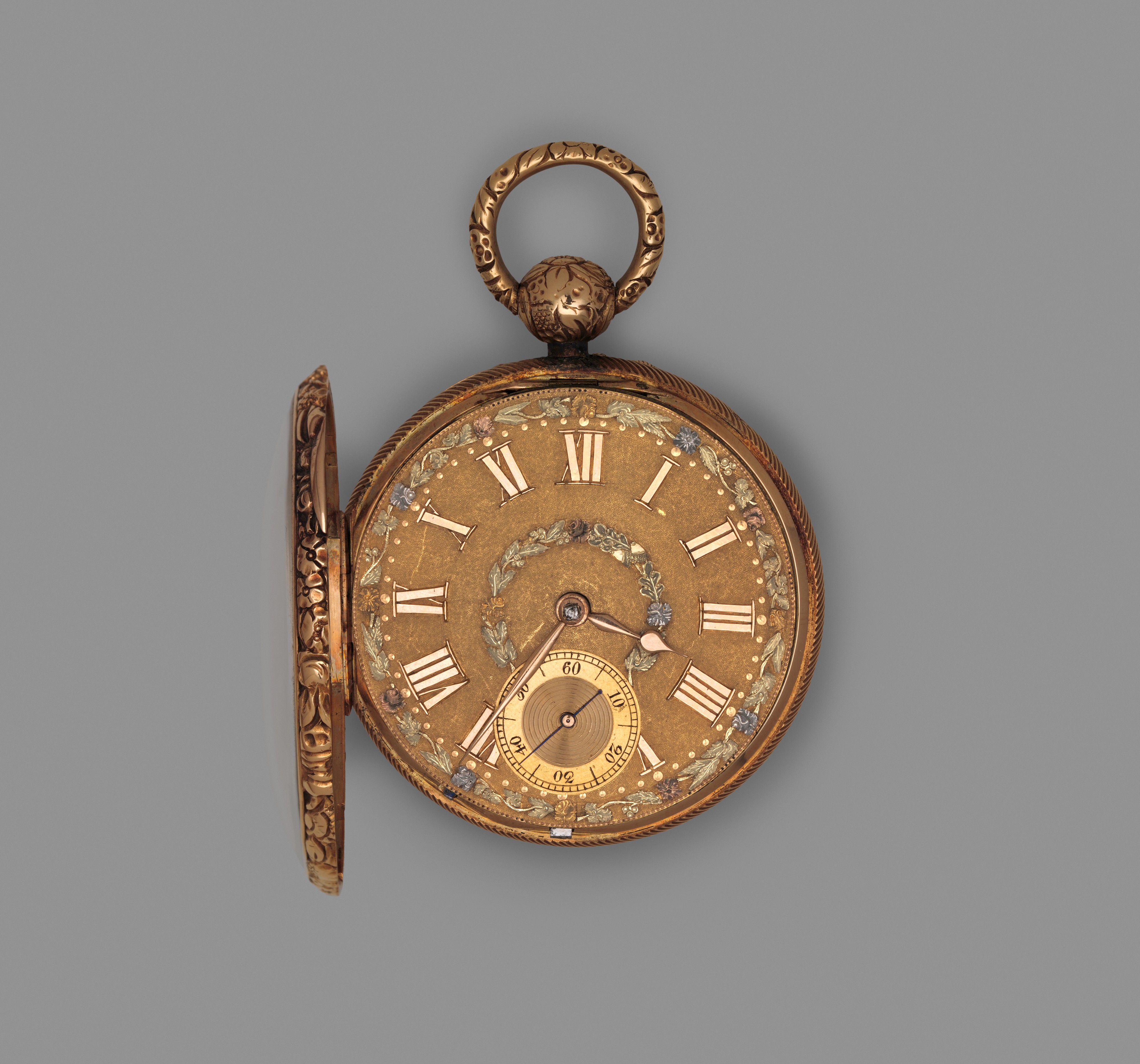
Figure. Roskell’s pocket watch No. 29664, with a rack lever escapement. Watchmaker: Robert Roskell. Photographer unknown, image provided by the Met. Source Wikimedia Commons. Licence CC0 1.0. Reproduced unchanged.

Royal Museums Greenwich holds Robert Roskell’s No. 9892, a silver pair-cased pocket watch dated to about 1813. Its full-plate fusee movement has a rack lever escapement, and the white enamel dial has subsidiary seconds. According to the museum, many watches of this kind were made in the first half of the nineteenth century, many of them for export, chiefly to the United States. 5
Roskell’s No. 29664 at the Metropolitan Museum of Art also has a rack lever. Its case marks date to 1820–21. According to the museum, Roskell used both rack lever and detached lever escapements. Watches with the same maker’s signature may have different escapements. 1
The museum says rack lever escapements remained in use well into the nineteenth century in Lancashire. As the detached lever and other competing designs spread, a nineteenth-century manual described the rack lever as already obsolete. The accounts concern different times or places, so a single date for the design’s disappearance would obscure those differences. 1 3
Timeline#
- 1722 — Hautefeuille is credited with publishing the rack lever idea. 1
- Around 1750 — Mudge devises the detached lever escapement, with a different connection between the lever and balance. 1
- 1791 and 1792 — Litherland obtains related patents. 1 4
- Around 1813 — Roskell’s surviving No. 9892 uses a rack lever. 5
- 1820–21 — Date of the case marks on the Roskell watch at the Metropolitan Museum of Art. 1
- Nineteenth century — The rack lever remains in use in places including Liverpool as the detached lever and other designs spread. 1 2
References#
1. Metropolitan Museum of Art, “Pocket watch” (Robert Roskell, no. 29664), description and collection record (accessed 4 November 2026).
2. Michael Edidin, “Peter Litherland’s patent watches and their successors,” Antiquarian Horology, June 2023, pp. 223–230, text (accessed 4 November 2026).
3. Edmund Beckett Denison, A Rudimentary Treatise on Clock and Watch Making, §§116–117, pp. 147–148, text (accessed 4 November 2026).
4. “The ‘Rack’ and ‘Pinion’ Escapement,” H. I. A. Journal, November 1946, pp. 7–8, text (accessed 4 November 2026).
5. Royal Museums Greenwich, “9892,” object ZAA0407, collection record (accessed 4 November 2026).