This article was translated from Japanese using AI. Read the Japanese original
A watch set for 3 p.m. sounds two low notes at 2:58, followed by three pairs of notes for the quarters and thirteen high notes. The sequence tells the wearer that it is now 2:58. Patek Philippe’s 1938P-001 announces that the chosen time is approaching by striking the time at that moment.1
An alarm with time strike operates in relation to a preset time and communicates the hours, quarters and minutes through the number and combination of sounds. It triggers at a scheduled moment the strike that a minute repeater normally produces when the owner operates a slide or button.1 2
Telling the time with sounds#
A typical two-tone minute repeater first sounds the hours with low notes, then the elapsed quarters with pairs of high and low notes, and finally the minutes since the previous quarter with high notes. At 2:58 there are three groups of fifteen minutes and thirteen minutes left over. The 1938P-001 gives 2 + 3 × 2 + 13 = 21 strikes. The same calculation gives 31 at 12:58.1 3
Two minutes before any alarm time on the quarter-hour scale, there are always thirteen minute strikes. Two minutes before the hour, the sequence also includes the three elapsed quarters of the previous hour. An alarm set for 3 p.m. can therefore give a much longer audible sequence than the three low notes that would sound at 3:00. The Grandmaster Chime 6300G-001, set for 8:45, sounds at 8:43 with eight hour strikes, two three-note groups for the quarters and thirteen minute strikes, for 27 in all. The two watches use different numbers of notes in a quarter group.1 4
| Mechanism | What triggers it | What the sound conveys |
|---|---|---|
| Mechanical alarm repeating one note | The preset time arrives. | The scheduled time has arrived. |
| Minute repeater | The user operates a slide or button. | The hours, quarters and minutes at the time of operation. |
| Grande sonnerie | The watch passes the hour or a quarter. | The hour and quarters just reached. |
| Alarm with time strike | The watch reaches the trigger time for an enabled alarm. | The hours, quarters and minutes when striking begins. In the examples above, this is two minutes before the setting. |
A single-tone alarm can also use a gong. The 5322G-001, for example, strikes a gong with a single hammer and uses an inertia fly to regulate the interval between blows. The mechanism that sets the number of strikes determines whether the time can be read from the sound.3 4 5
Breguet’s US patent US8599651B2 proposes sharing a sonnerie striking mechanism with an alarm. In the version described, the quarter and minute racks are held away from the snails, and a timing train determines how long the alarm sounds. It illustrates control of the connection between the parts that read the time and the parts that sound the alarm when they share the striking mechanism.11
The Grandmaster Chime’s 24-hour setting#
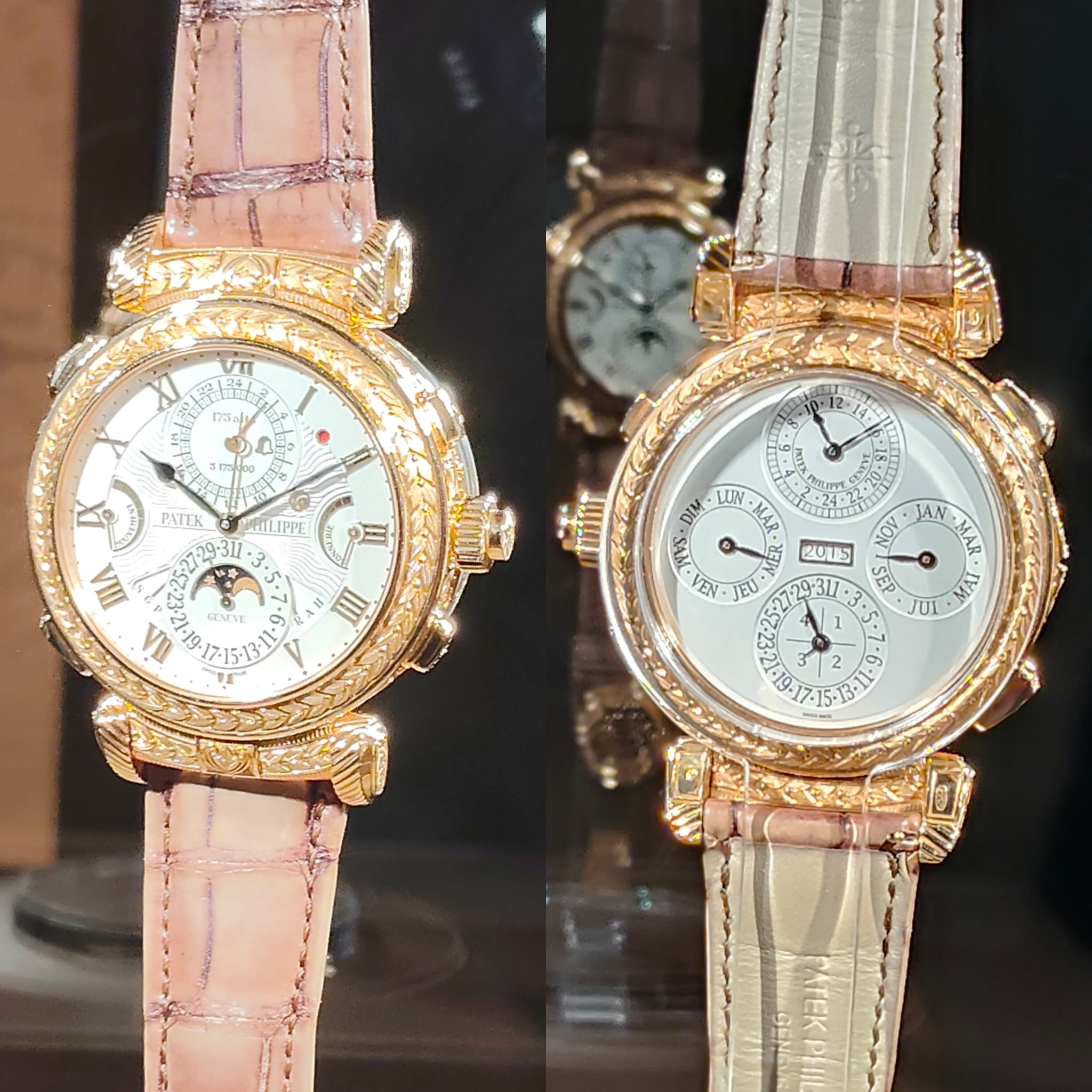
Patek Philippe Grandmaster Chime Ref. 5175R. Photograph by EMore98, Wikimedia Commons, CC BY-SA 4.0. Unmodified.

Introduced in 2014, the 5175 uses three gongs for the grande sonnerie, petite sonnerie, minute repeater, alarm with time strike and date repeater. Its hand-wound calibre GS AL 36-750 QIS FUS IRM winds the timekeeping or striking side according to which way the crown is turned in its pushed-in position. Patek Philippe lists a 30-hour reserve for the strike and at least 72 hours for timekeeping.2
The instructions for the subsequent 6300G-001 specify setting the alarm in 15-minute increments on the 24-hour display at twelve o’clock, from 30 minutes to 22 hours in advance. After setting it with the crown, the user presses the button at two to enable it, and the bell-shaped aperture turns red. Other strikes are suspended while the alarm is enabled. The aperture turns white after the alarm finishes and the other striking functions are available again. Since they share the striking mechanism, on-demand date or time striking gives way while the alarm is waiting.4
Patek Philippe’s Swiss patent CH703635B1 describes the design problem through levers and cams. In the arrangement of claim 2, arming the alarm both trips the striking mechanism and brings the parts that count the strikes into a held position. A cam linked to the hour wheel and a lever hold the strike before it is due and release it at the position corresponding to the alarm setting. The patent includes an example that strikes at the time set and a claim for a strike one minute before. The 6300G-001 instructions document operation two minutes before the setting.4 6
The slide and holding mechanism in the 1938P-001#
The 2023 1938P-001 uses two gongs, a slide on the left and a selector button in the crown. With the crown in its intermediate position, the central alarm hand can be set in 15-minute steps. The selector aperture shows black for the repeater, red when the alarm is selected and white when the slide has been pulled all the way to arm it. The alarm uses a 12-hour display, and the slide winds the striking spring. An off-centre rotor winds the timekeeping side of the automatic calibre R AL 27 PS.1
EP4320487B1, which claims the same priority as the European application EP4071560 named in Patek Philippe’s technical literature, describes the striking barrel, the parts that read the strike counts and the lever that holds the mechanism.1 7
- Wind the strike. The slide moves the operating rack. A one-way clutch winds the striking barrel and disengages the operating rack on its return.
- Hold it in readiness. With the alarm selected, a pin stops the quarter-reading part in its waiting position and also holds the linked hour and minute parts. The wound barrel stores energy until the release time.
- Compare the times. In the patent example, an output cam on a differential senses the relationship between the preset and current times. A separate notch fixes the minute phase. At the release position the holding pin enters a groove, letting the quarter-reading part fall onto the snail.
- Read and strike. The stepped cams for hours, quarters and minutes set the number of strikes, and the hammers sound the gongs in sequence. With the repeater selected, the same slide operation triggers a strike immediately without the waiting stage.
The cams determine the count when the mechanism is released, so an alarm set for 3:00 can sound the time as 2:58. Hand setting is also blocked while striking to keep the setting mechanism from applying force to the parts reading the cams.1 7
Designing for a shared striking mechanism#
To make the hours, quarters and minutes intelligible in sequence, the readings of the cams must agree at each quarter boundary and the hammers must strike in order. For the 1938P-001, Patek Philippe describes a mechanism that holds back the minute rack until the quarter mechanism reaches its position. Requiring the same full stroke of the slide also winds the striking barrel in the same way for short and long sequences. The 31 strikes at 12:58 illustrate one sequence powered by that winding action.1 7
Timeline#
| Year | Event |
|---|---|
| 1950 | Jaeger-LeCoultre introduces the mechanical alarm calibre Memovox.8 |
| August 2010 | Priority date underlying Swiss patent CH703635B1 on scheduled operation of a striking mechanism.6 |
| December 2013 | Breguet’s US patent US8599651B2 is published. It concerns using the same strike mechanism for a sonnerie and an alarm.11 |
| 2014 | Patek Philippe introduces the 5175 for its 175th anniversary, with five striking functions on three gongs.2 |
| 2016 | The Grandmaster Chime joins the regular collection as Ref. 6300.9 |
| April 2021 | Priority date for EP4320487B1 on a repeater and alarm sharing a slide.7 |
| 2023 | The two-tone 1938P-001 is introduced, as is the white- and rose-gold 6300GR-001.1 9 |
| March 2025 | The European patent EP4320487B1 is published.7 |
| November 2026 | The 6300GR-001 appears in the collection with an alarm with time strike.10 |
Related articles#
- Minute repeater
- Rack and snail
- Patek Philippe Grandmaster Chime
- Patek Philippe Minute Repeater Alarm 1938P
References#
Patek Philippe, Minute Repeater Alarm Reference 1938P-001, 2023, pp. 1–5.
Patek Philippe, Grandmaster Chime Ref. 5175, 2014, “Technical data” and “Patents and innovations”.
Patek Philippe, Les montres à sonnerie de Patek Philippe, sections on the repeater and sonnerie.
Patek Philippe, Reference 6300G-001, Instructions for use, “Minute repeater”, “Alarm” and “Date repeater”.
Patek Philippe, 5322G-001, mechanism and specifications.
Patek Philippe, CH703635B1, paragraphs [0005]–[0007] and claims 1–3 and 12.
Patek Philippe, EP4320487B1, March 26, 2025, figs. 16–22 and 27–35 and claims.
Jaeger-LeCoultre, Introducing Memovox Travel Clock by Marc Newson, 2026, history of the Memovox.
Patek Philippe, Watch Art Tokyo 2023 Catalog, 2023, “Supercomplications”, pp. 204–205.
Patek Philippe, 6300GR-001, mechanism and specifications.
Eric Goeller / Montres Breguet S.A., Alarm strike using the grand strike, US8599651B2, December 3, 2013, figs. 8–11 and 14–16 and detailed description.
All sources accessed November 20, 2026.