This article was translated from Japanese using AI. Read the Japanese original
A tourbillon mounts the balance, hairspring and escapement in a rotating cage, periodically changing the regulator’s orientation relative to the watch. Abraham-Louis Breguet (1747–1823) obtained a French patent on 26 June 1801. Rotation aims to average gains and losses associated with position under gravity. The idea has taken many forms, from early pocket watches to thin, self-winding, cantilevered and multiaxis wristwatches. 1 2
Origins and invention#
Positional errors in portable timekeepers#
The balance oscillates under the restoring torque of the hairspring. Ideally its period is independent of amplitude, a property known as isochronism. Real balances and springs have uneven mass distributions, and friction acts at pivots and bearings. Breguet’s original patent describes the difficulty of bringing the centre of mass exactly to the geometric centre and variations in pivot contact, wear and lubrication with position. 1
A stationary clock can be adjusted for a single orientation. A portable watch changes position during use, and a pocket watch in clothing can spend long periods upright. Rotating the regulator inside the watch takes it through orientations associated with gain and loss, even while the watch itself remains still. Breguet’s response was to average the effects over time while also using adjustment to reduce imperfections. 1 3
Breguet opened his workshop in Paris in 1775 and stayed in Switzerland from 1793 to 1795 after leaving revolutionary France. He worked on self-winding pocket watches and new escapements. The tourbillon is an arrangement that can carry several different escapements, as the early watches show. 2 4 5
The original patent and the name#
The French industrial property office INPI preserves file 1BA1792 with a description, drawings, Breguet’s letters and administrative records of receipt and grant. The application was received on 4 Nivôse, year IX, or 25 December 1800. The ten-year patent was granted on 7 Messidor in the same year, or 26 June 1801. Later company histories give 24 or 26 December for submission. Dates of writing and official receipt are distinct. 1 2 6
In his application letter, Breguet sought to compensate for irregularities due to the centre of mass, distribute friction around the pivots, and preserve lubrication. Recovering the expense of setting up manufacture was another reason he gave for seeking protection. The administrative documents state that no prior examination was made and that the government guaranteed neither priority, utility nor success. The patent grant and an independent accuracy test are different forms of evidence. 1
In French, tourbillon can mean a vortex or whirlwind. The original description makes an astronomical comparison. The cage orbits a fixed wheel as a wheel inside the cage turns on its own axis, like the Earth rotating while orbiting the Sun. The analogy describes a regular passage through successive positions. 1
How power and motion are transmitted#
The fixed wheel and rotating cage in the original drawing#
The original patent distinguishes fixed and moving parts. Wheel AAA drives pinion FF, which is integral with cage BBBB. The cage turns about axis EEE. Pinion PP, on escape-wheel arbor D carried by the cage, meshes with wheel CC, which is fixed relative to the watch. As the cage moves round that wheel, the escape wheel turns. 1
The same train drives the cage. While the escapement locks the train the cage stops, and when the balance causes unlocking, the applied power advances the cage. The balance and escapement set the period of its revolution. A regular rotation period describes its motion averaged over the small steps of locking and release. 1
The original description shows a one-minute revolution and the option of fitting a seconds hand to that axis. Early watches also include four- and six-minute revolutions. Designers can choose the cage period, escapement and seconds display independently. 1 4 5
Which errors rotation averages#
In a single-axis design, the orientation of any imbalance in the balance and spring changes as the cage rotates. This chiefly addresses differences in rate between vertical orientations. The horizontal-to-vertical difference, temperature, magnetism, shock and variations in mainspring output can still affect rate. A mechanism for averaging position and a small daily error for a complete watch are distinct measures. 1 3
The cage has mass and inertia. Driving it as well as sustaining the oscillator makes poise, bearings and train efficiency important. Accuracy does not automatically improve with cage speed. Specific high-speed designs combine weight reduction with specially developed tooth profiles. 3 7
Evaluating accuracy requires the positions, test duration and instruments compared. Omega’s competition movements and Greubel Forsey’s competition result provide examples of high performance. A test isolating the contribution of the tourbillon would need matching conditions and otherwise comparable designs with and without it. The results do not quantify its effect alone or settle its value in every wristwatch. 8 9
Early watches, customers and practical use#
Prototypes and sales#
The company history describes Nos. 282 and 169 as prototypes, dates the first commercial sale to 1805 and places a public exhibition at Les Invalides in September–October 1806. Work on No. 282 began in 1796. It stayed in the workshop until it was sold in 1832 under Breguet’s son Antoine-Louis. No. 169 was based on a watch by John Arnold and presented to Arnold’s son in 1809. Starting manufacture, completing a watch, selling it and presenting it were distinct events. 2 4
Four watches with different designs#
| Watch | Cage and escapement | Indications, construction and customer |
|---|---|---|
| No. 1188 | Four-minute revolution, natural escapement | Fusee and barrel, power reserve, running seconds and stoppable seconds. A certificate cited by Antiquorum records sale to the Spanish royal Don Antonio on 1 August 1808 for 3,600 francs. The dial was replaced in 1841. 10 11 |
| No. 1176 | Four-minute revolution, natural escapement | Has stop seconds, with three separate cocks supporting the mechanism. Christie’s description and certificate report a sale to Count Potocki through Moreau in St Petersburg on 12 February 1809 for 4,600 francs. 12 |
| No. 1297 | Four-minute revolution, Robin escapement | Thermometer, stop seconds and power reserve. Acquired in 1808 by King George III. The dial and plate bear the name of London agent Recordon, and Breguet’s signature is hidden beneath the cage. 13 14 |
| No. 2567 | One-minute revolution, lateral lever escapement | Gold hunter case 61 mm in diameter, silver dial, seconds at six, bimetallic balance and Breguet overcoil. The Breguet Museum records sale to the shipowner Le Bigot for 1,800 francs on 21 March 1812. 15 16 |
A disassembly of No. 1188 also shows poising screws on the back of the cage. The design had to balance the whole cage, transmit power from the barrel and accommodate separate seconds displays and a stop function alongside the moving escapement. 10
The natural escapement of No. 1176, the Robin escapement of No. 1297 and the lever of No. 2567 show the range of constructions. Breguet’s materials date manufacture of No. 1176 to 1802–1809, with different language editions assigning it a different place in the production sequence. The British government announcement and export review report give two different dispatch dates for No. 1297 in 1808, 29 and 21 June. 12 13 14 17
Royal collections and scientific use#
No. 1297 has a thermometer and stop seconds, and No. 2567 was bought by a shipowner. Read together, indications, controls and known buyers show uses in precision measurement and collecting. 13 14 15
The company history records three pieces acquired by the Spanish royal family between 1808 and 1814. In 1814 the British Prince Regent, the future George IV, bought a large tourbillon timekeeper. It was mounted on a gilt bronze cone, a different form from a cased pocket watch. 2
Emmanuel Breguet divides a total of forty pieces from 1796 to 1829 into thirty-five watches and five other pieces. This production count extends past Breguet’s death. The company chronology’s thirty-five sales during his lifetime uses different dates and counts sales. 2 4
Comparing early and modern designs#
Early pieces combined the rotating mechanism with legible dials, seconds for observations, power reserve and temperature indication. The thermometer in No. 1297 allowed temperature to be considered when examining rate. Compensation for temperature error is a separate function. 13 14
Modern cantilevered and multiaxis watches can present the cage and regulator’s motion as a design feature. Early and modern examples alike can combine practical and aesthetic aims. No. 1188 had its dial changed during its working life. Prescher highlights mechanical art, and the records for Omega and Greubel Forsey also document trials. Makers designed for different purposes. 10 8 9 33
Tourbillon, flying, double axis, multiple regulators and self-winding describe separate choices. A tourbillon describes the rotation of the regulator. “Flying” describes support of the cage, two axes describe its geometry, multiple regulators refer to their number, and self-winding describes how energy reaches the mainspring. A single watch can combine these features. 18 19 26 28 32
The carrousel and cantilever support#
Bonniksen’s separate power paths#
The carrousel, also called karussel, rotates a regulator using a different transmission path from a tourbillon with a fixed wheel. Bahne Bonniksen’s US patent US549287 cites British patent No. 21421 dated 24 November 1892. Its US filing was on 18 January 1894 and grant on 5 November 1895. These are procedures for the same invention in two countries. 18
In the drawing, third wheel A transfers power through B and C to the escapement. Coaxial pinion H drives the cup-shaped platform D by a separate route through G. The example gives a 52.5-minute period from 7.5 minutes and a gear ratio of seven, and allows other ratios and speeds. Rotation period alone cannot identify a carrousel or tourbillon. 18
Blancpain introduced a one-minute flying carrousel in 2008. Its 2013 Tourbillon Carrousel drives the tourbillon and carrousel with separate barrels and combines their outputs through a differential for one time display. Both turn once a minute. The difference is in the drive. A peripheral winding ring winds the two separated barrels, addressing the integration of multiple regulators in one watch. 19 20
Flying describes how the cage is supported#
A flying tourbillon omits the upper bridge spanning the cage and supports it from one side. This clears the view from above and makes support dimensions, rigidity and bearing placement important. A cantilevered cage can use two closely spaced bearings. 21
Glashütte’s company history credits Alfred Helwig and his watchmaking students with making such a design in 1920. Later commemorative models and reconstructions are separate from the original. Wempe’s 2020–2021 catalogue gives its whereabouts as unknown. 21 22
British watches also survive without an upper support. A Joseph White & Sons watch serviced by Curtis D. Thomson has a jewelled tube and a hollow steel pillar supporting the cage from below, and a fixed wheel. He reports a six-minute period from a 150-tooth outer wheel and a 25-tooth wheel. Frodsham No. 08895 has a twelve-minute revolution and is associated with the 1902 Kew trials. They show different cantilever designs, including British watches put to use. 23 24
The original text of the British patent attributed to North was unavailable. These descriptions follow service reports and examinations of the objects. Filing, grant and any claim to worldwide priority remain unconfirmed here. 23 24
Wristwatches and competitions#
Trial movements and commercial watches#
LIP’s current company history places Édouard Belin’s tourbillon related to the T18 in 1947. Prototypes, competition movements and wristwatches for sale give different grounds for claims of priority. 25
In 1947 Omega built twelve 30 mm Cal. 30I tourbillon movements. Its records describe trials in Geneva, Neuchâtel and Kew in 1947–1952 and report a new high score in the wristwatch category at Geneva in 1950. A prototype wristwatch sold by Phillips in 2017 for CHF 1,428,500 is described as a separate prototype from those twelve movements. 8
This documents high performance by a tourbillon competition movement. Observatory trials and rates in daily wear are measured under different conditions. 8
Automatic winding and reduced thickness#
Audemars Piguet’s Model 25643 with Cal. 2870 is a self-winding tourbillon wristwatch from 1986. The company describes it as the first automatic example in the world and identifies its hammer-shaped winding weight. The cage measures 7.2 mm in diameter and the case 5.3 mm thick. 26
For modern Breguet’s Ref. 3350 with Cal. 558, current company materials in English and German give 1989 for its first tourbillon wristwatch, while French gives 1988. The differing dates place the development in the late 1980s. The current Classique 7357 uses Cal. 187B, a descendant of that line. 27
Multiple axes, faster rotation and materials#
Nested rotations and separate regulators#
Two nested cages can rotate the balance through orientations beyond those reached in a single plane. This uses one regulator, separate from an arrangement with two independent regulators. Greubel Forsey’s Double Tourbillon 30°, introduced in 2004, has a one-minute inner cage and a four-minute outer cage, with the inner axis inclined at 30°. 28
Jaeger-LeCoultre’s Gyrotourbillon I dates to 2004, II to 2008 and III to 2013. The III has a spherical hairspring and revolutions of one minute inside and two and a half minutes outside. The Sphérotourbillon is a separate model announced in 2012. In 2024 the company introduced the three-axis Heliotourbillon. 29 30
Thomas Prescher’s account distinguishes a two-axis pocket watch of 2003 from the 2004 Trilogy of single-, double- and triple-axis wristwatches. WO2004077171A2 cites priority of 27 February 2003, international filing on 26 February 2004 and publication on 10 September 2004. It describes three axes that need not meet at a point or be mutually perpendicular. Patent publication and completion of the watches concern different events. 31 32
The third axis in the current Triple Axis Tourbillon Regulator turns once an hour. Prescher stresses mechanical art alongside improvements to timekeeping. Comparing multiaxis watches involves the orientations they pass through, their periods and the maker’s aims. 33
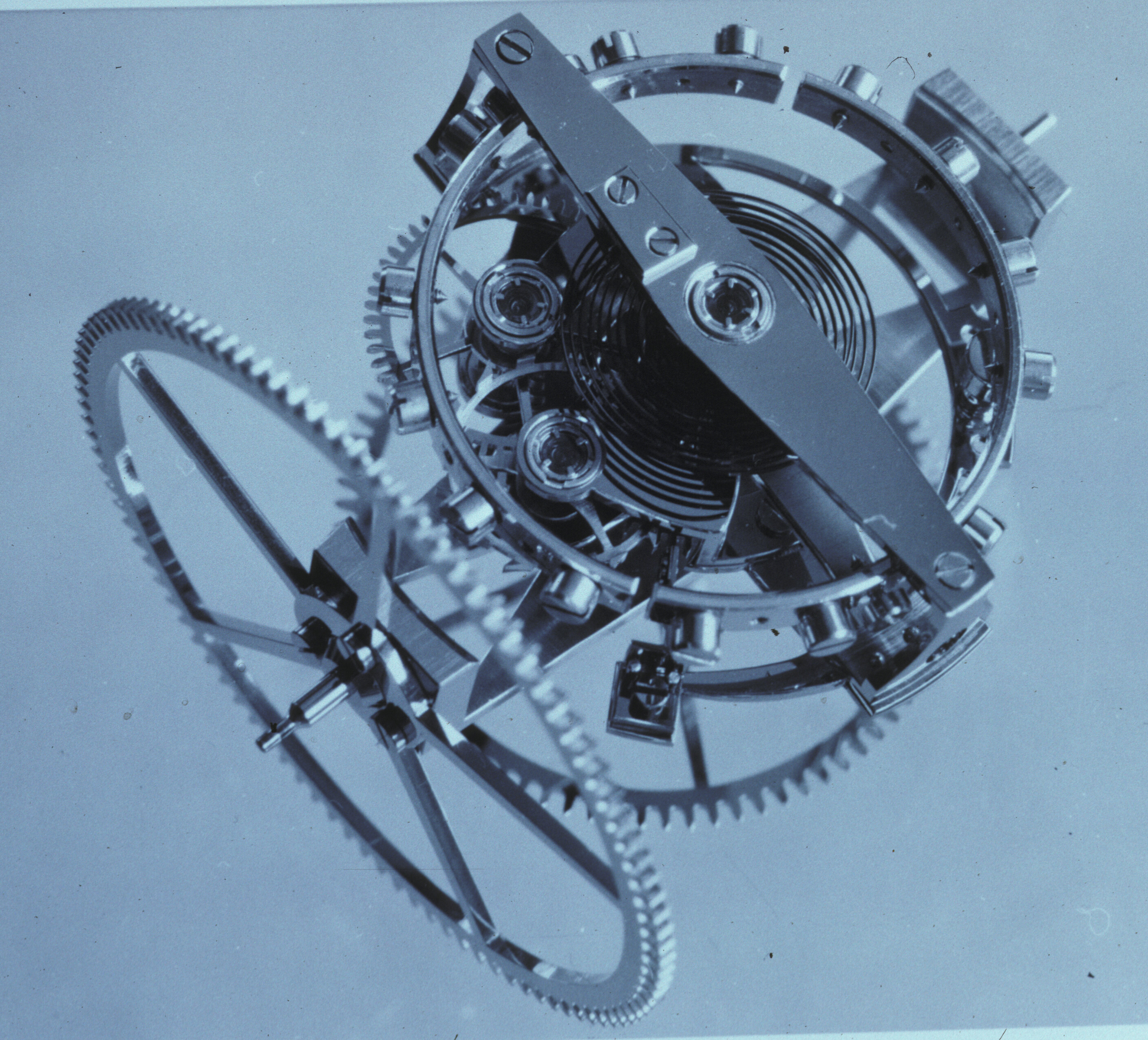
Double-axis tourbillon mechanism. Original photograph title: Double axis tourb. The original source describes a mechanism fitted to a table clock in 1980. Photograph by Charles Restalic. Source Wikimedia Commons file page. Licence CC BY-SA 3.0 Unported. No changes. The photograph documents this table clock movement.

Designing for faster rotation#
Greubel Forsey’s Tourbillon 24 Secondes revolves in 24 seconds on an axis inclined at 25°. The technical sheet gives an 88-part cage weighing 0.39 g, with light-alloy pillars, titanium bridges and a gold counterweight. The company also developed tooth profiles for the fixed wheel and pinion to accommodate the fast, inclined rotation. Higher speed called for changes in weight and power transmission as well as gear ratios. 7 34
The company records a score of 915 out of 1,000 for the Double Tourbillon 30° in a 2011 competition. This score belongs to that model and is a competition measure distinct from daily rate. The developer’s design aims, the completed watch’s result and the effect of the rotating layout are different questions. 9
Materials, transmission, manufacture and service#
Breguet’s Tradition 7047 uses a titanium cage and silicon hairspring. The company dates its titanium cage to 2010. Reducing cage mass and designing the spring’s mass distribution, elasticity and shape involve related work on different parts. The materials alone give insufficient evidence of magnetic resistance for the entire watch or of lubricant and maintenance requirements. 27
A thinner movement can also come from relocating the drive. In Breguet’s thin design, power is sent to the cage’s perimeter in place of a drive pinion underneath, and the fixed wheel is an outer toothed ring. This reduces the number of parts stacked vertically while preserving the relationship of cage and escapement to the fixed part. 3
Part count alone gives little indication of the manufacturing challenges. Disassembly of No. 1188 shows the means of poising its cage, and the Joseph White service report describes returning supports and train to operation. The records describe individual manufacture, adjustment and servicing. Industry-wide yields and service life, and tolerances and service intervals for other watches, require their own specifications or data. 10 23
Breguet’s 2025 Classique Tourbillon Sidéral 7255 is its first flying tourbillon wristwatch. The support is concealed to create a “mysterious” display. This dates the company’s own adoption. In 2026, marking 225 years since the patent, the company also developed the 7357 and Marine 5887 lines. These watches retain the principle while revising support, transmission and appearance. 27
Adoption in Asia and independent watchmakers#
Chinese-born independent watchmaker Kiu Tai Yu made tourbillon wristwatches and joined the AHCI in 1992. His membership date is documented separately from his first tourbillon wristwatch. A Phillips account based in part on an interview with his daughter places the introduction of his first tourbillon wristwatch in the year after a 1990 visit to Basel. Its opening dates completion to 1990. Both dates place his contribution to independent watchmaking in the early 1990s. 35 36
China’s Sea-Gull dates commercial introduction of its tourbillon to 2005 and its double tourbillon to 2007. Japan’s Kentex dates its successful production to 2006 and describes the Classic Grand 3 with a one-minute flying tourbillon. Kentex lists a hand-wound TY800 for E436M-01. The movement designation alone leaves its maker and country of manufacture unconfirmed. Product development, sale price, output and the extent of domestic manufacture are separate questions. 37 38 39
The AHCI says Hajime Asaoka began making watches in 2005, made what it calls Japan’s first wristwatch with an in-house tourbillon in 2009 and began sales under his own brand in 2011. These dates show how an independent maker moved from a first construction to regular sales. The AHCI also cites Project T’s ball bearings as an example of support using a different method from conventional jewel bearings. 40
Timeline#
| Date | Invention, watches and refinements |
|---|---|
| 1775 | Breguet opens his Paris workshop. 4 |
| 1796 | Company history dates the start of No. 282 to this year. Sale follows in 1832. 4 |
| 25 December 1800 | Patent application received, according to the original INPI record. 1 |
| 26 June 1801 | Ten-year tourbillon patent granted. 1 |
| 1805 | First commercial sale in the company history. 2 |
| September–October 1806 | Public exhibition at Les Invalides. 2 |
| 1808 | Don Antonio acquires No. 1188 and George III No. 1297. 11 13 |
| 1809 | No. 1176 sold to Count Potocki and No. 169 presented to Arnold’s son. 12 2 |
| 21 March 1812 | No. 2567 sold to Le Bigot. 15 |
| 1814 | British Prince Regent buys a large tourbillon timekeeper. 2 |
| 1832 | No. 282 sold under Breguet’s son. 4 |
| 24 November 1892 | Date of British patent No. 21421 cited by Bonniksen’s US patent. 18 |
| 5 November 1895 | Bonniksen’s US549287 granted. 18 |
| 1902 | Frodsham No. 08895 at Kew. Later examination identifies a twelve-minute cantilevered design. 24 |
| 1920 | Company history credits Helwig and his students with making a cantilever design. 22 |
| 1947 | Belin’s work on the T18 in LIP’s history. Omega produces twelve Cal. 30I competition movements. 25 8 |
| 1950 | Wristwatch category record at Geneva in Omega’s history. 8 |
| 1986 | AP Model 25643 with Cal. 2870 self-winding tourbillon. 26 |
| Late 1980s | Modern Breguet Ref. 3350. Official language editions give 1988 or 1989. 27 |
| Early 1990s | Kiu Tai Yu makes wristwatches, joining the AHCI in 1992. 35 36 |
| 2003 | Prescher displays a double-axis pocket watch. Priority year of the triple-axis patent. 31 32 |
| 2004 | JLC Gyrotourbillon I, GF Double Tourbillon 30° and Prescher Trilogy wristwatches. 28 29 31 |
| 2005 | Market introduction of a tourbillon in Sea-Gull’s history. 37 |
| 2006 | Successful production according to Kentex’s history. 38 |
| 2008 | JLC Gyrotourbillon II and Blancpain one-minute flying carrousel. 29 20 |
| 2009 | Asaoka’s in-house tourbillon wristwatch as recorded by the AHCI. 40 |
| 2011 | Asaoka begins sales under his own brand. GF records a competition score of 915. 40 9 |
| 2012 | JLC Sphérotourbillon. 30 |
| 2013 | JLC Gyrotourbillon III and Blancpain Tourbillon Carrousel. 29 19 |
| 2017 | Phillips sells Omega’s prototype wristwatch from 1947. 8 |
| 2024 | JLC announces the triple-axis Heliotourbillon. 30 |
| 2025–2026 | Breguet introduces the Sidéral 7255 and develops the 7357 and Marine 5887 for the 225th anniversary. 27 |
Evidence for the watches and their performance#
Evidence includes the inventor’s statement of benefits, examinations of particular watches, competition results and modern mechanical analysis. According to the authors’ institutional abstract, Xu, Ko and Du’s 2011 paper uses partial differential equations and Fourier expansion to analyse a mechanical watch. The bibliographic records and abstracts were consulted for that paper and Denny’s study of 2010. 41 42
Museums, auction houses and the export review report also quote certificates of sale and workshop registers for the early watches. Object descriptions document the cage periods, escapements, supports and indications of Nos. 1188, 1176, 1297 and 2567. Differences in transmission, design and conditions of measurement account for the variety of tourbillons. 10 12 14 15
References#
Accessed 15–17 October 2026. Entries identify the parts consulted and sources available only in outline.
- INPI, Patent file 1BA1792, Abraham-Louis Breguet, régulateur à tourbillon, 1800–1801. Technical description images 02–05, receipt 19, letter 22, grant documents 23–24 and drawing 25.
- Montres Breguet, Patent granted for a completely new type of regulator called the “Tourbillon”, company history, entry for 1801.
- Montres Breguet, Principles of the Tourbillon, Quai de l’Horloge. Mechanism and modern transmission.
- Emmanuel Breguet, The tourbillons of the inventor, Quai de l’Horloge. Workshop history.
- Montres Breguet, Classique 7225, French version dated 20 October 2025. Provenance of No. 1176.
- Emmanuel Breguet, À propos de la naissance du Tourbillon, company history reproducing Breguet’s letter.
- Greubel Forsey, Tourbillon 24 Secondes technical sheet, p. 1. Separate model from the Architecture.
- OMEGA, 1947 Tourbillon sells at auction, 2017. Twelve movements and the separate prototype wristwatch.
- Greubel Forsey, Histoire, company account of the 2011 competition.
- The Naked Watchmaker, Decon Breguet Tourbillon 1188, observations by the disassembler.
- Antiquorum, Breguet No.1188, Lot 127, 2002. Object description and account of the 1927 certificate.
- Christie’s, Breguet No.1176, 2014. Description and account of the March 2014 certificate.
- UK DCMS, King George III’s watch at risk of leaving the country, 29 January 2021.
- Reviewing Committee on the Export of Works of Art, Annual Report 2020–21, printed pp. 31–32, case 8.
- Breguet Museum, Treasures en voyage, Grandes Complications, 2024 handout, p. 1, No. 2567.
- Antiquorum, Breguet No.2567, Lot 196, 2005. Object and provenance.
- Montres Breguet, Classique 7225, Japanese version, 22 October 2025. The production sequence differs from the French version.
- Bahne Bonniksen, US549287A, Watch, 5 November 1895. Drawing p. 1 and description p. 3.
- Jeffrey S. Kingston, Le Brassus TOURBILLON CARROUSEL, Lettres du Brassus, issue 14. Development of the 2013 model, two barrels and differential.
- Blancpain, One minute – Flying Carrousel, manufacturer’s technical history.
- Wempe, Meisterwerke der Uhrmacherkunst 2020–2021, printed p. 61. Extracted text consulted, page image unchecked.
- Swatch Group, A tribute to a genius of Glashütte art of watchmaking, 28 September 2020.
- Curtis D. Thomson, Joseph White & Sons Pocket Watch, Horological Times 30(7), July 2006, printed pp. 8–12. Reprinted with permission from International Watch, February 2006.
- Christie’s, Charles Frodsham No.08895, object description including the 2011 certificate.
- LIP, T18 Original, company history.
- Audemars Piguet, The epic AP saga, AP Chronicles, section on the 1980s.
- Montres Breguet, Sorry Isaac, English version, French version, German version, 2026, entries for 7357, 7047, 5887 and 7255.
- Greubel Forsey, Double Tourbillon 30°, product history and construction.
- Jaeger-LeCoultre, Tourbillon multi-axes, Gyrotourbillon generations.
- Jaeger-LeCoultre, The Mastery of Precision, 9 April 2024.
- Thomas Prescher, Company History, maker’s account of exhibitions and manufacture.
- Thomas and Heike Prescher, WO2004077171A2, published 10 September 2004, eleven pages.
- Thomas Prescher, Triple Axis Tourbillon Regulator, current specifications and the maker’s intentions.
- Greubel Forsey, Invention Piece 3, design for rapid inclined rotation.
- AHCI, Kiu Tai Yu, member biography, joined 1992.
- Logan Baker, Phillips, Remembering Kiu Tai Yu, including an interview with his daughter Peony. Gives different dates for the first tourbillon wristwatch.
- SEA-GULL, Über uns, company timeline for 2005 and 2007.
- Kentex, Tourbillon, manufacturing history and Classic Grand 3.
- Kentex, E436M-01, TY800 specifications.
- AHCI, Hajime Asaoka, member biography and watches.
- Gu Xu, P. H. Ko and R. Du, A study on the precision of mechanical watch movement with tourbillon, Journal of Sound and Vibration 330(16), 2011, pp. 4019–4028, DOI 10.1016/j.jsv.2011.03.020. Institutional bibliographic record and abstract consulted. Full paper unavailable.
- Mark Denny, The Tourbillon and How It Works, IEEE Control Systems Magazine, 2010, DOI 10.1109/MCS.2010.936291. Bibliographic record and abstract consulted. Full paper unavailable.