This article was translated from Japanese using AI. Read the Japanese original
Controlling friction#
Lubrication in a mechanical watch controls friction and wear between components in relative motion and preserves the energy that reaches the oscillator from the mainspring. The practice is known as watch lubrication in English and lubrification horlogère in French. A watch contains fast-moving, lightly loaded bearings, a heavily loaded barrel and intermittent sliding contacts in the escapement. Each calls for a suitable lubricant. The choice depends on oil chemistry, contact materials, the state of their surfaces, quantity, temperature and humidity.12
Surface treatments have different purposes. An epilame is a thin film that limits oil spread, keeping oil where it is needed. Hard coatings and solid lubricant films are used to control friction and wear at the contacting surfaces. These treatments do not in themselves make the whole movement oil-free.13
What happens at the contact surfaces#
Oil films and friction#
Oil enters the space between two surfaces and reduces direct contact and wear. The usual categories are fluid-film lubrication, where the film is sufficiently thick to separate the surfaces, mixed lubrication, where some surface asperities make contact, and boundary lubrication, where the properties of the surfaces and additives dominate. In a watch, each contact and type of motion needs consideration. Speed, viscosity and load affect film formation, and motion varies even within one watch. The contact between an escape-wheel tooth and a pallet jewel also depends on geometry and on changes in speed over the course of contact.24
Oil that is too viscous can resist the movement of parts driven by small forces. Oil retention depends on wetting, geometry and the quantity of oil as well as viscosity. Grease combines a base oil with a thickener and sometimes other ingredients, giving it properties different from those of oil. Additives and compatibility with the contact materials also influence the choice.2
What lubrication does at each contact#
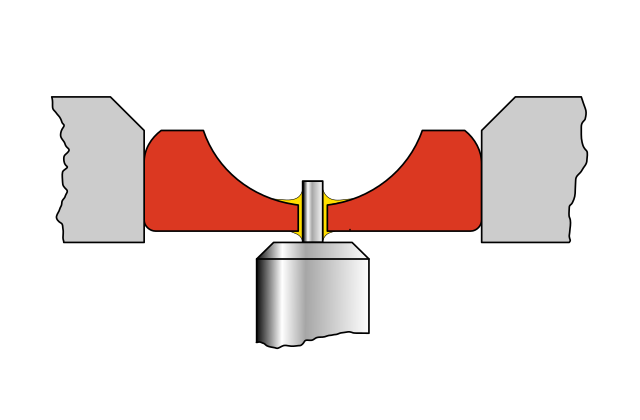
Figure 1. Diagram of a watch’s hole jewel, pivot and oil reservoir. Created by Chetvorno. Source and rights: Wikimedia Commons file description. Public domain by the creator’s worldwide dedication, with unconditional permission where dedication is unavailable. Unmodified.

| Contact | Lubrication task |
|---|---|
| Balance and train bearings | Protect contact between the small pivot and jewel while limiting resistance and oil migration. Choose oil for the speed and load. |
| Escape-wheel teeth and pallet jewels in a Swiss lever escapement | Retain a small amount of lubricant in an area of repeated locking and sliding. |
| Barrel and mainspring | Reduce friction and wear as the coils of the mainspring and the barrel wall touch, and keep power delivery steady. |
| Winding and hand setting | Protect teeth and levers that move intermittently. Some applications use grease. |
In a 1979 article for practitioners, the watchmaker Joseph Rugole explains how contact between mainspring coils and with the barrel wall makes unwinding irregular, and recommends suitable lubrication. The products he specifies illustrate the practice of his time. The general oil chart from the American Watchmakers-Clockmakers Institute also gives different lubricants by speed, load and contact point. Servicing follows the specifications for the individual movement.56
Holding oil in place with epilame#
Oil can spread over clean metal, leaving less at the point of friction. Epilame is a general term for a surface treatment that alters wetting and limits unwanted spread. It works through the interaction of oil and the treated surface. Contact angle gives one measure of the interfaces between liquid, solid and the surroundings. Durability inside a working watch involves other factors as well.3
A published Rolex patent states that Paul Woog developed a migration inhibitor based on stearic acid in 1930, and that fluoropolymer products appeared in the 1970s. A 2009 historical account by watchmaker Bernhard Stoeber places Woog’s treatment in 1925.8 For another material, the patent describes treating gold, polished steel and ruby and testing oil spread and behaviour after washing. These are the proposals and experiments reported in a patent. The text itself does not establish adoption in a commercial watch or performance under every condition.3
Oil retention involves trade-offs. A 2008 report from Laboratoire Dubois identifies evaporation, spreading into a thin film and tiny droplets thrown off by motion or shock as reasons oil can quickly disappear from view. Oil may adhere less strongly on an epilame-treated surface and in some cases scatter more easily. The surface treatment, oil placement and volume have to be designed together.1
Hard coatings and solid lubrication#
Other treatments modify the sliding surfaces themselves. Surface hardening and hard coatings have been studied for wear resistance, and solid lubricant films aid sliding at a contact. Results vary with the materials, film thickness, adhesion, load and humidity. Practical service life depends on that combination rather than on hardness or low friction alone.14
The Swiss horological research laboratory LSRH investigated dry friction from the mid-1960s, testing films such as titanium carbide and treated watch pivots. ASUAG’s GAMA project from 1974 to 1981 examined plastic parts, electroless nickel coatings, hard films and molybdenum disulphide (MoS₂), among other approaches.1
In MoS₂ film tests, humidity adversely affected friction and service life, prompting studies varying additives and underlayers. Solid lubrication avoids liquid migration at a contact but still poses problems of moisture and film wear. Lubrication elsewhere in the watch remains a separate question.1
In another barrel study, researchers at EPFL examined contact between a mainspring and a barrel with a thin gold coating over nickel, combining wear observations on actual components with tests. Gold thickness, surface topography and sliding direction affected how the film worked, showing that a finish can have a functional role. The results apply to the arrangement and test conditions studied.4
Deterioration and maintenance#
Oils and additives are affected by contaminants, wear debris, volatile compounds from nearby materials, temperature and humidity. Reddish-brown oil may contain oxidised wear particles, or the oil or additives may have deteriorated. Appearance alone gives no certain diagnosis. Oil can also travel along surfaces to unintended locations. Servicing combines cleaning, inspection of components and relubrication to specification.1
Inspection intervals vary by construction, use, storage, lubricant and the manufacturer’s instructions. Design and maintenance aim to sustain suitable conditions at each contact over time.
The history of watch oils#
In the late nineteenth century the watchmaker William T. Lewis discussed animal, vegetable and mineral oils as sources of horological lubricants and recorded their properties and refining. His account shows how watchmakers dealt with oxidation and oil quality at the time. During the twentieth century, specialist makers developed oils and formulations for different materials and uses.78
Selected developments#
| Period | Documented development |
|---|---|
| 1896 | William T. Lewis covers lubrication and oils in horology, documenting the materials and practices of his time.7 |
| 1925 or 1930 | Stoeber dates Woog’s stearic-acid-based treatment to 1925, and the Rolex patent dates it to 1930.38 |
| 1950s | Stoeber dates the introduction of synthetic oils for gear trains and shock-protection systems to this period.8 |
| Late 1960s to the 1980s | The LSRH investigates dry friction, hard coatings and MoS₂ films.1 |
| From 2006 | The Rolex surface-film application has priority from 2006. The European application is published in 2009 and the grant in 2017.3 |
| 2020 | EPFL research combines observations of actual escapement and barrel components with friction models.4 |
References#
[1] Michel Maillat, “Lubrification sèche et autolubrification, 40 ans de recherches pour l’horlogerie”, Société Suisse de Chronométrie, 2008, pp. 5–9. https://www.laboratoiredubois.ch/fileadmin/documents/prestations/controle_des_materiaux/lubrification_horlogere.pdf (accessed October 31, 2026)
[2] Jean Frêne and others, “Cours de Lubrification”, UNIT, pp. 22–23, classification of lubrication regimes. https://www.unit.eu/cours/cours_lubrif.pdf (accessed October 31, 2026)
[3] Rolex SA, “Ultra-thin water and oil repellent layer, manufacturing method and use in watchmaking as epilame”, EP2084252B1. Priority date December 1, 2006, published in 2009 and granted in 2017. Description, examples and claims. https://patents.google.com/patent/EP2084252B1/en (accessed October 31, 2026)
[4] Valentine Magnin, EPFL, “Tribological Approach to the Watch Movements”, doctoral thesis abstract, 2020. https://graphsearch.epfl.ch/fr/publication/0ee042e8-b9d7-4cb6-b5a7-e612eb00b74f (accessed October 31, 2026)
[5] Joseph Rugole, “Watch Adjustments”, Horological Times, November 1979, pp. 34–37 and 58. https://www.awci.com/wp-content/uploads/ht/1979/1979-11-web.pdf (accessed October 31, 2026)
[6] American Watchmakers-Clockmakers Institute, “General Lubrication Chart”, general oil chart by watch component. https://www.awci.com/wp-content/uploads/2020/05/Lubrication-1B.pdf (accessed October 31, 2026)
[7] William T. Lewis, Friction, Lubrication and the Lubricants in Horology, 1896. https://www.gutenberg.org/files/35001/35001-h/35001-h.htm (accessed October 31, 2026)
[8] Bernhard Stoeber, “Epilame and the Modern Watch Service”, Horological Times, April 2009, pp. 12–15. https://www.awci.com/wp-content/uploads/ht/2009/2009-04-web.pdf (accessed October 31, 2026)