This article was translated from Japanese using AI. Read the Japanese original
Oils from the sea that helped small mechanisms run#
A mainspring drives a mechanical watch, but efficient transmission of its power requires oil at contacts such as those between pivots and jewels. Even with polished parts and precisely made wheels, lubrication is needed for sustained, stable operation. Some of that oil once came from the jaws and heads of cetaceans. 1 2
The history includes animal oils from whales and other sources, mineral oils refined from petroleum, and synthetic oils made by chemical reactions. These oils coexisted and were blended over long periods. Choosing the right oil for each contact also developed over time. A fast-moving bearing might need a relatively light oil, while a slower part under heavier load might need a more viscous one. 1 3
The demands on a watch oil#
Oil works in minute quantities in a watch bearing. If it flows poorly it can hinder motion, and if it spreads it may leave the contact that needs it. It must stay fluid in the cold, resist excessive thinning in the heat and keep its properties with age.
In 1882 the chronometer makers T. S. and J. D. Negus devoted a section to oils. They wanted an oil that let the pivot move freely while remaining in place, resisted congealing in the cold and excessive thinning in the heat, and resisted gumming or drying out. They also mention blending thick and thin oils if needed. Nineteenth-century practice already matched the flow properties of oils to the job. 2
Different oils from cetaceans#
Sources beyond sperm whales#
Historical watch oils included porpoise jaw oil, taken from porpoise and related cetacean jaws, and blackfish melon oil, taken from the fatty head organ of pilot whales and related animals. Sperm whales were another source. 1 4
According to US lubricant manufacturer Nye’s company history, Ezra Kelley, a watchmaker in New Bedford, began selling oils from jaws and heads in 1844. William F. Nye also entered the trade. A specialist American industry grew in the nineteenth century around processing oils obtained from marine animals into watch lubricants. 4
Sperm whales yielded oil from the blubber and also from the head. Pressing the waxy material from the head separated its liquid oil from the solid spermaceti used in candles. Head oil, spermaceti and jaw oils from other cetaceans are distinct materials. 5
W. T. Lewis’s 1896 book on horological lubrication discusses jaw oils and blackfish head oil separately from sperm oil. He records uses of sperm oil in timepieces, but also points to changes in viscosity with temperature associated with its wax content and to deterioration by oxidation. Oils from different marine animals had different properties as watch lubricants. 1
Refining oils before use#
Animal oils for watches also required refining. Lewis records extracting oil from the fats of the jaws or head, removing water and cooling the oil to separate fractions that solidified. Selecting the fraction that remained liquid at low temperatures helped clocks and watches operate in the cold. 1
Other sources included neatsfoot oil from cattle legs, bone oil and olive oil. Moebius traces its founding in 1855 to watchmaker Hermann Moebius and his use of neatsfoot oil. Work on selecting and refining raw materials continued throughout the era of natural oils. 1 6
Mineral oils refined from petroleum#
Mineral oil is obtained chiefly by refining petroleum. The term refers to a liquid lubricant made primarily of hydrocarbons and distinguishes it from oils of animal or vegetable origin. 1
Lewis’s 1896 book already discusses the manufacture and horological use of mineral oils. He says there are many types and grades and that selection matters for precision mechanisms. He also describes mixing refined mineral oils with animal oils as well as using them alone. By the end of the nineteenth century, both were options for watchmakers. 1
Blending continued. Moebius’s published product literature describes its Microgliss D range as combining mineral and natural oils with additives. The blend tailors stability, resistance to pressure and flow. 7
Synthetic oils designed for particular properties#
Synthetic chemistry became part of the development of watch oils in the twentieth century. According to Moebius’s official history, a milestone came in 1952 when it worked with the Swiss horological research laboratory LSRH in Neuchâtel to develop the fully synthetic oil SYNT-A-LUBE. 6
Synthetic base oils allow the choice of molecular structures and blends for a particular set of properties. Different families of synthetic base oils offer different oxidation resistance, cold flow, load handling and compatibility with plastics and rubber. 8 The 2019 technical sheet for Moebius 9010 describes it as a fully synthetic oil based on ethers and aliphatic alcohols, resistant to ageing and suitable for fast-moving parts. 9
Nye’s company history dates the start of its shift from oils of cetacean origin and petroleum-based products to synthetic fluids to the early 1960s. It continued selling jaw oil into the 1970s, so synthetic development and natural-oil sales overlapped. 4
A 1982 Nye newsletter describes replacing earlier watch and clock oils with blends of synthetic and natural oils. Formulators continued combining useful properties from multiple sources after synthetic oils arrived. 10
Matching viscosity to the point of application#
Light oils and more viscous oils#
Viscosity expresses resistance to flow. In a watch the necessary film and the resistance introduced by the oil have to be balanced according to surface speed, load, shape and clearance. Excessive viscosity can hinder motion in a small, fast bearing. Slower contacts under greater load call for a more viscous oil. The AWCI general lubrication chart assigns different oils to high-speed, low-torque and low-speed, high-torque contacts. 3
What does cSt measure?#
The symbol cSt stands for centistokes, a unit of kinematic viscosity. One centistoke is one square millimetre per second (1 mm²/s). At a given temperature a higher figure indicates higher kinematic viscosity and, in this comparison, an oil that flows less readily. 13
Kinematic viscosity is dynamic viscosity, the fluid’s resistance to deformation, divided by density. Centistokes measure kinematic viscosity, while centipoise (cP) measure dynamic viscosity. Converting between them requires density. Watch oil tables often list kinematic viscosity in cSt or the numerically equivalent mm²/s. 7 13 14
Moebius’s product list gives 150 cSt at 20 °C for 9010 and 270 cSt for 9020. It describes 9020 as suitable for parts that move more slowly and experience higher pressure. Although 9020 is about 1.8 times as viscous on this measure, the ratio does not predict friction or service life. Comparison requires the same temperature and attention to the intended application. 7
| Point of lubrication or contact | Motion and load | Selection considerations and examples |
|---|---|---|
| Balance bearings and fast train bearings such as those of the escape wheel | Fast movement under light load | Relatively low-viscosity oil to minimise drag. 9010 is 150 cSt at 20 °C |
| Slower rotating parts under greater load | Load at the contact matters more than speed | Higher-viscosity oil. 9020 is 270 cSt at 20 °C. Some manufacturer guidance lists high-viscosity 9104 for barrel arbors and similar parts |
| Impulse faces of teeth and pallet stones in a Swiss lever escapement | Brief contact with repeated sliding and locking | Special lubricant to keep a film at the contact, such as escapement grease 9415 |
| Sliding surfaces in the winding and setting mechanism | Intermittent sliding, sometimes under high contact force | Grease selected for adhesion and pressure resistance, such as 9504 |
| Wall of a self-winding barrel and its slipping bridle | The outer bridle slips once the spring is wound | Braking grease to control the friction required and when the bridle slips |
The examples use the AWCI general chart and Moebius application guidance. The named products illustrate different properties. Each movement’s specifications determine where to lubricate it and how much to apply. 3 7 11
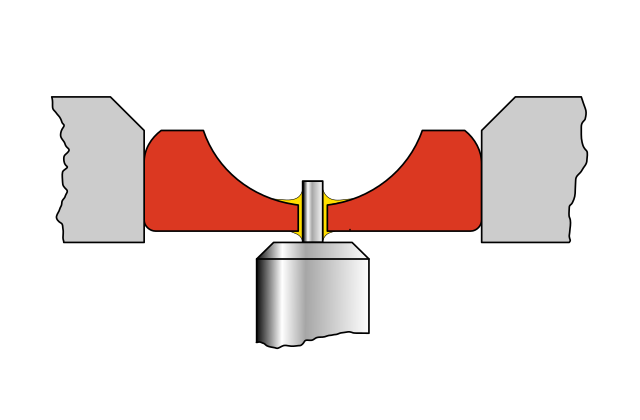
Figure 1. A train jewel and its oil sink. Lubricant stays at a small contact such as this and helps the pivot move. By Chetvorno. Source and terms on Wikimedia Commons. Public domain worldwide by the author’s dedication, with unconditional permission where the dedication cannot take effect. Unchanged.

Grease has properties other than viscosity#
A grease combines a base oil with a thickener and sometimes other ingredients. Its behaviour cannot be fully compared with liquid oil on the same scale. 8 The escapement grease 9415, for instance, is a soft, thixotropic synthetic grease. Its flow under motion and at rest contributes to its behaviour at the contact. Escapement lubricant selection therefore involves more than finding the highest oil viscosity. 12
A self-winding barrel has a different lubrication requirement. Braking grease helps the mainspring’s outer bridle slip appropriately against the barrel wall. The contact must retain enough friction for winding and allow slip when needed. Lubrication can also control friction rather than simply reducing it. 3
Temperature also affects synthetic oil#
The same oil changes viscosity with temperature. According to the 2019 sheet for 9010, its kinematic viscosity is 625 cSt at 0 °C, 150 cSt at 20 °C and 52 cSt at 40 °C. Even with synthetic oils, a lubricant has to remain sufficiently mobile in the cold and effective after warming. 9
Oil retention also depends on the shape of the parts, wetting of their surfaces and the amount applied. Epilame treatment changes the surface to limit spreading. See also Watch lubrication and metal surface treatments for how particular contacts are lubricated.
Milestones#
| Date | Development in watch oils |
|---|---|
| 1844 | According to Nye’s history, Ezra Kelley starts selling oils from the jaws and heads of porpoises, pilot whales and related cetaceans. 4 |
| 1855 | Hermann Moebius, who worked with neatsfoot oil, establishes H. Moebius und Sohn. 6 |
| 1882 | Negus describes jaw oil for chronometers and blending more and less viscous oils according to use. 2 |
| 1896 | Lewis discusses the manufacture and horological uses of animal, vegetable and mineral oils. 1 |
| 1952 | Moebius and LSRH develop the fully synthetic SYNT-A-LUBE. 6 |
| Early 1960s–1970s | Nye shifts towards synthetic fluids and continues selling jaw oil into the 1970s. 4 |
| 1982 | Nye’s newsletter introduces blends of synthetic and natural oils as replacements for earlier watch and clock oils. 10 |
Watchmakers and oil manufacturers refining marine fats already had to contend with cold, degradation and oil migration. Mineral and synthetic oils extended the choices available. Fast bearings, heavily loaded pivots and sliding escapement contacts still demand different properties. Watch oils evolved both through the search for raw materials and through the effort to formulate for tiny, specific contacts.
References#
[1] William T. Lewis, Friction, Lubrication and the Lubricants in Horology, 1896, chapter 1, §§2–14, and chapter 5, §§64–70. Animal, vegetable and mineral oils and their mixtures, used as an account of period practices and assessments. Full text at Project Gutenberg, accessed 4 November 2026.
[2] T. S. and J. D. Negus, “Rules for the Care and Handling of Chronometers”, Proceedings, April 1882, vol. 8/2/20, “On Oils”. Original at the U.S. Naval Institute, accessed 4 November 2026.
[3] American Watchmakers-Clockmakers Institute, “General Lubrication Chart”. Selection by speed, torque and contact, and braking grease for barrel walls. Chart PDF, accessed 4 November 2026.
[4] Nye Lubricants, “175 years of History”. Kelley’s sales from 1844, Nye’s entry, continued jaw-oil sales and switch to synthetic fluids. Manufacturer’s history, accessed 4 November 2026.
[5] U.S. National Park Service, New Bedford Whaling National Historical Park, “Whale Products”, updated 29 August 2018. Oil from blubber, material from the sperm whale’s head, and separation of oil and wax. National Park Service account, accessed 4 November 2026.
[6] Moebius, “about us”. Founding in 1855 and development with LSRH in 1952. Official history, accessed 4 November 2026.
[7] Moebius, “Oils”. Kinematic viscosities at 20 °C and uses of 9010 and 9020, and composition of the Microgliss D range. Official product list, accessed in indexed text on 4 November 2026. Direct access may redirect to the Swatch Group profile.
[8] Nye Lubricants, “Base Oils”. Grease composition and properties and material compatibility of synthetic base oils. Technical account, accessed 4 November 2026.
[9] Moebius, “SYNT-A-LUBE 9010: Synthetic oil for high precision micromechanics”, Technical Data, 12 November 2019. Base components, applications and kinematic viscosity at different temperatures. Manufacturer’s datasheet and same datasheet hosted by HS Walsh, accessed 4 November 2026. The manufacturer’s URL may redirect.
[10] Nye Lubricants, Nye Lubeletter, January 1982, p. 2, “New Literature — Watch and Clock Oils”. Period newsletter PDF, accessed 4 November 2026.
[11] Moebius, “Mechanical Watches – Application recommendation”. Applications of 9010, 9415, 9104, 9501 and 9504. Mechanical watch application guide, accessed in indexed text on 4 November 2026. Direct access may redirect.
[12] Moebius, “SYNTHETIC GREASE 9415: Synthetic grease for high precision mechanics”, Technical Data, 12 November 2019. Thixotropic synthetic grease for escapements. Technical data PDF, accessed in indexed text on 4 November 2026. Direct access may redirect.
[13] National Institute of Standards and Technology, “NIST Guide to the SI, Appendix B.9”, “Viscosity, Dynamic” and “Viscosity, Kinematic”. Conversion from cSt to m²/s. NIST conversion table, accessed 4 November 2026.
[14] Nye Lubricants, “What You Need to Know About Base Oil Viscosity”. Relation between kinematic viscosity, dynamic viscosity and density. Technical account, accessed 4 November 2026.