Watch rate stability#
This article was translated from Japanese using AI. Read the Japanese original
Even if a watch is set to the correct time, changes in how fast it runs make it hard to predict when it will next need setting. Rate stability is the ability to keep the rate of gain or loss within a given range.1
A stable watch that consistently gains five seconds per day will gain about 35 seconds in a week. One that gains ten seconds one day and loses ten the next has an average of zero over the two days, but its rate varies. A small average alone tells us little about stability.
Time error and rate#
The number of seconds a watch is ahead of a reference at a particular instant is its time error. If it is two seconds ahead at the start of 24 hours and five seconds ahead at the end, its rate that day is plus three seconds per day. The initial two-second setting error leaves the calculated rate unchanged, since the rate uses the difference between the readings. In ISO horological vocabulary, daily rate is the difference between time errors measured 24 hours apart, and variation in daily rate is the difference between two daily rates.1
For example, successive daily time errors of 0, +4, +8 and +12 seconds against the same reference yield three daily rates of +4 seconds, with no variation. Errors of 0, +10, 0 and +10 seconds give daily rates of +10, −10 and +10 seconds. These examples distinguish the rate from its variation. Shorter measurement intervals reveal shorter-term variation, but expressing the result in seconds per day does not establish what will happen over an actual 24 hours.1
Why the rate changes#
In a mechanical watch, the mainspring supplies energy to the balance through the gear train and escapement. The period of the oscillating balance and balance spring provides the time reference. Ideally, the period stays the same as amplitude varies. This property is called isochronism. In practice, friction, the way impulse is delivered, position and temperature can all affect it.1 2
| Condition | Effect on the rate |
|---|---|
| Position | The bearings and balance change orientation relative to gravity, so the watch may gain or lose at different rates in horizontal and vertical positions. |
| State of wind | The power delivered as the mainspring unwinds changes and can affect amplitude and rate. |
| Temperature | Component dimensions and material properties change, influencing the period. |
| Magnetism and shock | Magnetised components or changes in mechanical condition can alter gain or loss. |
These factors act together, so a change in rate alone does not establish its cause. Seiko’s instructions also explain that the actual rate varies with position, temperature, wrist movement and the state of wind.3 4
A compensation balance made of different metals is one response to temperature. Thermal deformation of its components compensates for temperature-related changes in the balance spring and elsewhere. A 1914 US Bureau of Standards testing guide describes the rate of a steel-and-brass balance with a steel balance spring as a function of temperature that cannot be represented by a straight line alone and can be approximately parabolic.5
In a quartz watch a quartz oscillator and an electronic circuit provide the time reference. Quartz responds to temperature and also ages over time as the resonator changes internally. In NIST’s 2008 study of four quartz wristwatches, the laboratory was cooler than the optimum temperature expected during wear. The results therefore cannot simply be generalised to everyday use. For any type of watch, the environment and duration of the measurements matter.6
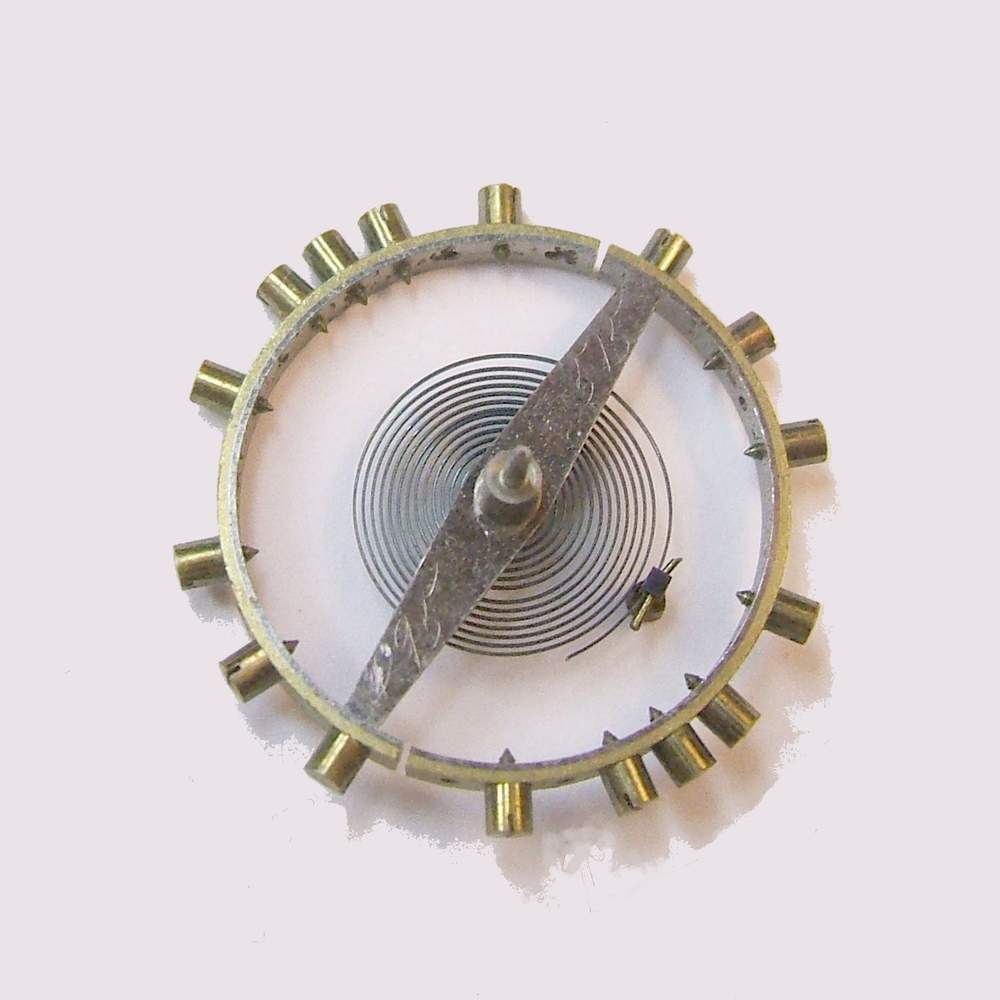
Figure. Bimetallic temperature-compensation balance from an early twentieth-century pocket watch. Photograph by Chris Burks. Source: derivative image on Wikimedia Commons. Rights: the creator’s original image. Public domain worldwide by the creator’s dedication, with unconditional permission where dedication is legally unavailable. Unmodified.


What different tests reveal#
Daily comparison and positional testing#
To check a watch in everyday use, compare it with the same reliable time reference for several days, at roughly the same time each day. Record the time error and how the watch was used. Noting the winding, resting position and hours worn makes changes easier to interpret. The individual daily rates and the differences between them reveal variation that an average daily rate can hide. A short acoustic measurement can help diagnose a movement, but it measures the watch in that position and at that moment. Extended wear can give a different result.1 4 5
Laboratory tests specify positions and temperatures so the conditions are comparable. For example, Grand Seiko’s in-house test described in its 9S instructions measures each of six positions for two days. It evaluates the average of the twelve daily rates, differences between the two consecutive days in each position, and differences due to temperature. It tests the movement before casing, a different condition from measuring the watch while worn.4
COSC’s 2026 deposit specifications refer to ISO 3159:2009 for testing mechanical wrist chronometers and give other provisions for other types of timekeeper. The Swiss Federal Institute of Metrology and certification body METAS tests the finished watch for Master Chronometer certification. It covers rate performance, magnetic resistance, water resistance and power reserve. Both assessments depend on what is tested and under which conditions. Comparing individual pass limits requires checking the test rules and category.7 8
Short and long time scales and Allan deviation#
Allan deviation describes oscillator frequency stability by comparing mean frequencies in consecutive intervals and varying the averaging time. Intervals of one second and then ten seconds, for example, show variations at those two time scales. Let τ (tau) be the averaging interval and y the dimensionless fractional frequency offset, the frequency error divided by the nominal frequency. Allan deviation is the square root of half the mean squared differences between the average values of y in adjacent intervals of length τ. The value of y is positive when the measured frequency is higher than nominal. A reported value should include τ, the measurement method and reference, the amount of data and whether long-term drift was removed.9
An oscillator that is stable over short intervals can be less stable over long ones. Allan deviation measures variation, so a constant frequency offset alone does not show up in it. It differs from the maximum daily rate or the pass or fail result of a specific chronometer test. Noise in the measurement system, temperature changes and ageing all influence interpretation. Dead time between readings can bias the estimate. Intermittent readings from a timing machine therefore cannot be treated as an Allan deviation from a continuous record.9 10
The development of rate testing#
Rate regularity has long been studied by comparing and adjusting timekeepers. A 1914 US Bureau of Standards publication describes daily comparison, the effects of temperature and position, and how to test the relationship between rate and time elapsed after winding. From the 1960s, frequency metrology developed Allan variance to describe variation at different time scales. Mechanical watches can be assessed by position and temperature testing, while electronic oscillators can be assessed at different averaging times, depending on the purpose.5 9
| Period | Documented example |
|---|---|
| 1914 | The US Bureau of Standards publishes test methods for comparison, rate, temperature effects and isochronism.5 |
| 1966 | David W. Allan publishes a paper on the statistics of frequency stability.9 |
| 2008 | NIST research measures and reports the accuracy and stability of four quartz wristwatches.6 |
| 2026 | ISO’s horological vocabulary distinguishes rate, rate variation and rate stability. COSC publishes deposit specifications for mechanical wristwatches and other timekeepers.1 7 |
To interpret a claim that a watch is stable, check the reference, measurement interval, positions and temperatures. Looking at the average rate and its variation then separates a steady offset that can be regulated from changes in how fast the watch runs under different conditions.
References#
1. ISO, ISO 6426-2:2026, Horological vocabulary — Part 2, 9.1–9.21. Accessed November 2, 2026.
2. Michael A. Lombardi, NIST Special Publication 960-12, Stopwatch and Timer Calibrations, 2009, description of mechanical stopwatches. Accessed November 2, 2026.
3. Seiko Watch, Mechanical watch accuracy. Accessed November 2, 2026.
4. Seiko Watch Corporation, 9S Mechanical Instructions, Grand Seiko Standard terminology and tests. Accessed November 2, 2026.
5. Bureau of Standards, Measurement of Time and Tests of Timepieces, Circular No. 51, first edition, 1914, sections on isochronism, temperature and testing. Accessed November 2, 2026.
6. Michael A. Lombardi, The Accuracy and Stability of Quartz Watches, Horological Journal, February 2008, pp. 57–59. Accessed November 2, 2026.
7. COSC, Deposit Specifications, edition 14, February 5, 2026, section I.1. Accessed November 2, 2026.
8. Federal Institute of Metrology METAS, Watch certification. Accessed November 2, 2026.
9. W. J. Riley, Handbook of Frequency Stability Analysis, NIST Special Publication 1065, 2008, sections on stability and Allan variance and bibliography. Accessed November 2, 2026.
10. NIST, Time and Frequency from A to Z: Stability. Accessed November 2, 2026.